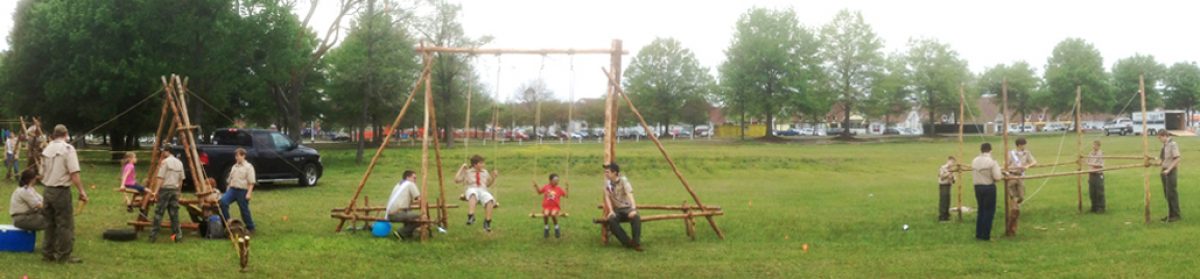
Here are three definitions for “pioneer” and how they can be applied to modern day Scouts:
pi·o·neer (p

 -nîr
-nîr ) noun
1. One who ventures into unknown or unclaimed territory to settle.
- Equipped with their pioneering skills, Scouts camping in a rustic, wilderness setting who use these skills to “settle” into their campsites for long or short terms are like modern day versions of the old-time pioneer. In this case, “settle” can mean improving their site with forked sticks and crossbar for hanging an 8 quart pot over a cooking fire, a large or small Chippewa Kitchen, and everything in between. Those old-time pioneers who ventured into unclaimed territory were not only adventurous, they were also resourceful. In today’s Scout Pioneering, these two qualities come to life as Scouts are faced with making practical decisions while camping and backpacking. Usefulness and fun can go hand in hand.
2. One who opens up new areas of thought, research, or development: (a pioneer in aviation).
- Once pioneering skills are learned and practiced, Scouts can devise their own gadgets, and structures and ways to build them. Commensurate with outdoor activities and camping, Scouts using their pioneering skills coupled with a good dose of ingenuity, come up with “new” and useful ideas, e.g. cutting a short piece of bamboo of the proper diameter and lashing it to an upright on the dining fly to serve as a convenient flagpole holder. From our standpoint, even if on a small scale, the Scout who recently came up with this ingenious little device is a “pioneer in camp gadgets.”
3. A soldier who performs construction in the field to facilitate troop movements.
- Scouts can facilitate troop movement by building a bridge over a gully or stream that can conveniently and efficiently be used to get from one location to another. Scouting publications are replete with photos of Scouts putting up various types of walkway bridges across small streams and gullies. That’s real pioneering (and real fun)
Is all that a little far-fetched? Well, it’s a fact, you can apply most anything to Scout Pioneering. It’s that universal in its appeal and that broad in its scope.

 SCOUT PIONEERING