Here are three definitions for “pioneer” and how they can be applied to modern day Scouts:
pi·o·neer (p-nîr) noun
1. One who ventures into unknown or unclaimed territory to settle.
Equipped with their pioneering skills, Scouts camping in a rustic, wilderness setting who use these skills to “settle” into their campsites for long or short terms are like modern day versions of the old-time pioneer. In this case, “settle” can mean improving their site with forked sticks and crossbar for hanging an 8 quart pot over a cooking fire, a large or small Chippewa Kitchen, and everything in between. Those old-time pioneers who ventured into unclaimed territory were not only adventurous, they were also resourceful. In today’s Scout Pioneering, these two qualities come to life as Scouts are faced with making practical decisions while camping and backpacking. Usefulness and fun can go hand in hand.
2. One who opens up new areas of thought, research, or development: (a pioneer in aviation).
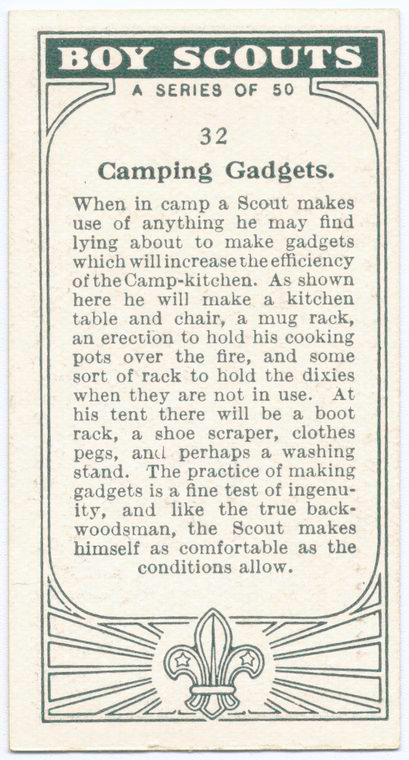
Once pioneering skills are learned and practiced, Scouts can devise their own gadgets, and structures and ways to build them. Commensurate with outdoor activities and camping, Scouts using their pioneering skills coupled with a good dose of ingenuity, come up with “new” and useful ideas, e.g. cutting a short piece of bamboo of the proper diameter and lashing it to an upright on the dining fly to serve as a convenient flagpole holder. From our standpoint, even if on a small scale, the Scout who recently came up with this ingenious little device is a “pioneer in camp gadgets.”
3. A soldier who performs construction in the field to facilitate troop movements.
Scouts can facilitate troop movement by building a bridge over a gully or stream that can conveniently and efficiently be used to get from one location to another. Scouting publications are replete with photos of Scouts putting up various types of walkway bridges across small streams and gullies. That’s real pioneering (and real fun)
Is all that a little far-fetched? Well, it’s a fact, you can apply most anything to Scout Pioneering. It’s that universal in its appeal and that broad in its scope.
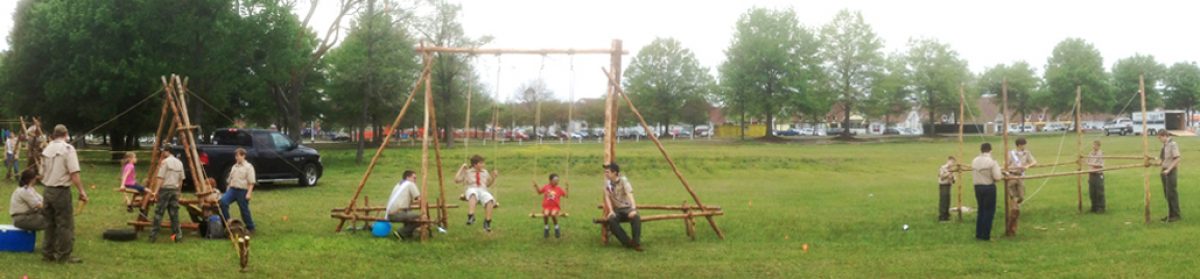
12′ Scout Swing Seeing Action at a Public Scout Expo
The design for this swing is not complicated, though it does present some logistical challenges. The main thing is, a working swing is going to get lots of play. Therefore, lashings need to be super tight, and the eight sturdy pioneering stakes that serve as anchors need to be driven solidly into the ground, perpendicular to and touching the six spars connecting the legs.
List of Materials
six 3-1/2-inch x 12-foot spars for the legs
one 4-inch x 12-foot spar for the crossbar
six 3-inch x 6-foot connecting spars
eight 3-foot pioneering stakes
two 2-inch x 8-inch x 2-foot prepared swing seats
four 20-foot x 1/2-inch swing ropes
four steel rings
four 6-foot x 5/8-inch ropes for Prusiks
twenty 15-foot x 1/4-inch manila lashing ropes
six 20-foot x 1/4-inch manila lashing ropes
two single pulleys reeved with 20 feet of rope, with a small loop of rope tied to the top
one eight-foot ladder
Though one might think this structure is built by making two simple tripods to support the crossbar, it’s MUCH better to make two A-frames, standing up vertically, supported by a third spar lashed to one leg of each A-frame, slanting down to the ground. The obvious reason is to give the crossbar maximum stability where it rests at the juncture of the two legs of each vertical A-frame.
Prepared Swing Seats
Rig the swing seats. Attach two 20 foot swing ropes to the two swing seats, using a scaffold hitch rigged with a bowline. In order to accommodate the swing rope with the scaffold hitch, the swing seats should be prepared with impressions cut on each side, 2 inches long and 1/2 inch deep, beginning 1-1/2 inches from each end.
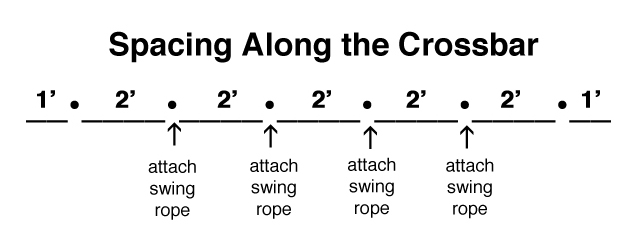
Attach the rings to the crossbar. Using the 6-foot ropes, tie the steel rings to the crossbar with prusiks at intervals as per the measurements reflected in the diagram.
Prepare the A-Frames. Using two 12-foot spars and one 6-foot spar, with tight square lashings, lash together two identical A-frames making sure the tips of the legs cross the same distance from the top for each. Use a 20-foot rope where the tips of the legs intersect, and 15-foot ropes at the bottom. NOTE: Make sure the 6-foot connecting spars are lashed low enough to the bottom so later on there will be plenty of room to lash them to the pioneering stakes.
Add the oblique supporting legs. About a foot or so below the top lashing on the A-frames, lash on a third 12-foot spar to one leg of each A-frame, using 20-foot ropes. These spars will be angled down, extending out to support the A-frames in their vertical positions.
Connect the legs. Stand up the A-frames so they’re in a vertical position. Connect the 12-foot oblique supporting leg to the legs of each A-frame, using the remaining 6-foot spars and eight 15-foot ropes. Again, make sure they’re lashed low enough to the ground so later on there will be plenty of room to lash them to the pioneering stakes. (If you’ll be using the pulleys to lift up the 12-foot crossbar, loop one over the top of a leg, before standing up the A-frames.)
Position the two 3-legged subassemblies. Line up both support assemblies so they are facing one another on even ground and with the A-frames 10 feet apart.
Position the crossbar. Tie one end of each pulley rope to the ends of the crossbar, and have two Scouts carefully hoist the crossbar up to near the tops of the A-frames. They must carefully hold it in place. Position the ladder so that it’s even with one A-frame, and have a strong Scout climb about four to five feet up and lift the end into the crux of one A-frame. Repeat the process on the other side of the swing.
Lash on the crossbar. Making sure the rings are properly hanging down, and the crossbar is extending out approximately one foot from each side, one Scout will climb up and tightly lash the crossbar to one of the legs of each A-frame with a 20-foot rope.
Tie on the swings. One Scout will climb up and connect the swing ropes to the rings using a roundturn with two half hitches, making sure the swings hang evenly at the desired height.
Drive in and lash on the anchors. Four pioneering stakes are driven into the ground on each side—two spaced evenly and touching the bottom of each A-frame, and one against each connecting spar, hammered in near the oblique supporting leg. After these stakes are solidly in the ground, so they cannot jiggle, lash them to the connecting spars using 15-foot ropes.
Test the swing and make any adjustments as necessary.


 -nîr
-nîr ) noun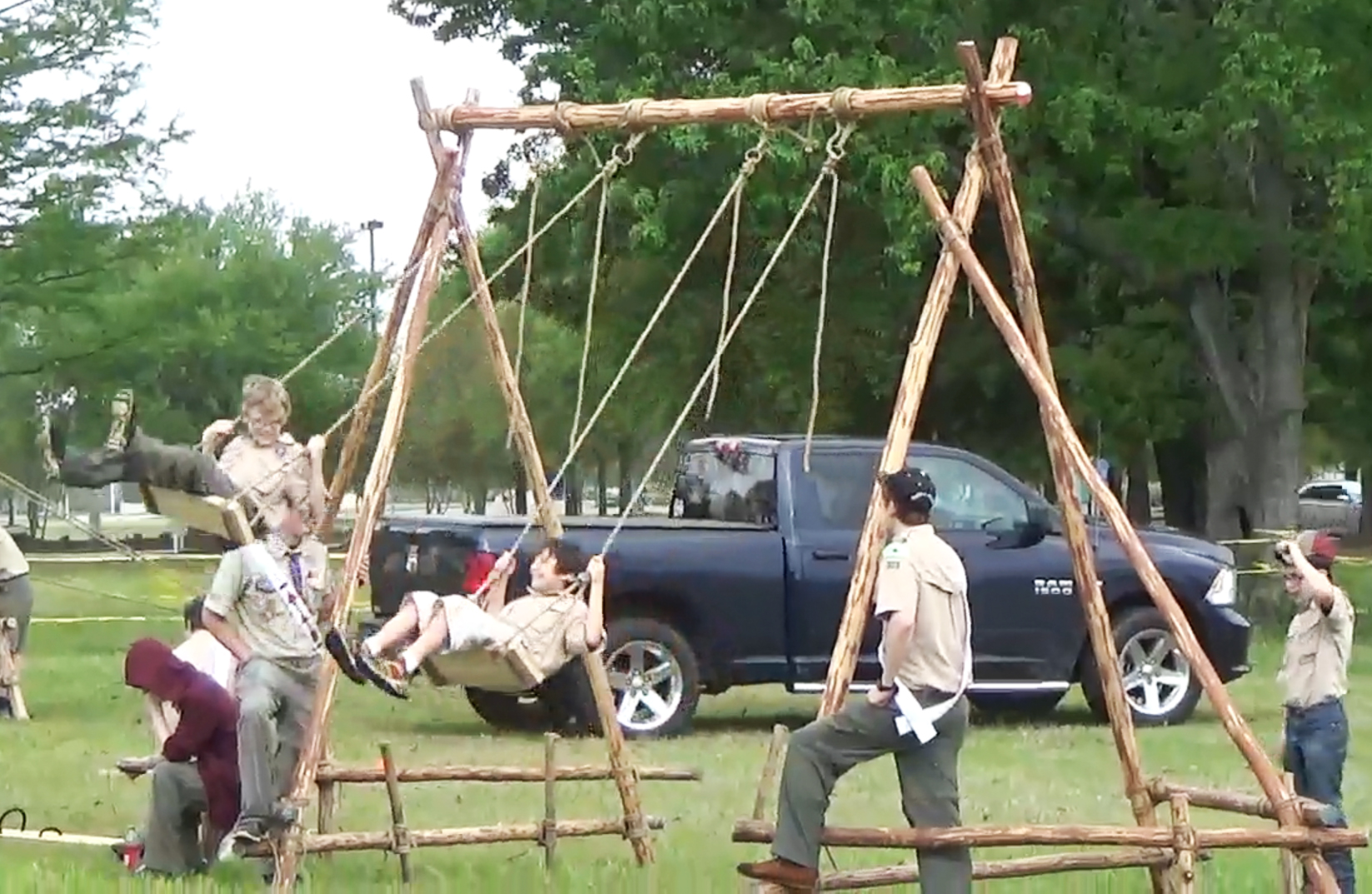

 Attach the rings to the crossbar. Using the 6-foot ropes, tie the steel rings to the crossbar with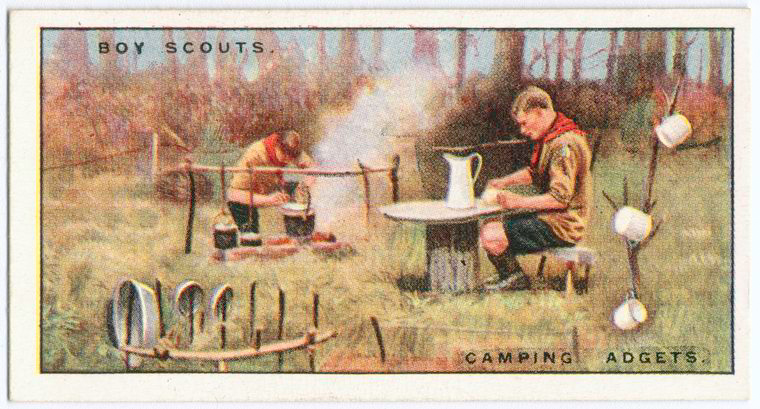
 SCOUT PIONEERING