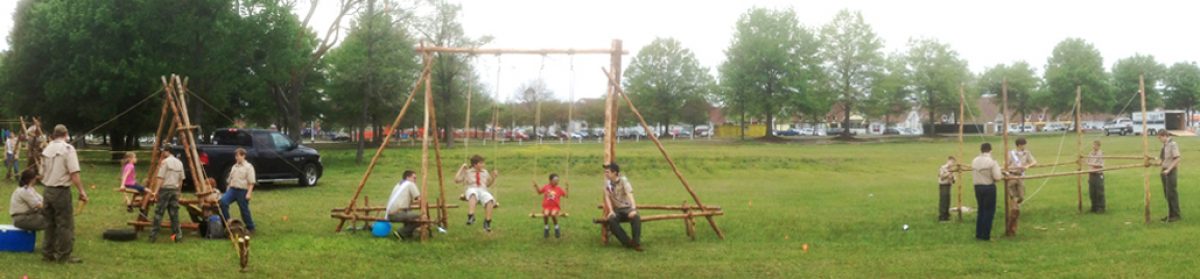

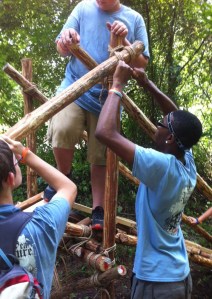
John Thurmann, camp chief of Gilwell for over twenty-five years, casually stated, “To me, the over-riding reason for presenting Pioneering is that boys like it.”
As always, the majority of today’s Scouts love the kind of woodsy activities that provide outdoor fun that’s involving and challenging. This kind of fun is timeless! To build a good pioneering project requires rope, wood, good sense, and skill, and when completed, there’s a happy feeling of accomplishment and success.
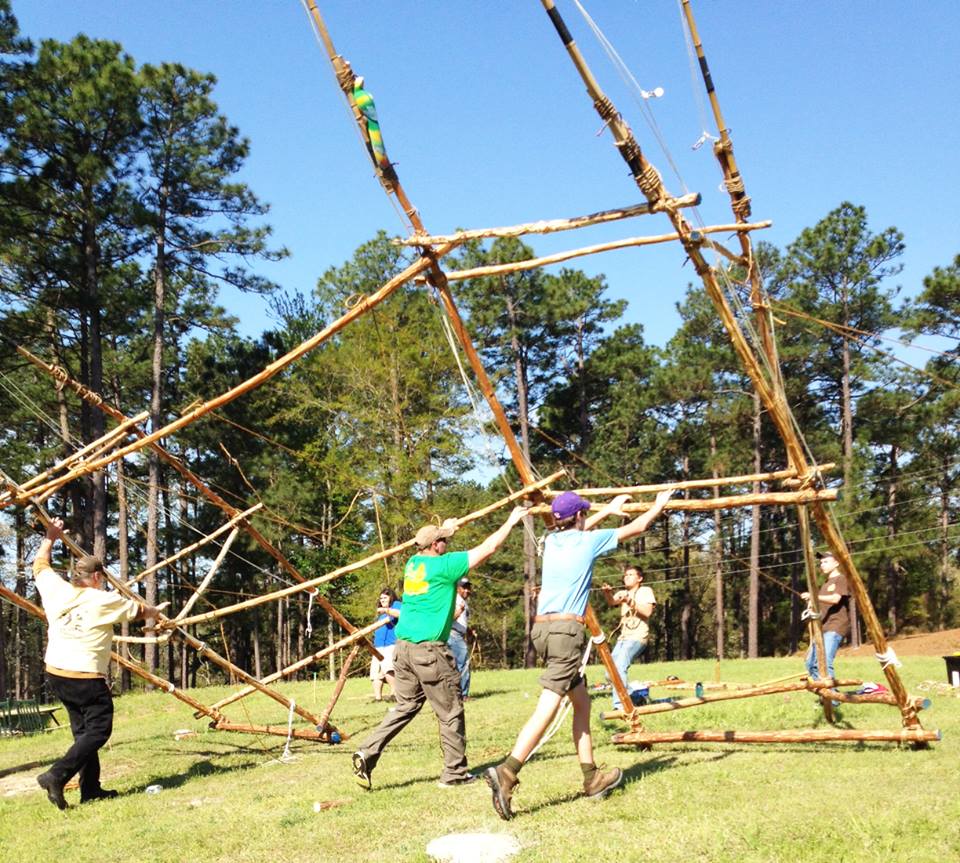
Naturally in today’s world, Scouting America places an emphasis on keeping up with the times—there’s a general thrust to make the Scouting program relevant to the youth of today. Of course, this makes sense. Maintaining interest and attracting new members is contingent on the assurance that what Scouting offers is YOUTH-RELEVANT!
But, amidst the wide spectrum of fun available in Scouting, there’s always an attraction to and fascination with what’s termed, “old school.” It’s the way things were done before all the modern technology so prevalent in today’s society. Pioneering is all about using basic and advanced Scout skills to get things done, to make life in the outdoors easier, and for having just plain ole fashioned good times.
 SCOUT PIONEERING
Hi all. A bit of background if I may. Three years ago my Scout District in the UK purchase a piece of land of about 3 acres in size. It is being developed as an activity field and green field camp site. The only storage we have are 3 steel shipping containers which, whilst weather tight, are subject to condensation.Currently our manilla hemp rope is kept away from the filed in a dry warm scout storeroom and taken to the field when needed. This is less than convenient especially when I’m not available. For now I am proposing to purchase some “poly hemp” rope (please don’t gasp too loud) so that pioneering ans rope activities can be provided to hand.
Question – does anyone know if new ;polyhemp rope needs pre-stretching before it is used for pioneering?
Brilliant wed site you run here – [pity there’s nothing like it in the UK. So hopefully some of my recommendations to other scouters to us it will bear fruit.
Rgds
Gasp! The impression is, synthetic manila will slip and be difficult to hold a knot. Though it is stronger than natural manila, it has a greater stretch factor. https://pioneeringmeritbadge.org/rope/
Yes, I’m not a fan of man-made fibres and ropes. However the fact that we live in a very wet part of the UK, that until we can build the new brick built work shop and tractor garage our only option is the use of the steel shipping containers – and they do suffer from condensation. So I’m not letting my manilla ropes anywhere near them. Hence driven to purchase -poily rope for use in the short term.
Thankfully the factory that makes the rope is only about 10 miles from home and I can visit the factor warehouse to pick it up at a reasonable price.
Question is though – do I need to pre-stretch poly rope before use are per natural fibre rope?
Rgdsas JimB
I confess, I’ve never tried to lash with 1/4-inch poly rope, but from my inexperienced viewpoint, my concern is regarding how slippery it is. So…after you try it, let us know how it goes. Thanks!
Two great small projects needed for any campout are the Scout Stave Flag Pole and a Tool Racks. Great patrol activities.
A liitle larger is the ‘A’ Frame bridge. Many variations of the A-Frame bridge can be done also; Two A-Frames (or more), Commando Bridge (between two A-Frames), balance beam, etc.
Also, I suggest making the platforms using the ‘Ladder Lashing’ and rungs only for quicker assembly. The Ladder Lashing requires about 40ft of rope for each 8ft side and is a bit diffificult to manage, so ‘rope management’ becomes an issue when working with long lengths, but is much quicker than square lashing for each tie down point.
Can any one provide me with ebooks of Pioneering Principles and Progressive Pioneering, both by John Thurman. I am a Rover scout from Pakistan and currently pursuing my woodbage in pioneering. I have heard these four books take us away from our regular 5 lashings (pole, shear, diagonal square and tripod) so I wanted to touch on that and give pioneering a new dimension in my work.
Regards
Aly
You can access pdf files of John Thurman’s books from the Links page on this site. John Thurman would be the first to tell you that knowing the basics and using them effectively and with creativity is all you’ll need to enhance your Pioneering experience. Indeed, there are lots of projects in these books that can serve to inspire you and expand your horizons.
Larry,
I am working on a show for a campfire and 100th anniversary of the O.A. I would like to find a discussion of characters that would a further the intrigue along with the story of our founding of the order. I wish to use the characters in our legend and the founders of scouting. Do you know of such a thing? I was hoping not to have to do all the research and write it myself. I will do this if I need to. I want to inspire new members, rededicate older members to our cause, and form interest in the scouts not yet called out. Any help would be greatly appreciated.
Your Friend,
Tom
Hi Tom, I’ll email you a pdf of something our lodge did last summer that was somewhat along the same lines of what you’re describing.
I have two books, purchased at the Scout office in London many years ago. Titles are: Pioneering Principles and Progressive Pioneering, both by John Thurman, Camp Chief Gilwell Park. Both books suggest alternatives to our standard four lashings, especially many knots from Asia. The one I use most often with bamboo is the tourniquet lashing. It is quick and easy to tie, and also permits “tightening up” while in place without having to untie the entire lashing. Towers, bridges, flag poles can go up in minutes, Scouts don’t get rope burns on their hands. This is the way to go.
If you are using bamboo, be sure to seal the cut ends with paint or motor oil to extend the life of the spars. They can dry out and split quickly.
As per John Thurman, we’ve applied the Tourniquet Lashing in conjunction with “The Ten Minute Tower.” Feeling a little reticent to apply it in other applications since the lashing forms only one, tight single diagonal. I’d be interested to see some photos of the structures your Scouts have completed with this as the featured lashing,
This blog is awesome!! Thanks for sharing!
I have a new troop (well we are almost one year old now) and we don’t have a
good pioneering kit. Where/how can I get good poles and spars. Right now we
have about 3 spars we found on a campout and 6 poles/dowels) (about 3 foot
long). Buying suitable dowels at Lowes or Home Depot is very expensive.
Any ideas you have will be greatly appreciated.
Thanks, Scott Victor, Scoutmaster Troop 149, Fort Leonard Wood, MO
Hi Scott,
Thanks for your email. Acquiring spars for your troop’s projects is a stepwise progression. Refer to Pioneering Stumbling Blocks, the third one.
Here’s what should be appearing in the next edition of the Pioneering Merit Badge Pamphlet: “Where do I get pioneering poles? Stands of trees with the right characteristics grow in numerous locations. Get permission from the land owners and perform a conservation project! Under most conditions, thinning out the land encourages a healthier tree population. But, get permission and be prudent. Each spar is a prize and with the proper care will last for several years of repeated use.”
Additionally, here’s a link to where you can economically procure Scout Staves. They are exceedingly useful for skills instruction, camp gadgets and have a host of campcraft uses: http://www.scoutstuff.org/catalogsearch/result/?q=1443
We are headed to a Camporee this weekend, and a Scout needs to build a useful camp gadget. I suggested the wash stand, and he thought that would be OK..
The wash station is, for sure, one of our favorite camp gadgets! It’s definitely useful, and it’s also really an impressive, little example of “Scout Engineering.”
Excited! Your website inspired my boys and now we’re founding a new troop here in Oregon focusing on pioneering!
We just got poles donated, have rope coming, and will be officially chartered on Aug 1, 2013!
Thanks for the stories and the inspiration.
That’s wonderful! Thanks for the great news!
Doug,
What size poles did you get and who donated them?
Sheldon in AZ.
Sheldon, sorry that I didn’t see your question sooner 🙂
We got a trailer full of 16′ spars ranging from 2″ to 6″ in diameter.
Thanks for the reply. Who donated? A Lowes/home depot type store or a lumber yard?
It was actually a small mill in a neighboring town.
Hi Sully!
As you know, China’s been using bamboo for centuries. It’s strong! Look at all those enormous scaffolds! Also, the largest and most elaborate pioneering structures I’ve ever seen consist of numerous bamboo poles: http://www.scoutmastercg.com/shiang-yang-ope/
Personally, I have very limited experience with bamboo. Other than for patrol tables during a camporee, one 10′ double tripod gateway, and just recently the 14′ Tower Gateway, https://scoutpioneering.com/2013/04/15/tower-gateway-4-flag-tower/ we consistently use pine. We’re blessed by residing in an area where there’s LOTS of pine. Because bamboo is so light, you can harvest lengths with thicker diameters which should provide a fine measure of confidence and security in their ability to stand up to the stress related to larger constructions.
The stumbling block I think most people falter over is: how does one lash bamboo so the lashings hold? I can’t seem to get a consummate answer to this query. Because the bamboo was so slick, when we used our usual manila lashing ropes, the lashings would slip. Some years back, we used a 3′ strip of rubber inner tube with a length of 1/4″ manila tied to each end. The rubber stretched around the bamboo for the initial wraps, and this held okay. On the last, most recent occasion, we wrapped the areas where the lashings were to be tied with friction tape, and this worked very well.
Good luck with your pioneering program! Send us some photos! And let us know what you come across that works well for lashings!
We will likely use a mix of pine and bamboo. We have come up with a design that I still need to model for testing. We are using 3 of the 14′ towers and connecting them with two 3 meter bridge spans. For safety we have added netting to the towers and bridges so there is not enough room to fall through. We also have a lot of track and field high jump/pole vault mats around the base and under the bridges. We do not have the same restriction of 5′ in China. But they do require netting and safety pads or harness.
For weight we are thinking of using bamboo for the bridge. 10 ladder support rungs holding up 1cm plank boards as a walking surface.
Thought?
Just re-reading what John Sweet says in Scout Pioneering about bamboo, “…because nature has developed it to withstand a vertical strain only, it will develop a ‘green stick’ fracture if subjected to a bending moment of any severity.” He then does pose a question about its reliability where personal risk is entailed.
I was also concerned about that on the bridges. My intent for the bamboo has been reduced to use as hand rails and the cross spars on the bridge. With the number and length of cross spars I am not worried about them cracking. But the long spans are a very different story. Those will have to be pine.
We have have a lot of luck using vinyl/PVC Screen Cord. It’s rubbery and GRABS the Bamboo/River Cane. You can get a 500′ roll of it for about $18.
https://www.google.com/shopping/product/14122514886319822617?rls=com.microsoft:en-us:IE-SearchBox&biw=1351&bih=776&q=window+screen+spline&oq=window+screen+spline&sa=X&ei=PAsCU8CcMqKTyQGo44HADg&ved=0CIUBEPMCMAo
THANKS for the link! I’ve tried strips of inner tube but it never grabbed well, and effectively wrapping friction tape at the lashing points requires lots of preparation—also wears out pretty quick. We are planning to have flotillas of rafts at Scout camp this summer, using bamboo and 35 & 55 gallon drums. This just might be the answer to one of our quandaries in regards to what to use for lashings.
Worked great!
I spent almost 3 years in Hong Kong, and observed bamboo being used for all sorts of construction. Once, sitting my my living room, on the 16th floor of a 21 story building, I looked out and saw a pair of feet hanging down from the balcony of the flat just above me. Walking out on the balcony, I discovered the WHOLE building had been scaffold-ed with bamboo. Apparently it had all been put up that day, and I hadn’t left the building until mid afternoon, when I saw the feet. No rope, no twine. They use strips of bamboo as the ties to tie em all together. Some of that bamboo (did you know it is simply a grass/) was 9-`12 inches radius at the butt end. We have some local Chinese bamboo here, that I occasionally take the boys to harvest. It was brought back by the parents of the old woman who lives on the property now, in the 30s or early 40s when they were missionaries there. We cut is back out of her front yard, and then get to keep the cutting – and of course carry off the leaves etc. to clean up the place. There is also lots of bamboo “forests” in Virginia even now. The whole area was mostly covered with it, when Jamestown was founded.
Strips of bamboo! Holy cow!
I’ve been using bamboo spars with my scouts quite successfully. I first saw bamboo being lashed together when I visited a Taiwan scout fair and in China for building scaffolding (5 stories tall). At the scout fair they used twine and on the scaffolding they used bailing wire. Also, while at the 19th world Jamboree in Chile we were issued bamboo to create a gateway for or campsite.
Where can you get bamboo? I bought an 8 ft roll of bamboo fencing from my local home improvement center. It was all ready cut into convenient 6 ft lengths. All I has to do is remove the wire holding the spars together. Then I bought a roll of Agri twine (the synthetic stuff used for hay or straw bales).
My information has it that bamboo grows in the US in the Southeast. (I’m in SC and we have plenty.) Then again, a Scouter from PA on staff in the Pioneering Area at the Jamboree brought in a trailer full which we used for our gateway and a “mock” AT&T tower. So, it’s out there, that’s for sure. We lashed the bamboo projects with green baling twine.
I would love to know where to buy all those wonderful poles or where to look.
I confess, the 5′ Scout Staves we use for training and interpatrol competitions, (and putting up dining flies) ARE purchased, from the BSA Supply Division. But, all the pioneering spars have been harvested through the years from SC pine forests and stands of mature bamboo. Refer to https://scoutpioneering.com/2013/02/14/pioneering-kit/ for information regarding spars. I’ll email you with some specific questions.
Hello Larry,
I am starting a new scout group and we are putting together a pioneering kit. If we are using bamboo spars, are the diameter requirements the same as pine? We are in Mainland China and growing a 15 meter length of bamboo can take about 3 months! Actually, in our new Boy Scout Camp location the bamboo is kind of a pest. This will make for fairly unlimited spars! But for larger builds I want to know if it is as safe. I have never used bamboo myself, only pines.
That flagpole was an adaptation of a design inspired by Rex Hendricksen of the 29th Cardiff Scout Group. The notion is by lashing together a series of interlocking tripods the structure is given greater rigidity. Here’s a link to the source: http://www.pioneeringmadeeasy.co.uk/misc/flaggiant.html
I would like to know how the base of the 30′ flagpole is made