Poles for Pioneering – What is a Spar?

Wooden poles are the main ingredient in building a pioneering structure. Everyone knows what a pole is. Depending on the project at hand, we use them in all different lengths and diameters. But, what are all these references to spars? Is a spar different than a pole?

What is a spar? Simply stated, in pioneering, a spar is a thick, strong pole. Obviously, when completed, a pioneering project has to be able to withstand the strain and stress that will occur while performing its intended function. We can’t build a structure out of spindly sticks tied together with string and expect it to work. We use spars lashed together with good, natural fiber rope!
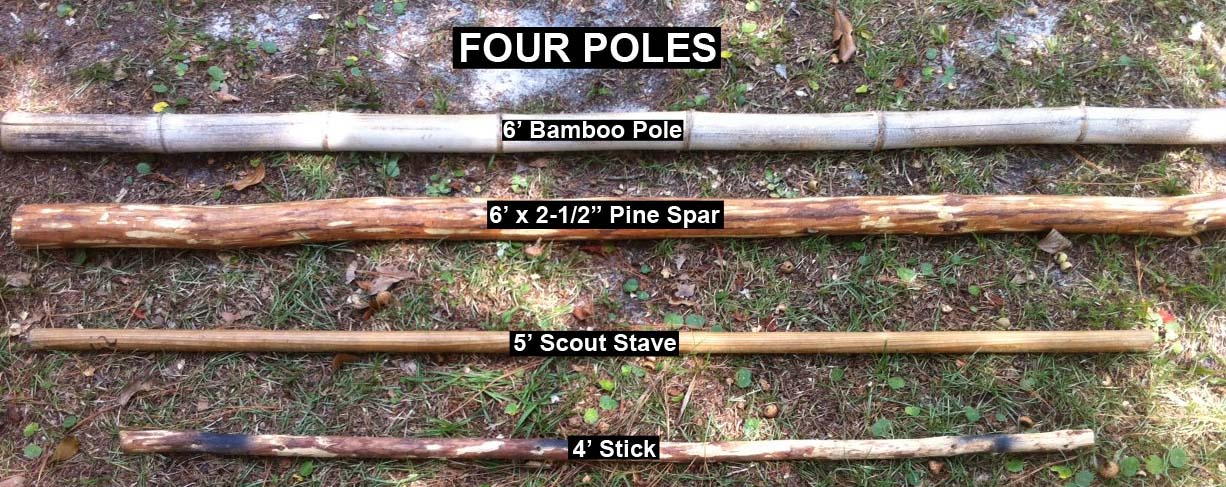
Bamboo Pole, Pine Spar, Scout Stave, Stick
Poles, Staves, Sticks, and Spars

Okay. So a spar is a thick, strong pole. Now there are a lot of givens, but we’ll go through them anyway, and quickly:

  • The best spars for pioneering are straight with a minimum of taper.
  • The diameter of a spar is measured at the butt end, not the tip. Depending on what’s being built, butt ends are frequently between two and four inches thick, and under certain circumstances, even thicker.
  • Spars can be any length, depending on what’s being built. In Scout Pioneering, the most common sizes are six, eight, ten, and twelve feet. (Depending on what’s being built, fourteen, sixteen, and even longer are sometimes called for.)
  • For pioneering projects, spars should be skinned. (If the bark moves when the project is under strain, lashings can slip, skinned spars last longer and the projects look nicer.)
  • Spars should be stored out of the weather for future use.

Is a Scout Stave a spar? No. By themselves, they’re too skinny. Scout Staves are great for instruction and small projects, but a 5-foot Scout Stave is a strong stick, not a spar. Many camp gadgets can be built using short, smaller diameter poles, like Scout Staves.

Is a bamboo pole a spar? A bamboo pole is a bamboo pole. Large diameter bamboo is certainly thick, and depending on it’s condition, also strong, however it should be born in mind, bamboo can withstand vertical stress much better than horizontal stress. It’s super for a variety of pioneering uses because it’s wonderfully straight and for its size it’s very light weight. Due to it’s surface being so slick, lashing bamboo poles together presents additional challenges.

RELEVANT LINKS

Pioneering Program Curriculum IV: Square Lashing!

This is the fourth post in a series that will eventually comprise an activity-based, unit pioneering program curriculum.

SUPPORTING VIDEO: How to Tie a Mark II Square Lashing

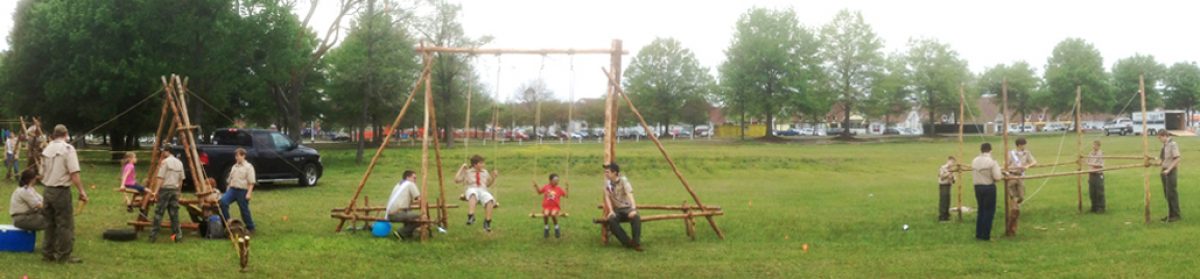
IV. Simply speaking, Pioneering can be seen as building structures by lashing together spars. In most cases, the lashing that is used is the square lashing. For ease, simplicity and above all efficiency, the square lashing used here is the Mark II Square Lashing.

Click on the Images, and then click on them again for a Larger View.

OBJECTIVES

  • A. Scouts will demonstrate they can tie a proper Mark II Square Lashing by:
  •       1) positioning their lashing rope so that the crossbar is initially supported
  •       2) completing three neat, tight wraps
  •       3) making the transition from wrapping to frapping
  •       4) completing two tight fraps and finishing with a square knot
  •  B. Scouts will demonstrate they can join two Scout Staves at 90° angles, by using a properly-tied square lashing.

MATERIALS

  • Crossbar(s) suspended between to uprights or supports, about 3 feet high and long enough so that each Scout can stand in front with enough room to practice
  • Two Scout Staves for each Scout
  • One 10-foot x 1/4-inch manila lashing rope for each Scout
  • One 6-foot x 1/4-onch manila lashing rope for each Scout

PROCEDURE A

1) Instructor crouches down or sits in a chair in front of a crossbar. A Scout Stave is leaning against the bar on the other side. Scouts are gathered behind and to the sides of the instructor, so they can watch his hands as he demonstrates the Mark II Square Lashing while narrating:

  • First thing is to halve the rope.
  • Place the middle of the rope behind the vertical spar and under the horizontal (crossing) spar.
  • Start the wraps by working both ends at the same time bringing them up in front of and over the horizontal spar and then crossing behind the vertical spar.
  • Start the second wrap by carrying both ends to the front, bringing them down over the horizontal spar and down behind the vertical spar. Cross them underneath.
  • Just like the first wrap, bring the ends up in front of and up over the horizontal spar and then cross them a final time behind the vertical spar. You now have three wraps. Carry both ends to the front on top of the crossing spar.
  • To begin the fraps, cross the ends over the top of the wraps.
  • Pull the rope tightly, around the wraps between the spars, and after two fraps, finish with a square knot.

Note:  An Instructor monitors each of the following steps:

SImple Lashing Pole. Note that the vertical spars are behind the crossing spar.
Simple Lashing Pole. Notice the vertical spars are behind the crossing spar.

2) Using a Scout Stave and a 10-foot lashing rope, each Scout takes a position in front of the crossbar, which will serve as the horizontal (crossing) spar. They place their Scout Stave behind the crossbar.

3) Scouts halve their rope and place it behind their Scout Stave with an end on either side and under the horizontal spar.

4) Scouts start theirs wraps, keeping them neat, even, and flush to one another.

5) After three wraps, Scouts bring the ends of the rope to the front and cross them to begin their wraps.

6) Pulling their two fraps tightly, Scouts finish their lashing with a square knot.

PROCEDURE B

1) Each Scout is given two Scout Staves and a 6-foot lashing rope and instructed to lash the poles together in the middle with a neat, tight square lashing.

INTERPATROL COMPETITIONSIndoor Ladder Race and Free-Standing Flagpole

PIONEERING CURRICULUM: MAIN PAGE

Scout Meeting Challenge: Simple A-Frame Transport Race

Chariot races are fun and here’s about the easiest version around. Once Scouts are familiar with the shear lashing and square lashing, they can make an A-Frame to serve as a simple carrying structure (chariot). The race can be run in a variety of ways:

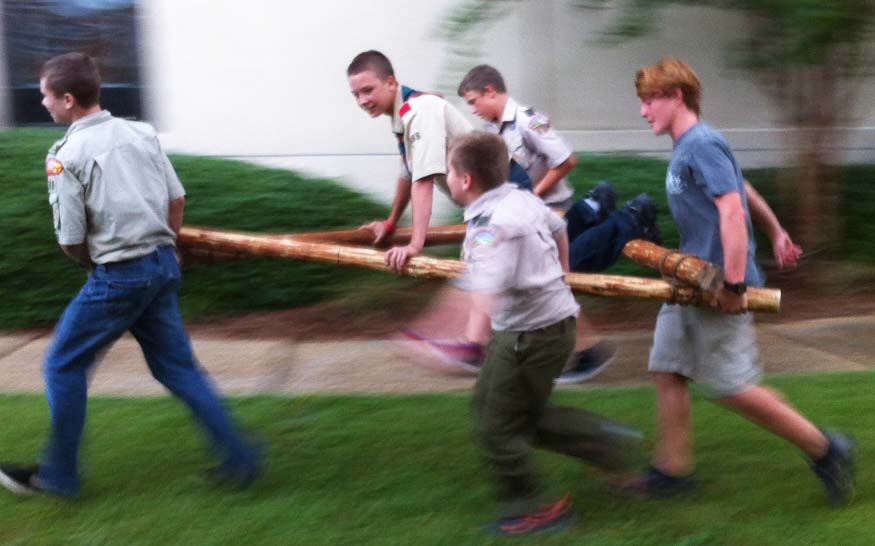
Th Simple Pick Up and Carry Approach
The Simple Pick Up and Carry Approach
  • Pick up the chariot and carry it (advisable if the playing field is a well-cared for lawn)
  • Drag the chariot (works well in wide open fields)
  • Run relay-style heats on a short course (where space is limited)
  • Lay out a longer course

Materials for each Patrol

  • two 8-foot x 4-inch spars for the A-frame legs
  • one 6-foot x 3-inch spar for the ledger
  • three 15-20-foot x 1/4-inch manila lashing ropes
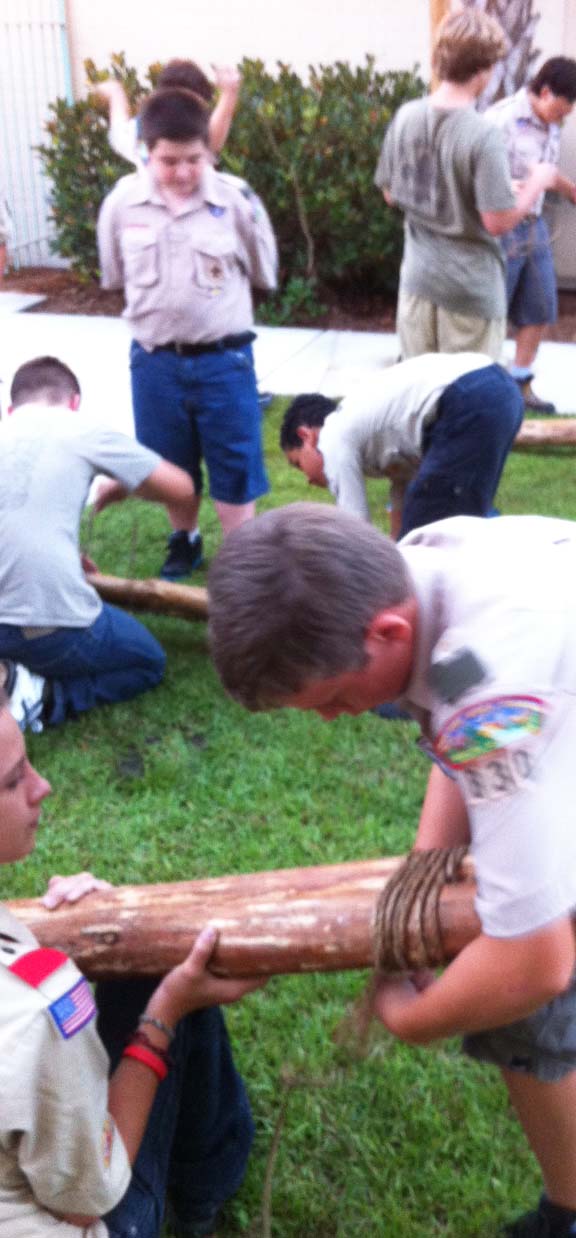
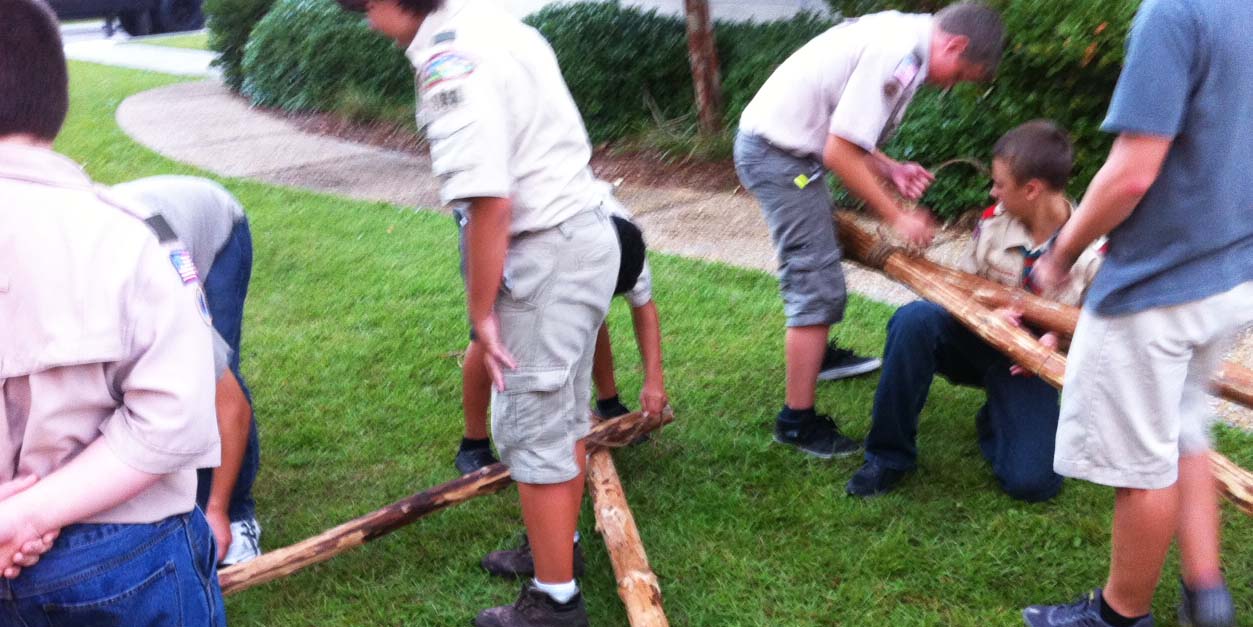
Shear Lashings are Applied to the Tips of the Legs

Procedure Patrols discuss their plan of attack. It’s decided who is to tie what lashings, who is to assist, who will ride and who will carry (or drag as conditions dictate).

A-Frames are Formed

On signal, patrols lash together an A-frame using a shear lashing at the tips of the 8-foot spars and square lashings at the butt ends for the 6-foot ledger. (If desired, three square lashings can be tied.) When the chariot is built, it is raced around a preset course or to a turn around line and back.