Scout Meeting Challenge: Patrols Have Fun With Scout Stave Launchers

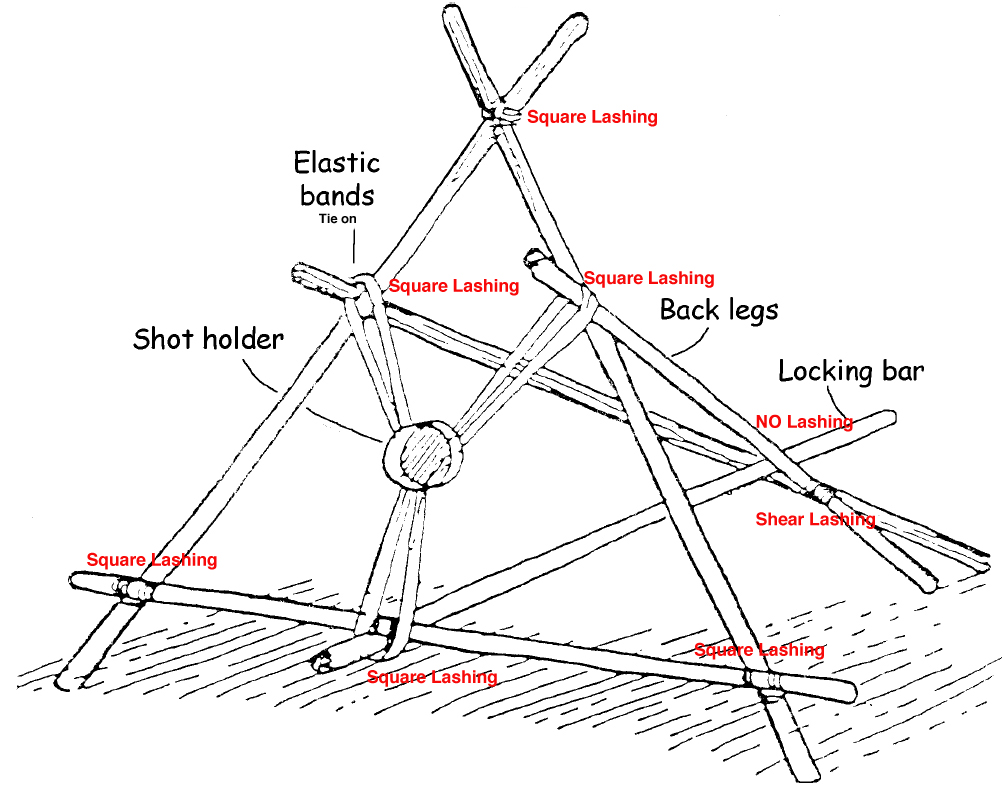
First of all, let’s acknowledge what appears to be the source for this easy-to-execute design—the Scouts of South Africa.. The activity surrounding the construction of this launcher incorporates sound square lashing technique, teamwork (of course), a geometric study of angles and trajectory, some concentration, and lots of laughter. The ensuing fun can be a real blast, indoors or outdoors*.

Link to: Larger Image
Assembling their Launcher

Here’s what each patrol will need:

  • six Scout Staves
  • seven 6-foot x 1/4-inch  lashing ropes
  • three short lengths of cord (to secure the shot holder to the structure if your using surgical tubing)
  • one pre-made “shot-holder”
  • large supply of newspaper and masking or scotch tape
  • large enough room to spread out

In a nut shell, here’s what happens:

An indoor or outdoor area is set up so there’s plenty of room to launch the “shots.”  Each patrol is provided the necessary materials along with the design drawing. They are each assigned their own designated area (about 10′ x 10′) in which they must stay. On signal, they race to build their Scout Stave Launcher. Using the newspaper and tape, they will also have to set to work and make a supply of “shots.” As soon as they are ready, they can proceed to launch tightly, taped-together newspaper “shots” at designated targets in the shooting area. They can also launch the “shots” for distance.

It should be noted, the “locking bar” (refer to the drawing) is only lashed to the bottom crossbar of the A-frame. The angle of fire is adjusted by moving the “locking bar” up and back. Printable  Diagram

Each launching can serve as a point of reference to adjust the “locking bar” and, if necessary, the position of the elastic bands. Remember, the patrol must stay within their duly designated area. Used “shots” can be retrieved at defined intervals, during which no further launching can take place until an “all clear” is sounded.
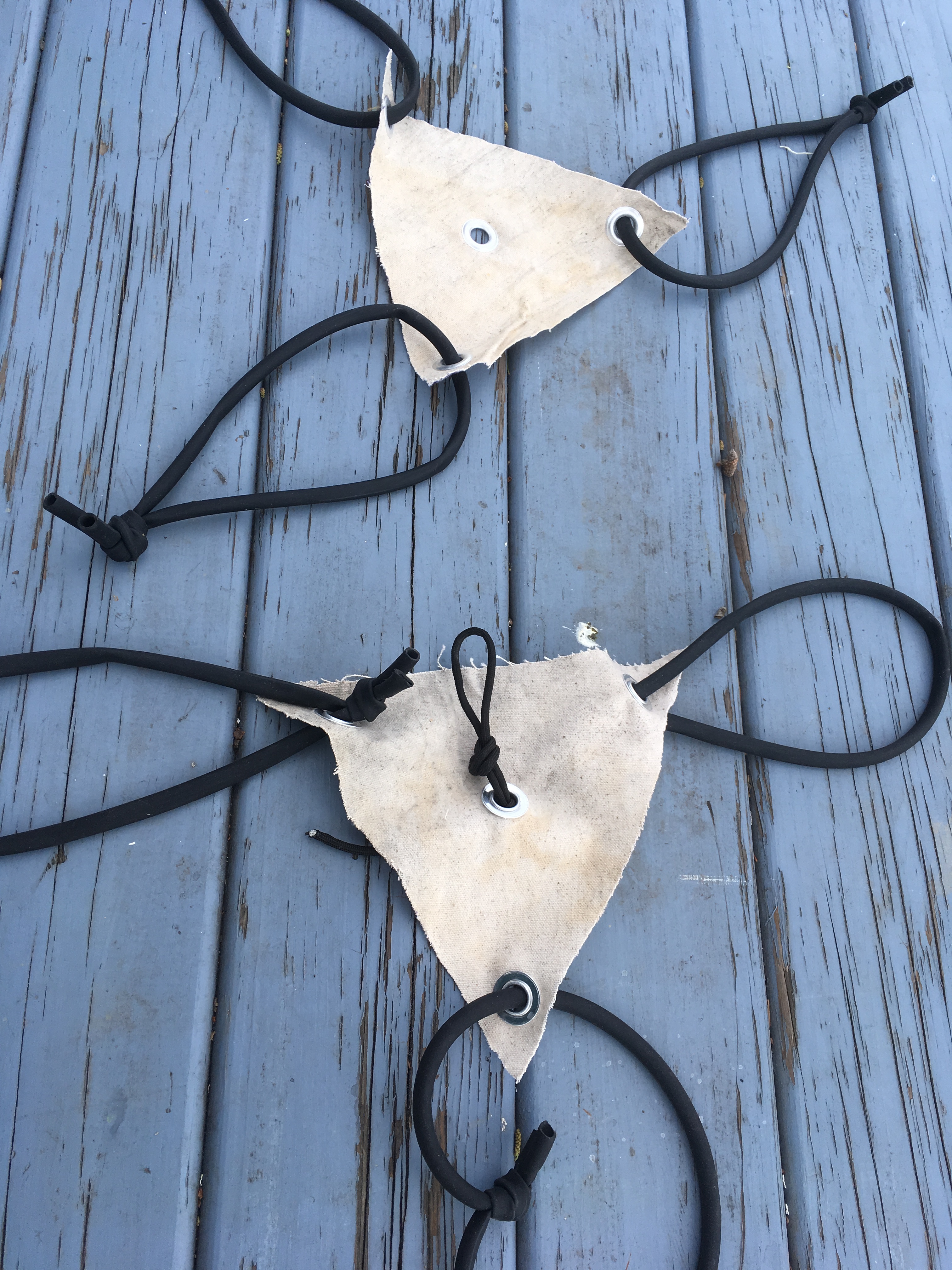
Canvas Pouch Shot Holder

Making a Shot Holder—the most simple approach:

  1. Cut out an equilateral triangle with 12-inch sides from a piece of canvas. 10-oz canvas will work if you double one triangle on top of another.
  2. Place a grommet on each corner of the triangle(s).
  3. Reeve a 24-inch length of surgical tubing through each grommet and  make a loop by joining the ends of each with a tight knot.
  4. If you choose, you can add another grommet to the middle and use it to fashion a pull line.

Tin can shot holder—another approach that works well is as follows:

For each shot holder, you’ll need a can and a length of surgical tube, inner tube, or some kind of  stretch band. Six feet works well with Scout staves.

Ballista rigged with surgical tubing. (Notice the cord used to secure the tubing to the structure.
Launcher rigged with surgical tubing. (Notice the cord used to secure the tubing to the structure.

Prepare the cans. Using 12.5 oz. cans (commonly filled with canned chicken or beef) cut three slits in the bottom the same width as the rubber strips or more narrow if you’re using surgical tubing. Flatten the sharp edges as much as possible against the inside of the can and then apply tape to serve as a cushion between the slits and the stretch material.
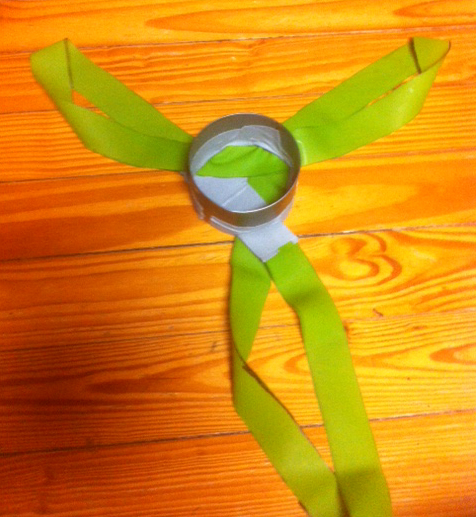
Sample Shot Holder made from a strip of a 6' Exercise Stretch Band and a 12.5 oz Can
Sample Shot Holder made from a strip of a 6-foot  Exercise Stretch Band and a 12.5-ounce Can

The stretch material. One bicycle inner tube can be cut into three to four 6′ strips each of which are just the right size for one shot holder. If you can’t easily obtain inner tube, heavy duty exercise stretch bands work okay, but are less durable. What works best by far are six foot lengths of 1/4″ surgical tubing! They’re the most stretchy and can withstand a lot of strain. Surgical tubing can be purchased through scuba supply companies.

Attach the rubber. Tie together the ends of the rubber strip or surgical tube making one loop with a circumference of approximately six feet. Feed the loop through one slit in the can. The objective here is to extend an even-sized loop through each slit, by forming bights in the loop and threading them through the other two slits.

*Outdoor action can give rise to a host of variations. “Shots” can consist of tennis balls, and targets can be set up at varying distances. Depending on the elastic bands used to make the shot holder, this simple design can easily launch well over a hundred feet.

NOTE: Eye protection and supervision by an NCS trained shooting sports director is required for this activity.
SCOUT MEETING CHALLENGES MAIN PAGE

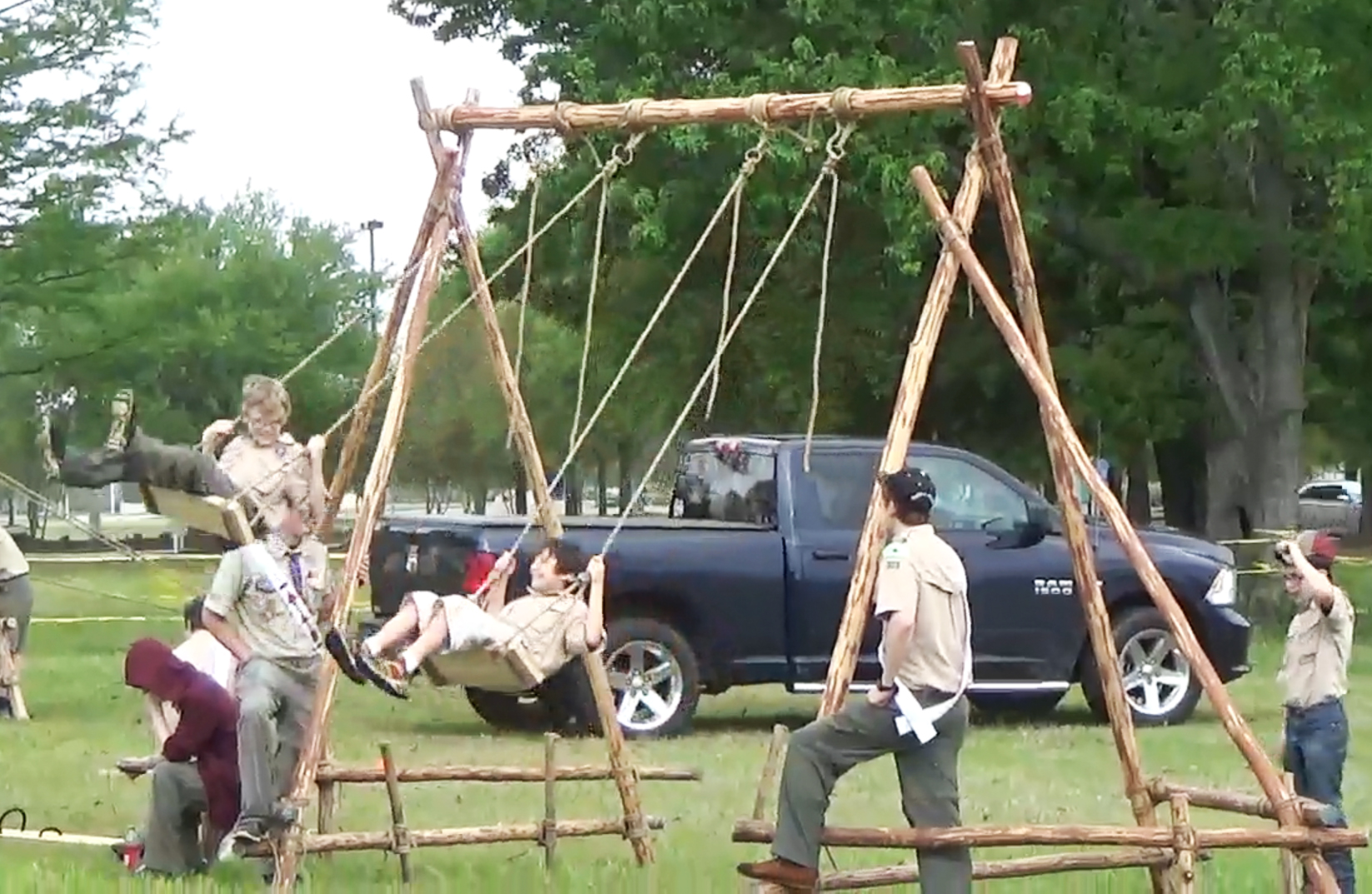
Scout Swing

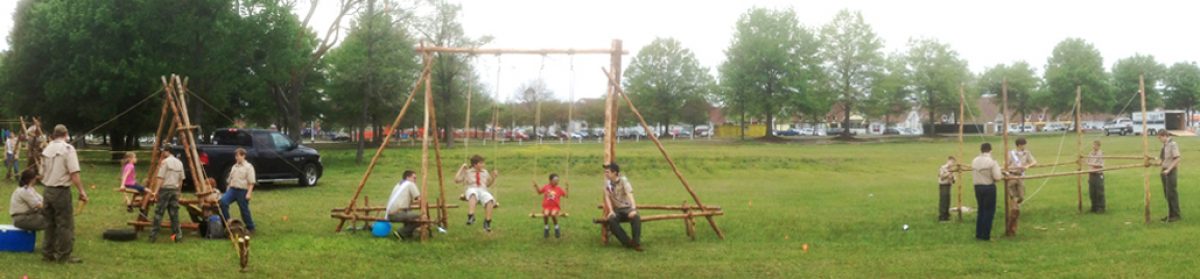
12' Scout Swing Seeing Action at a Public Scout Expo
12′ Scout Swing Seeing Action at a Public Scout Expo

The design for this swing is not complicated, though it does present some logistical challenges. The main thing is, a working swing is going to get lots of play. Therefore, lashings need to be super tight, and the eight sturdy pioneering stakes that serve as anchors need to be driven solidly into the ground, perpendicular to and touching the six spars connecting the legs.

List of Materials

  • six 3-1/2-inch x 12-foot spars for the legs
  • one 4-inch x 12-foot spar for the crossbar
  • six 3-inch x 6-foot connecting spars
  • eight 3-foot pioneering stakes
  • two 2-inch x 8-inch x 2-foot prepared swing seats
  • four 20-foot x 1/2-inch swing ropes
  • four steel rings
  • four 6-foot x 5/8-inch ropes for Prusiks
  • twenty 15-foot x 1/4-inch manila lashing ropes
  • six 20-foot x 1/4-inch manila lashing ropes
  • two single pulleys reeved with 20 feet of rope, with a small loop of rope tied to the top
  • one eight-foot ladder

Though one might think this structure is built by making two simple tripods to support the crossbar, it’s MUCH better to make two A-frames, standing up vertically, supported by a third spar lashed to one leg of each A-frame, slanting down to the ground. The obvious reason is to give the crossbar maximum stability where it rests at the juncture of the two legs of each vertical A-frame.

Prepared Swing Seats

Rig the swing seats. Attach two 20 foot swing ropes to the two swing seats, using a scaffold hitch rigged with a bowline. In order to accommodate the swing rope with the scaffold hitch, the swing seats should be prepared with impressions cut on each side, 2 inches long and 1/2 inch deep, beginning 1-1/2 inches from each end.

Link to: Larger ViewAttach the rings to the crossbar. Using the 6-foot ropes, tie the steel rings to the crossbar with prusiks at intervals as per the measurements reflected in the diagram.

Prepare the A-Frames. Using two 12-foot spars and one 6-foot spar, with tight square lashings, lash together two identical A-frames making sure the tips of the legs cross the same distance from the top for each. Use a 20-foot rope where the tips of the legs intersect, and 15-foot ropes at the bottom. NOTE: Make sure the 6-foot connecting spars are lashed low enough to the bottom so later on there will be plenty of room to lash them to the pioneering stakes.

Add the oblique supporting legs. About a foot or so below the top lashing on the A-frames, lash on a third 12-foot spar to one leg of each A-frame, using 20-foot ropes. These spars will be angled down, extending out to support the A-frames in their vertical positions.

Connect the legs. Stand up the A-frames so they’re in a vertical position. Connect the 12-foot oblique supporting leg to the legs of each A-frame, using the remaining 6-foot spars and eight 15-foot ropes. Again, make sure they’re lashed low enough to the ground so later on there will be plenty of room to lash them to the pioneering stakes. (If you’ll be using the pulleys to lift up the 12-foot crossbar, loop one over the top of a leg, before standing up the A-frames.)

Position the two 3-legged subassemblies. Line up both support assemblies so they are facing one another on even ground and with the A-frames 10 feet apart.

Position the crossbar. Tie one end of each pulley rope to the ends of the crossbar, and have two Scouts carefully hoist the crossbar up to near the tops of the A-frames. They must carefully hold it in place. Position the ladder so that it’s even with one A-frame, and have a strong Scout climb about four to five feet up and lift the end into the crux of one A-frame. Repeat the process on the other side of the swing.

Lash on the crossbar. Making sure the rings are properly hanging down, and the crossbar is extending out approximately one foot from each side, one Scout will climb up and tightly lash the crossbar to one of the legs of each A-frame with a 20-foot rope.

Tie on the swings. One Scout will climb up and connect the swing ropes to the rings using a roundturn with two half hitches, making sure the swings hang evenly at the desired height.

Drive in and lash on the anchors. Four pioneering stakes are driven into the ground on each side—two spaced evenly and touching the bottom of each A-frame, and one against each connecting spar, hammered in near the oblique supporting leg. After these stakes are solidly in the ground, so they cannot jiggle, lash them to the connecting spars using 15-foot ropes.

Test the swing and make any adjustments as necessary.