What is a Pioneer?

Here are three definitions for “pioneer” and how they can be applied to modern day Scouts:

pi·o·neer  (p-nîrnoun

1. One who ventures into unknown or unclaimed territory to settle.

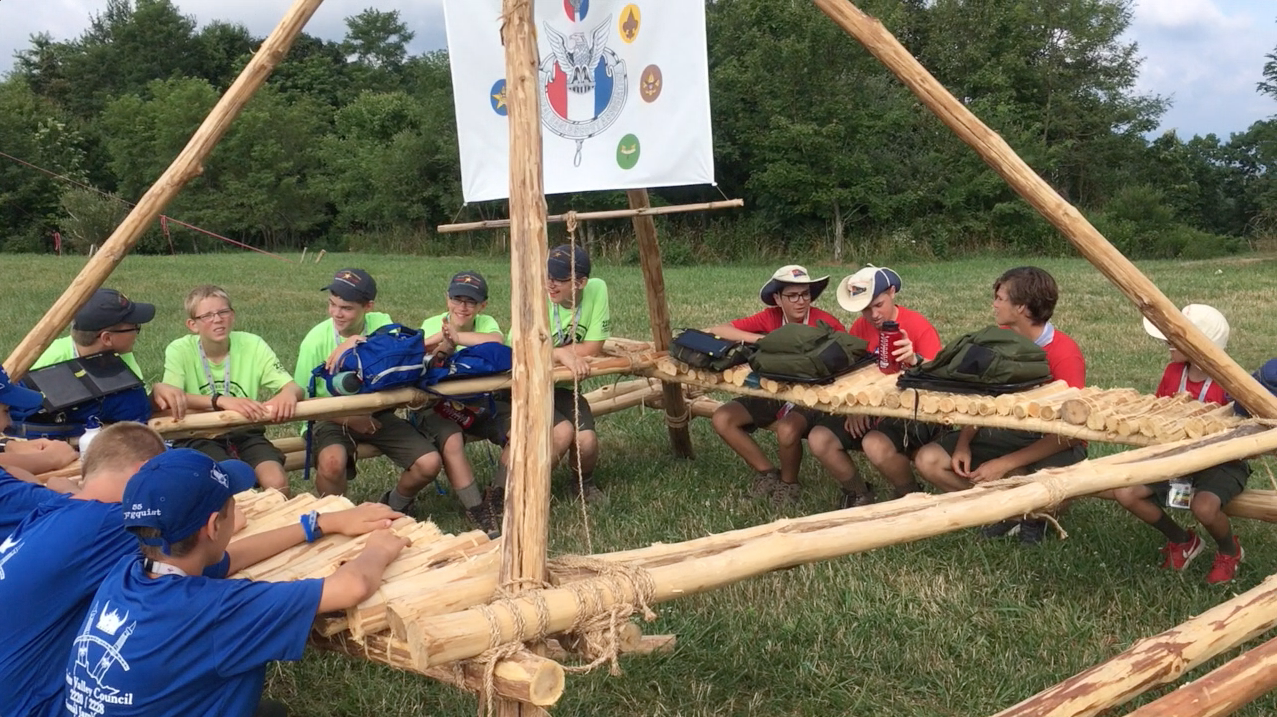
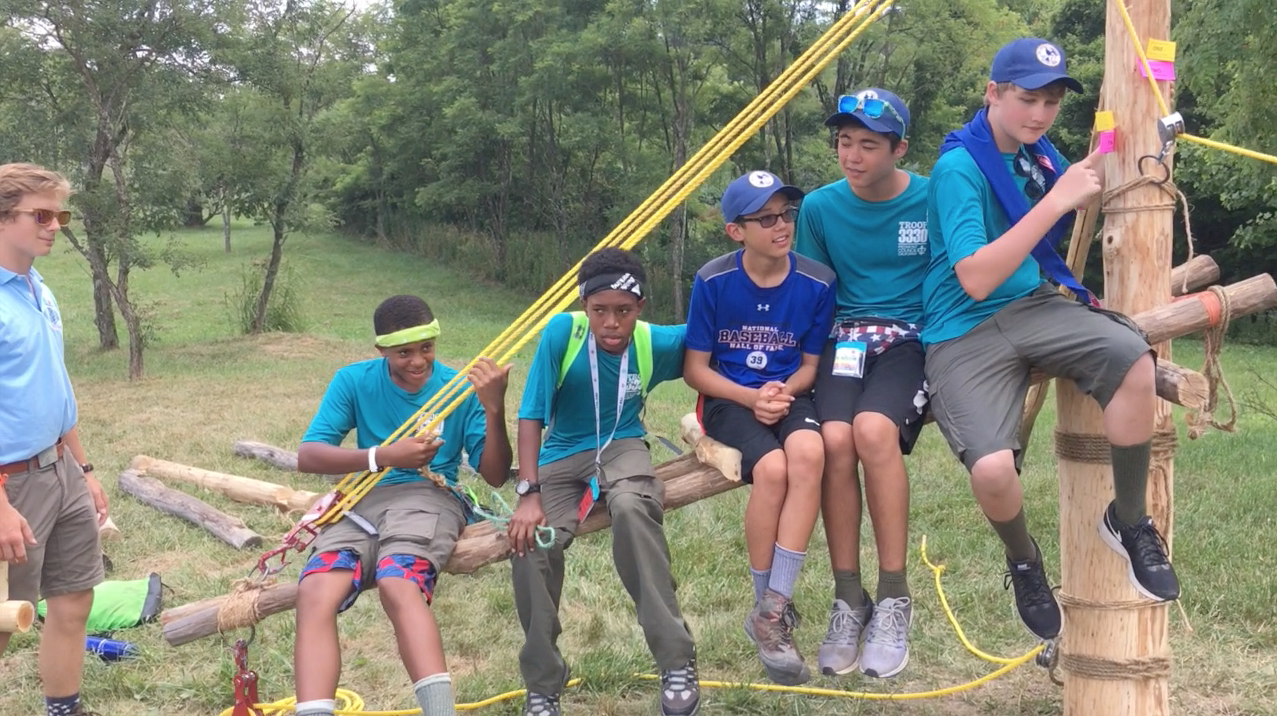
  • Equipped with their pioneering skills, Scouts camping in a rustic, wilderness setting who use these skills to “settle” into their campsites for long or short terms are like modern day versions of the old-time pioneer. In this case, “settle” can mean improving their site with forked sticks and crossbar for hanging an 8 quart pot over a cooking fire, a large or small Chippewa Kitchen, and everything in between. Those old-time pioneers who ventured into unclaimed territory were not only adventurous, they were also resourceful. In today’s Scout Pioneering, these two qualities come to life as Scouts are faced with making practical decisions while camping and backpacking. Usefulness and fun can go hand in hand.

2. One who opens up new areas of thought, research, or development: (a pioneer in aviation).

  • Once pioneering skills are learned and practiced, Scouts can devise their own gadgets, and structures and ways to build them. Commensurate with outdoor activities and camping, Scouts using their pioneering skills coupled with a good dose of ingenuity, come up with “new” and useful ideas, e.g. cutting a short piece of bamboo of the proper diameter and lashing it to an upright on the dining fly to serve as a convenient flagpole holder. From our standpoint, even if on a small scale, the Scout who recently came up with this ingenious little device is a “pioneer in camp gadgets.”

3. A soldier who performs construction in the field to facilitate troop movements.

  • Scouts can facilitate troop movement by building a bridge over a gully or stream that can conveniently and efficiently be used to get from one location to another. Scouting publications are replete with photos of Scouts putting up various types of walkway bridges across small streams and gullies. That’s real pioneering (and real fun)

Is all that a little far-fetched? Well, it’s a fact, you can apply most anything to Scout Pioneering. It’s that universal in its appeal and that broad in its scope.

Guided Discovery

The Guided Discovery Process is a fancy term for what? Guided Discovery is an approach where Scouts are asked a question which leads them to examine a situation, and then discover the best way to proceed. Put another way, Guided Discovery enables Scouts to think for themselves in order to solve problems and find solutions. This approach is Scout-based. By Scout-based it is meant the focus is on the learning and the Scout, not on the teaching and the teacher.

Asking a question is a big part of this process. Asking the right questions takes as much skill as giving the right answers. The idea is, the right kind of question is going to get the Scouts thinking. It’s this thinking that leads them through a path of discovery where they can figure out for themselves what they need to do.

When Scouts are faced with a challenge or have a problem, it is natural they will frequently have their own questions. But, with Guided Discovery, we, don’t just spoon feed them the answer. Instead, in order to guide them through this path of discovery, we present them with a counter question—a question which requires them to find their best answer by applying what they know, using their resources, and coming to their own valuable conclusion. And why is their conclusion so valuable? It’s because whatever a Scout learns through a process of discovery is there’s. It’s something they’ve arrived at through their own efforts. So, they own it.

Guided discovery as a process. There’s a lot that youth leaders have to go through before they can take the reins and run the troop. All through their ranks and as they mature, Scouts are gaining knowledge. Not just facts, but skills and techniques
too. Let’s talk about a brand new troop where we want to enable the newly elected SPL to run things. With the Guided Discovery Process, the first thing they need is a vision. They can be given a picture of a troop that’s involved with an exciting program that reflects what they want. They’re learning, they’re advancing, and they’re having a lot of fun. Also, everything’s planned and carried out by them. In this vision, the only time the Scoutmaster is in front of the troop is for a minute at the end of the meeting. The rest of the time, it’s all up to them.

Now once the Scout is given a vision like this, the second thing they need is the strong desire to make it happen—they’re motivated to be an effective Senior Patrol Leader.

The third necessary thing any youth leader needs is the prerequisite tools to carry out their job. And here, it is the Scoutmaster’s responsibility to make sure they learn, or at least have access to, all these necessary tools. For example, the new SPL needs to know that putting up the Scout sign is a means to getting the troop’s attention. This is a basic tool. Now, discovering how to use this tool most effectively is something else. This is a technique, and techniques can be gained… through Guided Discovery.

Back to the Scout sign. Maybe the SPL had a terrible time at a meeting to get the troop quiet when they held up the sign. After the meeting, the Scoutmaster might ask, “So, how do you think things went tonight? Were you able to control the troop the way you’d like?” And the SPL might answer, “The troop doesn’t ever really get quiet when the sign goes up.” The Scoutmaster might then ask a guiding question like, “Well, when you hold up the sign, what do you think the Scouts see?” Now, after mulling this over, if the SPL just scratches their head, the Scoutmaster might ask, “What do you want them to see?” That question should serve to further guide them and get their wheels turning. Through this process, they can start zooming in and find their own answer. If they picture the troop as they’re holding up the sign, they might remember how even some of their own leaders were still carrying on. Ah-ha! There’s a key! They’ve got to make it clear to their leaders that as soon as they put up the sign, they need to quickly get quiet and put up their’s. This way, the rest of the troop is going to have a good example to follow. What’s important here is that this SPL comes to the conclusion on their own. They are guided to find a solution, but it’s actually their discovery. See how this is different than just telling them that the Patrol Leaders Council leads by example!?

So, through guided discovery, a youth leader can find the solution to their problem and gain needed techniques. Learning these techniques by discovering them is a way they can make these techniques their own. When they find a solution to their own problem, through their own efforts, they own that solution!

So, now as they gain techniques, they can use them to do a good job. This is good because doing a good job gives them confidence. With confidence, a motivated youth leader can start using their own initiative to make everything better. Youth leaders using initiative is amazing. When this happens, it’s awesome! 

THIS IS THE PROCESS:  A vision / a desire / the tools and the techniques to use them / gaining confidence / using initiative.

How does a Scoutmaster shift the attention off themself as the leader to the Senior Patrol Leader? When a Scoutmaster is approached by the SPL with a question or problem, with guided discovery, they won’t just dole out hard and fast answers. Instead, again, they ask a counter question. “This is your troop. What do you think needs to be done?” If it’s not a matter of health and safety, then reflecting the situation back onto the SPL with a question, is shifting the attention off of themself. As for the rest of the troop, have you ever seen T-shirts for the adults with the back saying, “Ask the Senior Patrol Leader?” There’s even a little, round, patrol medallion sized patch for a Scouter’s right sleeve saying, “ask the SPL.”

How does the Scoutmaster instill their knowledge to the Senior Patrol Leader? First, by inspiring them with a shared vision, and of course encouraging them whenever appropriate. Then, by providing them with all the necessary resources so they can do things independently. Along the way, the Scoutmaster serves as a mentor, but a Scoutmaster really needs to lead by following one step behind. That means, they know where the SPL and the troop are heading and what they need, but from there, they enable them to discover things on their own.

Youth leaders should always have a Plan B. Plan-B-Prepared. A perfect example of a Guided Discovery question that will get a Scout thinking is: “What if?” Asking Scouts questions beginning with “what if” is a good way to ensure they have their bases covered. It gets them thinking about alternatives and also utilizing their troop’s resources.

Some other examples of the Guided Discovery Process. Here’s a couple more guided discovery scenarios: Two Scouts carry a third through a 4-foot wide track as part of a Disabled Person Obstacle Course activity. The two Scouts really struggle to carry the third because they hadn’t learned the “two handed carry” or the “four-handed seat.” Now, after their struggle, it could just be explained to them how to do these carries. But, it would be better to ask them, “How would you like to find out how to carry an injured person a whole lot easier, even if they’re heavier?” and then guide them: “Where can you see how to do this in your own handbooks?” They’re most likely gonna want to check this out, because after what they just went through, they’re definitely ready to learn something better than what they did. But the emphasis is on them to discover it themselves. When we pour ourselves into finding our own solutions, we become invested in the process. When someone makes an investment, they’re much more likely to feel involved. For example, a person is much more likely to read a book if they buy it, as opposed to someone just giving it to them.

Another scenario is about using woods tools to prepare tinder and kindling and then build and light a fire. As Scout leaders, before a Scout tries anything where safety enters the picture, we must make sure they have the necessary tools. In this case, the prerequisite tools are knowing how to safely use woods-tools, and knowing how to be careful with fire. So, here’s a Scout who we observe knows how to properly use a knife and axe, and they’ve prepared tinder and kindling to start and feed a cooking fire. They’ve got everything they need, a safe area, a proper surface, a fire bucket nearby, but, before they try to light a fire, they put their tinder and kindling into the fire pit, all mixed together, and then, try as they will, each time they put a match to this mess, it goes out. They find they can’t light a fire. They recognize they’ve come face to face with a stumbling block, and they’re definitely ready to learn what needs to be done next. But, using guided discovery means we don’t just show them how to do it, and we don’t hover over them providing guidance every step of the way either. They need to get actively involved with learning how to do this, themself. Remember, with this approach, it’s all about the learning, not the teaching. Guided Discovery happens when we ask questions. Here, we might ask something like, “Why do you think this fire won’t stay lit?” Let them think about this. A follow up question might be, “Looking at all your tinder and kindling here, what will burn the easiest when you touch a match to it?” The Scout will naturally answer the light weight stuff—the tinder. Now, after getting them thinking about what needs to be done, they should be given the opportunity to explain what they’re going to do, and if their explanation is good, then let them do it.

Are there any resources available to assist Scoutmasters and Advisors on how to facilitate leadership? Beyond Scoutmaster Position Specific Training, Woodbadge goes more deeply into communication and leadership. But additionally, when it comes to assuring youth leaders are successful, IntroductIon to Leadership Skills for Troops serves as an invaluable resource. Another good resource is Scout leaders who themselves have well run, successful troops. Most any Scoutmaster or Assistant Scoutmaster, who is passionate about what they do, loves to talk about their troop, especially when it comes to talking about what their Scouts do to run things well.

Additional Information. The three basic roles of the Scoutmaster:  

  1. Make sure the rules of the BSA and chartered partner are followed, 
  2. The Scoutmaster should be a good mentor and positive role model.
  3. The Scoutmaster trains and guides Scout leaders. 

—> The Guided Discovery Process does this, by asking the right kinds of questions, and then getting out of the way.

—> Guided discovery provides the framework within which, Scouts can lead themselves to realize a vision they have.

—> Provide the Scouts the objective, equip them with the tools and the skills or the resources to learn how to use them, and turn them loose.

—> Scouts will learn to lead by practicing leadingand experiencing the results of their hands-on leadership efforts.

—> “Why” and “How” questions enhance the Scouts’ ability to make decisions, which is one of the central goals of empowerment.

—> When Scouts run their own troop, they’ve been empowered to do this. A troop run by motivated Scouts who have the right skills, and techniques, is bound to have good membership, the highest retention rate, and the most fun! 
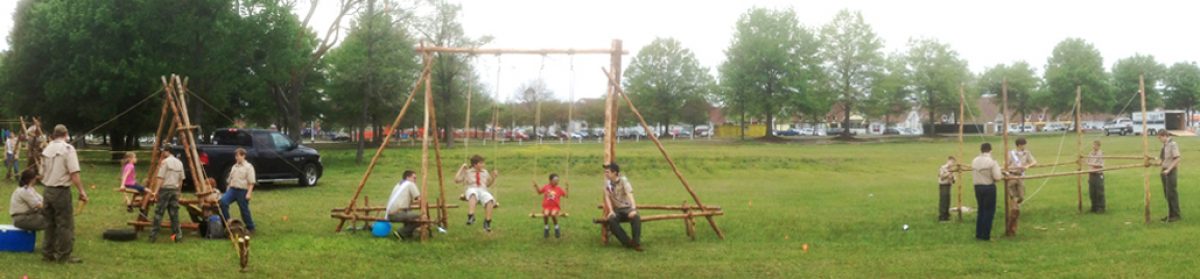
THE IMPORTANCE OF OUTDOOR SKILLS IN SCOUTING — Putting Outdoor Skills Into Action

CLICK HERE FOR COMPLETE ARTICLE

Scouts are required to demonstrate a variety of basic outdoor skills as part of their advancement through the early ranks. How does putting these skills into action, during troop meetings and outings, contribute to a richer and more rewarding Scouting program?

I. WHAT ARE SOME WORTHWHILE EXPERIENCES THAT ARE OUTGROWTHS OF PUTTING OUTDOOR SKILLS INTO ACTION?

Planning a Course of Action – In order to experience success, before they put their skills into action, Scouts need to get their act together. Planning is an essential step, so they can be prepared to accomplish whatever they are setting out to do.

Cooperating with One Another and Practicing Teamwork – This is how things most effectively get done, and this is how a group succeeds. When small groups of Scouts are faced with challenges to use their acquired outdoor skills, everyone has an opportunity to get into the act and contribute to the group’s success.

Becoming Engaged, Focused, and Involved– The attention of the Scouts is maintained, when they get to use what they’ve learned to complete a task that is challenging and fun.

Pride in Satisfying an Objective and Meeting a Challenge – Because they can use their resources, and rely upon their skills to satisfy the challenges they face, Scouts get to feel good about themselves and their abilities.

Being Successful – Nothing succeeds like success. Of course, failures are acceptable and Scouts can learn from their oversights and mistakes. But, when they are enabled to put the skills they’ve learned into action, and apply the principles of sharing leadership, sharing responsibilities, and working together, success is within their reach.


II. WHAT IMPORTANT ROLES DO TRADITIONAL OUTDOOR SKILLS PLAY IN TODAY’S SCOUTING PROGRAM?

To Attract Youth to Our Program – The lure of learning and using these kinds of outdoor skills appeals to many young people.

To Enhance the Enjoyment of Camping – These kinds of outdoor skills can continually come into play, in conjunction with our wide range of available outdoor adventures. 

To Contribute a Unique Brand of Fun to Our Program – The NOVEL activities that feature these kinds of outdoor skills are eminently satisfying.

To Provide our Members with a Useful Set of Tools that can be Utilized Over their Lifetimes – There can be opportunities to use these skills repeatedly, during work and recreation.

To Open the Door to the Development of Character and Leadership – Putting outdoor skills into action with their patrol and troop contributes to a Scout’s development of good character and leadership—two central aims of the Boy Scouts of America.


III. WHAT ARE SOME OTHER VALUABLE INTANGIBLES  INHERENT IN PUTTING OUTDOOR SKILLS INTO ACTION?

RESPONSIBILITY – By using their outdoor skills to contribute to the welfare of the group, Scouts learn the essential meaning of good citizenship. Sharing responsibilities is the hallmark of the patrol method.

RESOURCEFULNESS – Faced with the necessity of using whatever resources are on hand, by relying on their outdoor skills Scouts learn what it means to become resourceful.

ORGANIZATION – Organizational skills are honed as Scouts are confronted with the need to keep things accessible and neat as they use their skills to most successfully meet challenges.

SELF RELIANCE – Using their skills, Scouts learn they can rely upon themselves to overcome obstacles.

SELF ASSURANCE – By putting their skills into action, Scouts experience a growing assurance they can get things done.


NOTE: After a skill is presented using the EDGE Method, Scouts should ideally participate in a well-planned and well-presented CHALLENGE THAT IS FUN and:

—> reinforces the skill

—> illustrates how the skill is used

—> provides an opportunity to rely upon the skill to complete the task at hand.

A Library of Scout Skill Challenges

Durable Atomic Pile

Suggested Materials

  • 4    10′ x 3″ spars for corner uprights
  • 4    12′ x 2″ spars for lateral supports
  • 12  6″-diameter wooden discs, four of them painted with the numeral “5,” four with “10,” and four with “20”
  • 1    6″-diameter log, 20″ long with a large eye hook on one end and a flat, even surface on the other
  • 4    single pulleys
  • 4    40′ lengths of 1/4″ braided nylon cord for the pulleys
  • 4    3′ lengths of 1/8″ nylon cord to attach pulleys to the corner uprights
  • 8    15′ x 1/4″ manila lashing ropes for lashing the lateral support spars to the corner uprights

Set the parameters. Lay the four lateral spars on the ground in a square where you want to position the Atomic Pile. Overlap the ends about 4″ so there will be room to lash them to the corner uprights. Drive a small stake into the ground on the inside of where the ends intersect. This is where the holes for the corner spars need to be dug.

Prepare the corner spars. Using a post hole digger, dig the holes about two feet into the ground at the spots marked by the four small stakes. Make sure the holes are the same depth so the tips of the spars come up to the same height. Before actually placing the corner uprights into their holes, attach the pulley to each with the 40′ cord reeved through. Tie the inside end of each cord to eye hook of the log using a Roundturn With Two Half Hitches.

Attach the “boundary poles.” After placing each upright into its hole, with the pulleys facing the center of the square, and firmly tamping them in for solid support, tightly lash on the four lateral support spars about belly high.

ATOMIC PILE INFORMATION

SCOUT MEETING VERSION WITH MORE INFORMATION

Sequential Programming

A sequential approach to program planning is one where gaining specific skills, and then putting them into action, pave the way towards a larger experience that is memorable and rewarding. This larger experience is ordinarily featured during a “main event” like an outing or special trip.

During the meetings leading up to the special event, the skills and their related activities are presented in a stepwise progression and can be likened to building blocks. The ultimate goal of this sequential approach is to use these building blocks to enable the Scouts to enjoy and appreciate the larger experience. This larger experience is a culmination of the preceding meetings with their periods of skills instruction and activities. In order to contribute an optimum level of fun to the meetings, the activities connected to each building block should not only reinforce the skills, but also be challenging and fun!

Here’s an illustration: For the initial meeting in this sequence, the square lashing is presented during a period of skills instruction. Following this, the Scout skill challenge is a Ladder Building activity. For the next meeting  during a period of skills instruction, the tripod lashing is presented. The Scout skill challenge following this is Everyone on the Tripod, which incorporates both the tripod and square lashings. The third meeting in this sequence includes a period of skills instruction for the floor lashing. To put this skill into action in a fun way illustrating how it can be used, troop leaders orchestrate a Lift Seat Procession. The troop now has all the skills required to construct  a Double Tripod Chippewa Kitchen, the building of which can be scheduled for the coming outing. For a fourth meeting, leading up to the outing, during a period of group instruction, the Chippewa Kitchen video can be projected, and during patrol meetings, various recipes can be reviewed. During their outing, the Scouts will necessarily have to rely upon the skills they learned to construct their Chippewa Kitchen, and then enjoy what they built as they cook up and devour their outdoor feasts.

To recap the sequential approach to programming: after presenting information, a skill, or a technique, (building blocks), whatever’s been presented will be brought to life in a fun and/or challenging way. Eventually, each building block will be combined with others, contributing to that larger experience that is especially memorable and rewarding.

Unlike most programs, where it seems students often learn something just to get tested on it, Scouting can provide opportunities to learn something and then have fun with it. What’s even better, is when what’s learned is combined with other learnings, to experience something bigger—something outstanding. This kind of sequential programming approach is an effective way to deliver the promise of Scouting!

Raft Race at Summer Camp

The camp staff placed a supply of materials in an open area by the lake assigned as the designated raft building place. Groups of Scouts could use any of the materials there to create whatever kind of raft they chose. On hand were lengths of precut bamboo, plastic 55 gallon drums, and lengths of old manila rope. There was no set raft building schedule, so Scouts could devote as much of their free time as they wanted. The only definition regarding time factor was that of the race itself, scheduled for Friday at 3:00 p.m.

This raft building venture revealed a consideration that was not so obvious for many who participated, either in an advisory capacity or as a builder — a little something called “center off gravity”. As soon as many of the rafts were launched, this not so obvious consideration quickly reared its head, to the shock and surprise of the riders and to the delight of many observers. As soon as the race began, some of the rafts that looked like they’d do just fine performed a 180º flip over. By lashing on their drums directly under the bamboo, without taking into consideration the need to provide some form of counter balance, many of the Scouts had created a center of gravity that was too high, and this resulted in an unexpected and immediate dunking. All in all, it was a great race! And, after the race, I happened to overhear a wet group of Scouts remark, “That was fun. We gotta do that again!” Experience is the best teacher.

Flashback: 2017 Jamboree Pioneering Village

CLICK ON EACH PHOTO FOR A LARGER VIEW:

Single Trestle Bridge

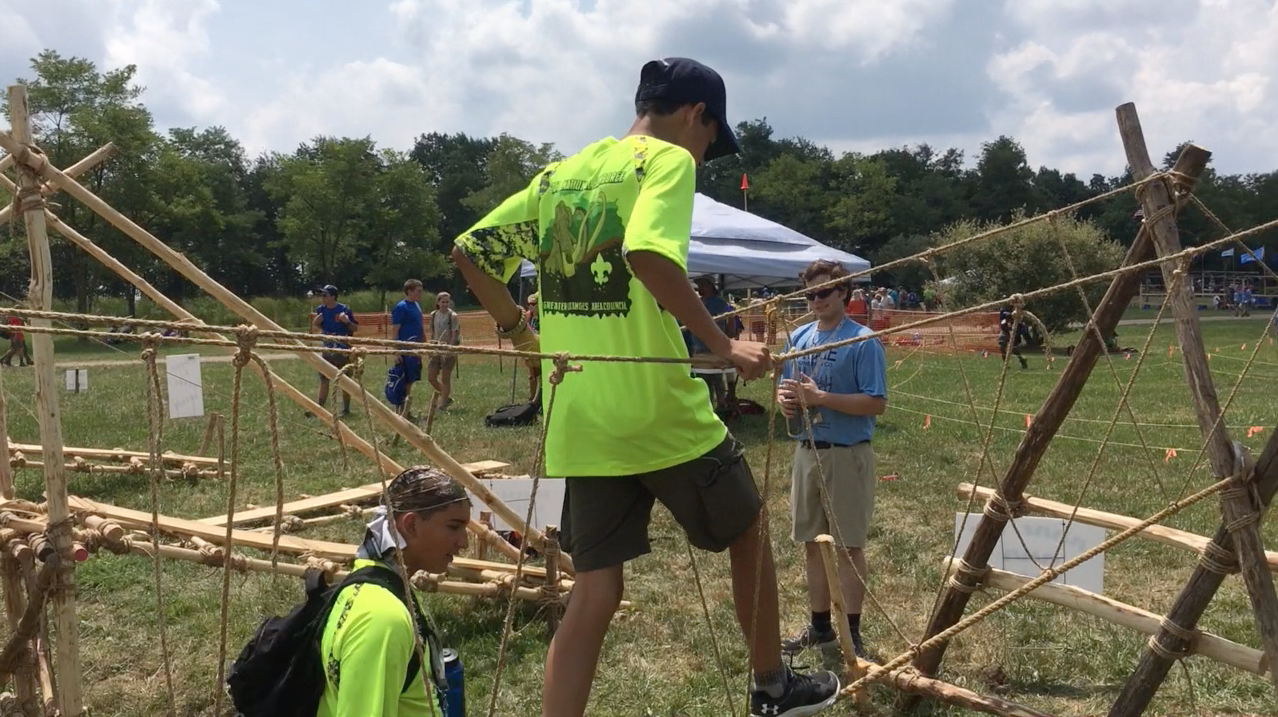
Monkey Bridge

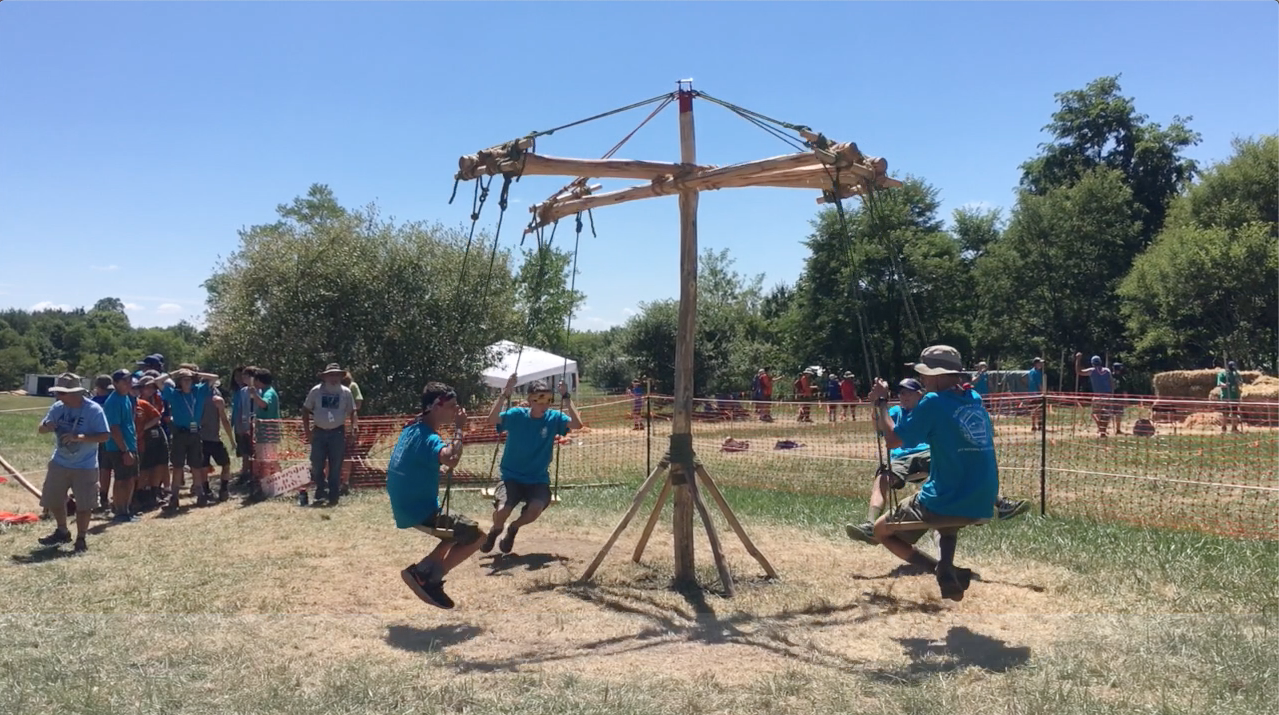
Carousel

Four-Sided Picnic Table

Atomic Pile Team Building Station

Square Lashing Instruction

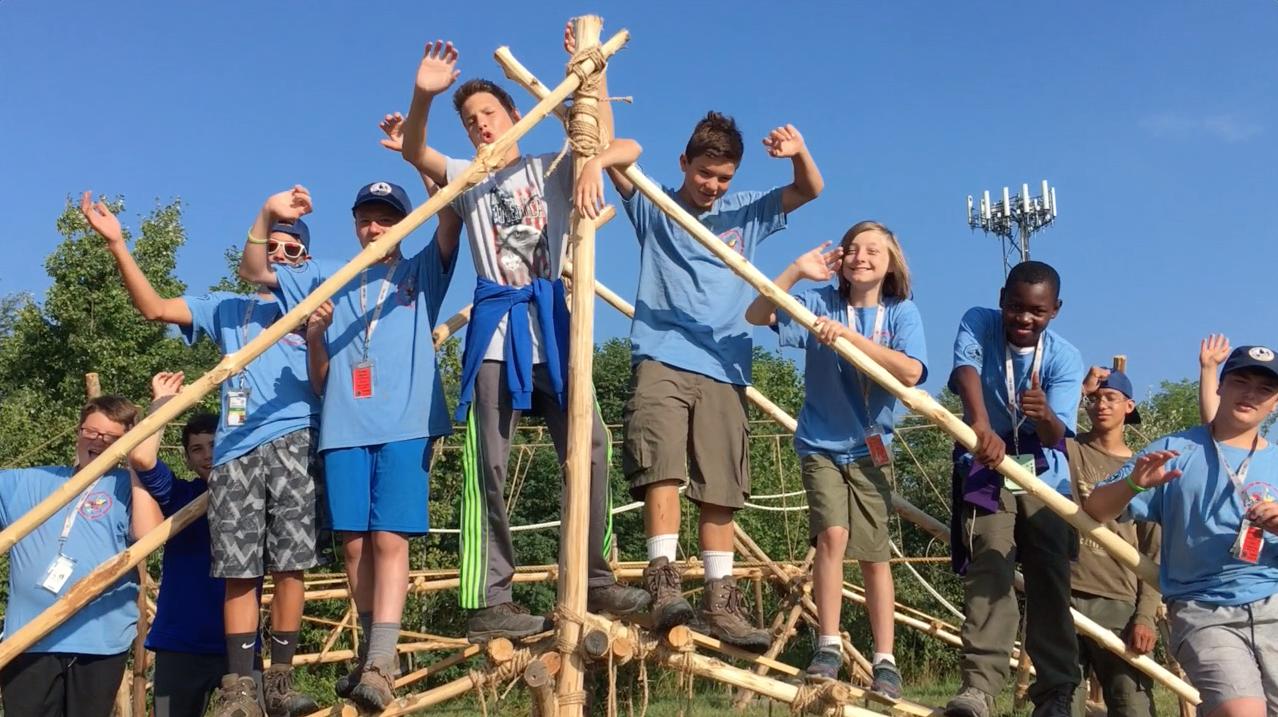
Climbing Platform

Dish Washing Rack (Camp Gadget Display Area)

Swing Derrick

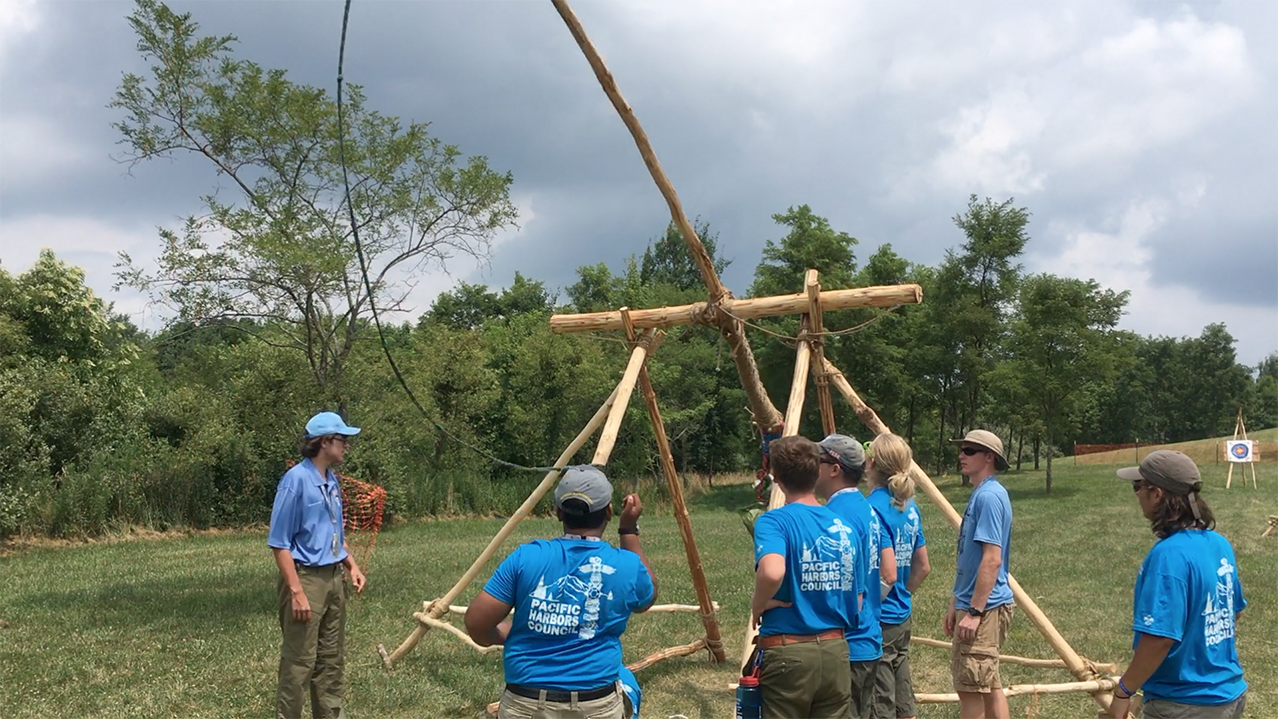
Trebuchet

Double A-Frame Monkey Bridge as Presented in Scouting Magazine

Teach your Scouts how to build a monkey bridge

Scouting founder Robert Baden-Powell believed every Scout should know how to build bridges. From designing the structure to gathering materials and putting it all together, bridge construction combines technology, teamwork and enthusiasm to complete a span that is memorable and useful.

A bridge on a hiking trail can be as simple as a log across a narrow gap. A more serious one relies on sturdier materials like rope and poles. A rope bridge Baden-Powell described in his 1908 manual, Scouting for Boys, is what today’s Scouts would call a monkey bridge.

Monkeying around

This is a classic pioneering project, and a variety of styles and instructions have been shared many times, from a 1965 Boys’ Life article penned by Scouting leader and author William “Green Bar Bill” Hillcourt to various editions of the Pioneering merit badge pamphlet.

If Scouts don’t have a stream or small gully to cross, they can build the bridge in a meadow or backyard. Follow safety rules, ensuring the foot rope is no higher than 6 feet off the ground and no longer than 25 feet between A-frames. Using a 50-foot rope, the maximum span between A-frames should be 20 feet, with the extra length being used for anchoring the bridge.

Before building any pioneering structure, it’s necessary to first acquire the wherewithal to experience success. The skills, along with the lashing ropes and poles required to build a monkey bridge using double A-frames for better stability, can be used time and again, for a variety of pioneering projects and troop meeting activities. Here’s how to build a monkey bridge.

Materials

  • Eight 8-foot-by-4-inch A-frame legs
  • Four 6-foot-by-3-inch ledgers
  • 14 15-foot lashing ropes for square lashings (Use 14-inch manila for all lashing ropes.)
  • Six steel rings or locking carabiners to join grommet and rope tackle
  • Two 12-inch-by-10-foot polypropylene ropes for rope grommets
  • Binder twine to create loops for tourniquets
  • Six 10-foot lashing ropes for round lashings
  • Two 12-inch-by-50-foot hand ropes
  • One 12-inch- or 34-inch-by-50-foot foot rope
  • Five to seven 8-foot lashing ropes for stringers
  • 12 24- to 30-inch-by-212-inch pioneering stakes for two 3-2-1 anchors
  • Two pieces of scrap burlap for saddles

1Begin by building four identical A-frames with the 8-foot and 6-foot spars. Make sure the A-frames are all uniform in size when lashed together. Lash them together with three tight square lashings. You could also use shear lashings at the top of the A-frames.

2. Once you have four identical A-frames, it’s time to make two pairs of double A-frames. Stand up two A-frames so they overlap each other one-half their length (about 3  feet). Join the legs together where they intersect with a tight square lashing. Finally, lash the two 6-foot bottom ledgers together where they overlap with three tight round lashings. Do the same for the other double A-frame.

3. Drive the pioneering stakes into the ground first with three stakes together, then two, and then one. Use loops of binder twine and a small stick in between each set to form a tourniquet. Both 3-2-1 anchors should be installed about 10 feet from where the A-frames will be erected. Place a rope grommet around the front stakes, before applying the tourniquet joining the three front stakes to the middle two.

4Position the double A-frames no more than 20 feet apart from each other. Lay the foot and hand ropes alongside the A-frames. Attach the stringer ropes to a hand rope with a clove hitch at 3- to 4-foot intervals along the hand rope. Make roundturns around the foot rope and tie the running ends of the stringer ropes to the other hand rope with a clove hitch.

5. Make two saddles by folding pieces of burlap, placing one above the square lashings in the middle of the double A-frames where they intersect. This is where the foot rope will rest.

6. With the double A-frames held in place on each side, place the foot rope over the saddles, and tie the hand ropes to the top of the A-frames with clove hitches on a bight.

7. About halfway between the anchor and the A-frames, tie a butterfly knot in the foot rope to form a fixed loop for a rope tackle (trucker’s hitch). With Scouts still holding the double A-frames in position, use the rope tackles to put strain on the foot rope. Next, pull the hand ropes tight and attach them to the anchors using rope tackle or roundturns with two half-hitches.

8. Once all the ropes are tightened, check the knots and lashings before crossing the bridge. Allow only one person on the bridge at a time.

Bridging the gap

Scouts can celebrate their bridge’s completion by crossing it and reflecting on how the project came together. What went well? What would they do differently next time? What roles did teamwork and leader-ship play in the project?

After it has served its purpose, the bridge can be dismantled: The ropes can be coiled and stored with the poles in a dry place, ready to bring out for the next pioneering project.

Helping Scouts realize they have the power to plan and construct big projects is a practical way to bridge the gap between the promise of Scouting adventure and fulfilling that promise in the field.


Robert Birkby is author of three editions of The Boy Scout Handbook, two editions of the BSA’s Fieldbook and the newest edition of the Conservation Handbook. Find him at robertbirkby.com

Special thanks to Larry Green

Scout Skill Activities as presented in Bryan on Scouting

Here are some ideas to put outdoor skills into action at Scout meetings

Outdoor skills aren’t just for the monthly campout. There are plenty of ways your Scouts can hone their outdoor skills on a regular basis, like during unit meetings.

Here is this week’s tip that the BSA’s national camping subcommittee shared with us. Special thanks to Larry Green for the tips and text below. For previous camp hacks and tips from the subcommittee, click here.


Once Scouts can demonstrate an acquired skill, they should be given opportunities to do something fun with it that provides a challenge that illustrates how the skill is used, and an opportunity requiring them to rely upon the skill in order to complete the task.

When properly planned, well-prepared, and effectively presented, these kinds of engaging activities contribute greatly to making a Scout meeting fun with positive outcomes.

Putting skills into action keeps Scouts involved, requires them to use teamwork, and provides the grounds for experiencing success. Bringing skills to life during a troop meeting in a manner that nearly simulates the way they’re used in the field, is always a good way to reinforce what Scouts learn, while honing their skills to keep them sharp.

Here are some fun activities and games your Scouts can do while incorporating skills they’ve learned:

50-Foot Rescue Relay

Hitching Race

Taut-line Hitch Race

Reactor Transporter Challenge

For more team-building activities and skills challenges, click here.

Clove Hitch as presented in Bryan on Scouting

Here’s a tip to help your Scouts remember how to tie a clove hitch

Did you know a clove hitch is essentially two simple knots? When your Scout is tying lashings, all they need to know to create a clove hitch is how to tie a half-hitch.

For the next few weeks, we’ll be sharing some camp hacks that the BSA’s national camping subcommittee has shared with us. This week, we’re showing you how to tie a clove hitch, which is used to begin and end many lashings. Special thanks to Larry Green for the tips and text below.


John Thurman, the Camp Chief at Gilwell Park in England for more than 25 years, wrote, “The first and everlasting thing to remember about the clove hitch is that it is composed of two half-hitches.”

  1. If you make one half-hitch…
  2. and then an identical half-hitch…
  3. and bring them together, you form a clove hitch.
  4. The identical half-hitches can be formed in any direction. This is a good thing, because many lashings need to be finished from either one direction or the other.
  5. First half-hitch (finishing a shear lashing).
  6. Second half-hitch.
  7. Both half-hitches are brought together.

When a clove hitch is formed in this manner, snugging it right against the wraps to finish a lashing is easy.

Watch the video of this technique below.