Favorite Scout Meeting Challenge: Lift Seat

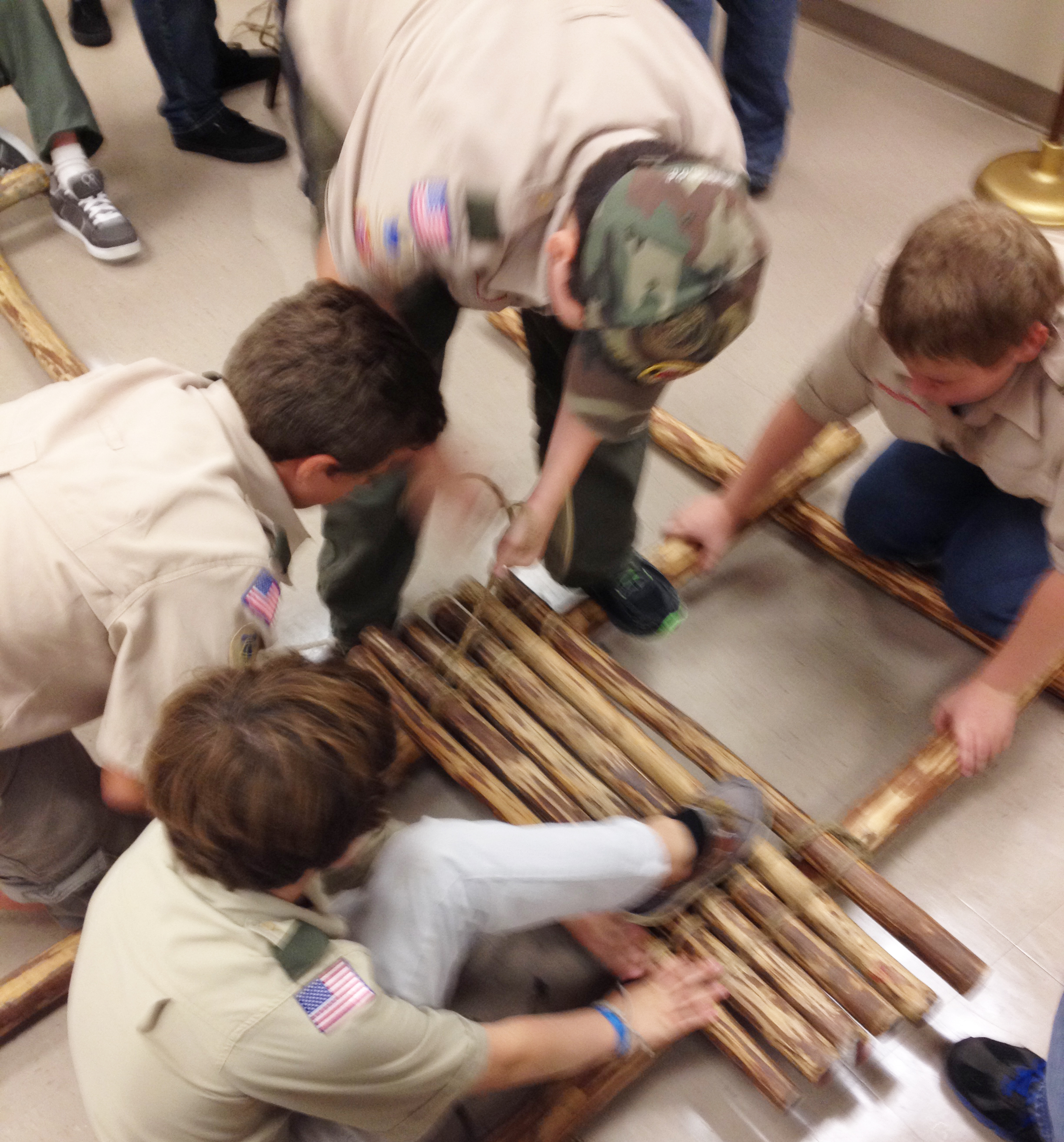
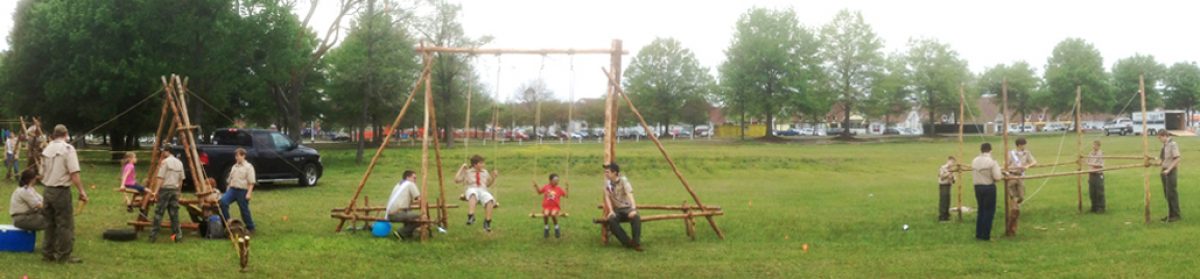
In the ever-important pursuit to pair each knotting and lashing instructional session with a fun activity that puts the newly-acquired skill into action, here’s a simple one that can be used as an entertaining culmination in conjunction with learning the Double Floor Lashing. Besides being lots of fun, the simple structure can subsequently be used to add some levity when making an entrance or forming a procession during Scout gatherings. It’s along the same lines as carrying an individual on the shoulders to express admiration. But, it’s much more “glamorous” and a whole lot more regal! Here’s all you’ll need for each patrol:

  • two 6-foot x 3-inch spars as carrying poles
  • six 3-foot x 2-foot platform spars as the seat
  • two 20-foot lashing ropes
The Floor Lashing has to be Tight!

The procedure’s just as simple as the materials. The patrol lays the two 6-foot spars parallel to one another and lashes on the 3-foot platform poles with two floor lashings using the lashing ropes. That’s it. One thing is necessary, though—the Floor Lashing has to be pulled tight after binding each individual platform spar. No square lashings are used to connect the carrying poles, just the floor lashings. Of course, to make the lift seat more secure for repeated use, the carrying poles can be connected at each end with an additional 3-foot spar and two square lashings. And if you want to really get elaborate, lash together a framework over the platform using Scout Staves, and add a lattice work of braided nylon cord. While your at it, lash on one or more flags!
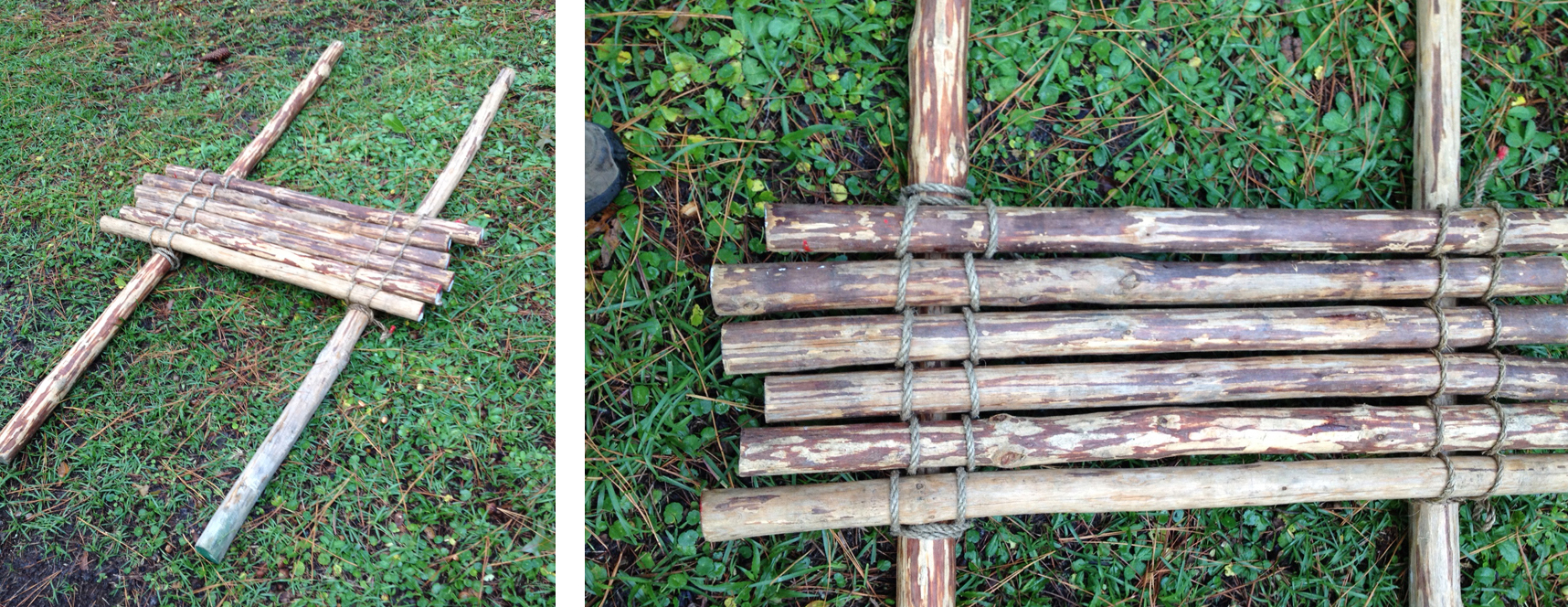
Th Most Simple Construction for a Lift Seat
The Most Simple Design for a Lift Seat

Camp Seesaw Video and Photo Montage

CAMP SEESAW INSRUCTIONS

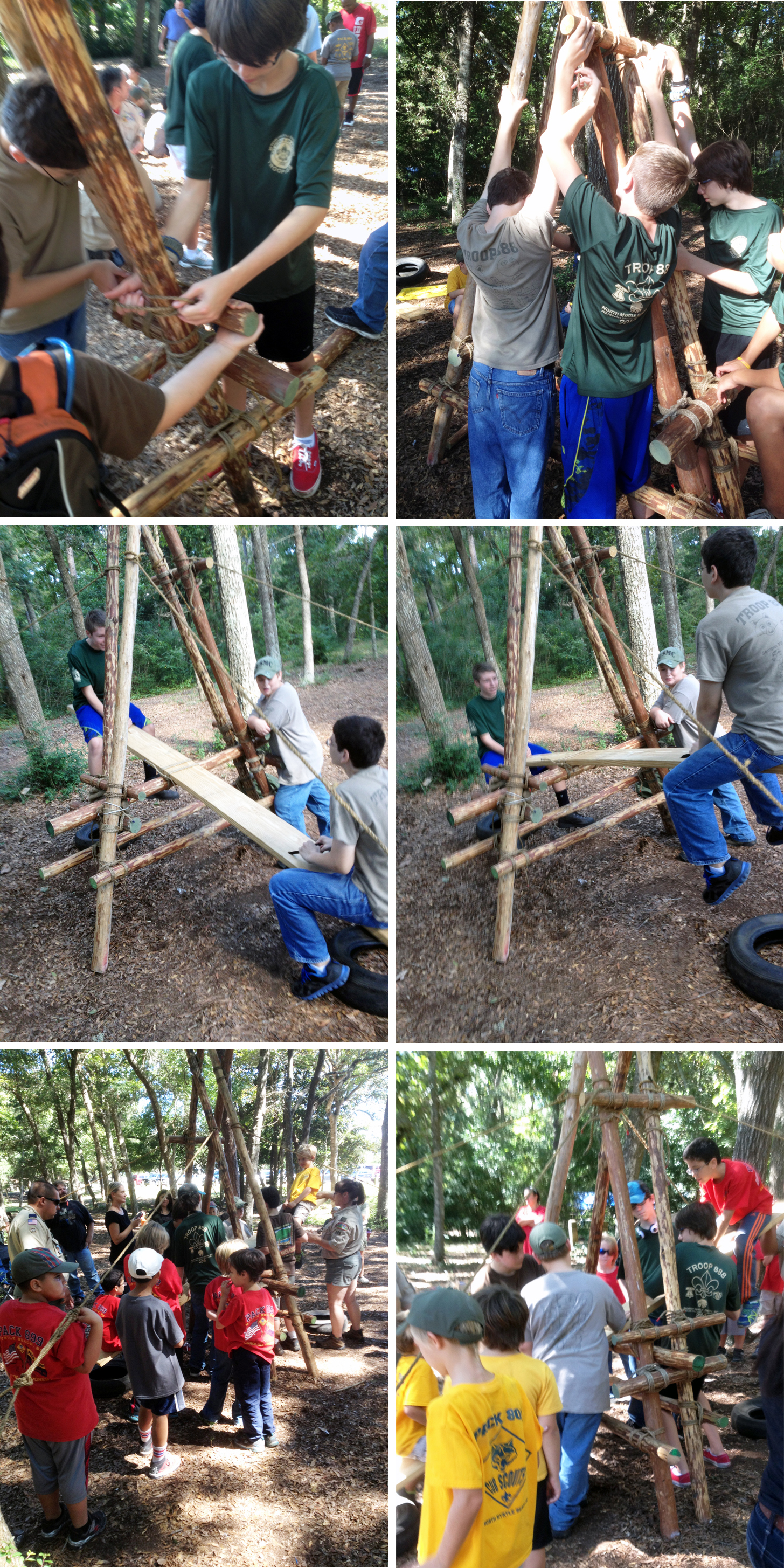
With limited space for their exhibit at the 35th annual Aynor Harvest Ho-Down, Boy Scout Troop 818 erected this seesaw.

ScoutingNews.org

Boy Scout Troop 888 builds a seesaw as an attraction at a District Webeloree.

Lots of See-Sawing at a district event for Webelos Scouts

Pioneering Curriculum IX: Using a Diagonal Lashing and Making a Trestle

This is the ninth post in a series that will eventually comprise an activity-based, unit pioneering program curriculum.

SUPPORTING VIDEO: How to Tie a Diagonal Lashing

Link to: Larger Image
Trestles are often used to support bridge walkways.

IX A. The diagonal lashing gets its name because the wraps form a diagonal where they cross the spars. It’s primary use is to spring together two spars that are not touching when the ends are lashed in place on a structure (as in a trestle).

IX B. The trestle is a basic component of many pioneering projects. When we speak of a trestle, we’re referring to what has been dubbed an H-trestle. The way it’s designed yields a very strong supporting structure that is often used as a subassembly for something larger, and frequently serves to support the walkways of a bridge.

OBJECTIVES

  • Each Scout will tie a diagonal lashing to effectively spring together the X-brace of a trestle.
  • Working individually or in small groups, Scouts will properly construct a trestle.

MATERIALS

  • two 6-foot x 2 to 3-inch spars and 15-foot lashing rope for demonstration
  • six Scout Staves for every four Scouts (six will be needed for each trestle)
  • two 6-foot x 1/4-inch manila lashing ropes for every Scout (eight will be needed for the square lashings on each trestle)
  • one 10-foot x 1/4-inch manila lashing rope for every Scout (one will be needed for the diagonal lashing on each trestle)

PROCEDURE A

Basic Four Steps to Tying a Traditional Diagonal Lashing

Using the 6-foot spars and the 15-foot lashing rope, Instructor demonstrates a diagonal lashing, then using a 10-foot lashing rope and two Scout Staves, with the aid of an instructor and following the basic four steps, Scouts will tie a diagonal lashing.

  1. Cinch the poles together by tying a timber hitch around them where they cross.
  2. Make three wrapping turns on the opposite diagonal to the timber hitch.
  3. Keep the wraps parallel to one another and pull them tight. Make three more tight wraps across the first three, again keeping them parallel.
  4. Take two frapping turns between the poles, tightly around both sets of wraps and complete the lashing with a clove hitch around one of the poles.

PROCEDURE B

With eight 6-foot lashing ropes, one 10-foot lashing rope, and working individually or in a group of up to four individuals, Scouts will follow the following procedure and build a trestle:

Trestle Formed with Scout Staves


  1. Lay out two poles parallel to one another as the trestle legs.
  2. Place a pole over the legs at the top and bottom to serve as the ledgers, and then lash them to the legs with four tight Square Lashings using the 6-foot lashing ropes.
  3. Turn the legs and ledgers over and place one pole diagonally over two of the legs as one of the X-braces.
  4. Where it intersects, join this pole to the legs with two tight square lashings.
  5. Place the last pole diagonally OVER one leg and UNDER the other leg, as the other X-brace.
  6. Where it intersects, join this pole to the legs with two tight square lashings.
  7. Stand the structure up. There should be a gap between the the two X-braces where they cross in the middle.
  8. Using the 10-foot lashing rope, spring the X-braces together with a tight diagonal lashing.
  9. The completed trestle should be sturdy enough to be lifted and shaken without losing its shape or becoming loose. After building their trestles, Scouts are ready to have a Roman Chariot Race.

INTERPATROL COMPETITON: Roman Chariot Race

PIONEERING PROJECT: Single Trestle Bridge

PIONEERING PROJECT: Single Lock Bridge

PIONEERING CURRICULUM: MAIN PAGE