What is a Pioneer?

Here are three definitions for “pioneer” and how they can be applied to modern day Scouts:

pi·o·neer  (p-nîrnoun

1. One who ventures into unknown or unclaimed territory to settle.

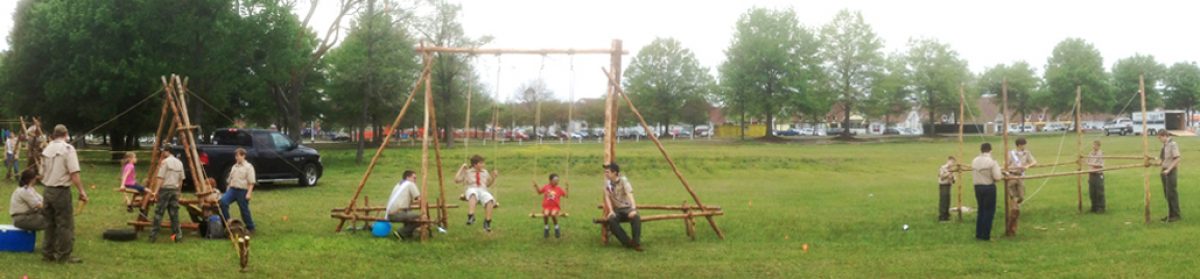
  • Equipped with their pioneering skills, Scouts camping in a rustic, wilderness setting who use these skills to “settle” into their campsites for long or short terms are like modern day versions of the old-time pioneer. In this case, “settle” can mean improving their site with forked sticks and crossbar for hanging an 8 quart pot over a cooking fire, a large or small Chippewa Kitchen, and everything in between. Those old-time pioneers who ventured into unclaimed territory were not only adventurous, they were also resourceful. In today’s Scout Pioneering, these two qualities come to life as Scouts are faced with making practical decisions while camping and backpacking. Usefulness and fun can go hand in hand.

2. One who opens up new areas of thought, research, or development: (a pioneer in aviation).

  • Once pioneering skills are learned and practiced, Scouts can devise their own gadgets, and structures and ways to build them. Commensurate with outdoor activities and camping, Scouts using their pioneering skills coupled with a good dose of ingenuity, come up with “new” and useful ideas, e.g. cutting a short piece of bamboo of the proper diameter and lashing it to an upright on the dining fly to serve as a convenient flagpole holder. From our standpoint, even if on a small scale, the Scout who recently came up with this ingenious little device is a “pioneer in camp gadgets.”

3. A soldier who performs construction in the field to facilitate troop movements.

  • Scouts can facilitate troop movement by building a bridge over a gully or stream that can conveniently and efficiently be used to get from one location to another. Scouting publications are replete with photos of Scouts putting up various types of walkway bridges across small streams and gullies. That’s real pioneering (and real fun)

Is all that a little far-fetched? Well, it’s a fact, you can apply most anything to Scout Pioneering. It’s that universal in its appeal and that broad in its scope.

Guided Discovery

The Guided Discovery Process is a fancy term for what? Guided Discovery is an approach where Scouts are asked a question which leads them to examine a situation, and then discover the best way to proceed. Put another way, Guided Discovery enables Scouts to think for themselves in order to solve problems and find solutions. This approach is Scout-based. By Scout-based it is meant the focus is on the learning and the Scout, not on the teaching and the teacher.

Asking a question is a big part of this process. Asking the right questions takes as much skill as giving the right answers. The idea is, the right kind of question is going to get the Scouts thinking. It’s this thinking that leads them through a path of discovery where they can figure out for themselves what they need to do.

When Scouts are faced with a challenge or have a problem, it is natural they will frequently have their own questions. But, with Guided Discovery, we, don’t just spoon feed them the answer. Instead, in order to guide them through this path of discovery, we present them with a counter question—a question which requires them to find their best answer by applying what they know, using their resources, and coming to their own valuable conclusion. And why is their conclusion so valuable? It’s because whatever a Scout learns through a process of discovery is there’s. It’s something they’ve arrived at through their own efforts. So, they own it.

Guided discovery as a process. There’s a lot that youth leaders have to go through before they can take the reins and run the troop. All through their ranks and as they mature, Scouts are gaining knowledge. Not just facts, but skills and techniques
too. Let’s talk about a brand new troop where we want to enable the newly elected SPL to run things. With the Guided Discovery Process, the first thing they need is a vision. They can be given a picture of a troop that’s involved with an exciting program that reflects what they want. They’re learning, they’re advancing, and they’re having a lot of fun. Also, everything’s planned and carried out by them. In this vision, the only time the Scoutmaster is in front of the troop is for a minute at the end of the meeting. The rest of the time, it’s all up to them.

Now once the Scout is given a vision like this, the second thing they need is the strong desire to make it happen—they’re motivated to be an effective Senior Patrol Leader.

The third necessary thing any youth leader needs is the prerequisite tools to carry out their job. And here, it is the Scoutmaster’s responsibility to make sure they learn, or at least have access to, all these necessary tools. For example, the new SPL needs to know that putting up the Scout sign is a means to getting the troop’s attention. This is a basic tool. Now, discovering how to use this tool most effectively is something else. This is a technique, and techniques can be gained… through Guided Discovery.

Back to the Scout sign. Maybe the SPL had a terrible time at a meeting to get the troop quiet when they held up the sign. After the meeting, the Scoutmaster might ask, “So, how do you think things went tonight? Were you able to control the troop the way you’d like?” And the SPL might answer, “The troop doesn’t ever really get quiet when the sign goes up.” The Scoutmaster might then ask a guiding question like, “Well, when you hold up the sign, what do you think the Scouts see?” Now, after mulling this over, if the SPL just scratches their head, the Scoutmaster might ask, “What do you want them to see?” That question should serve to further guide them and get their wheels turning. Through this process, they can start zooming in and find their own answer. If they picture the troop as they’re holding up the sign, they might remember how even some of their own leaders were still carrying on. Ah-ha! There’s a key! They’ve got to make it clear to their leaders that as soon as they put up the sign, they need to quickly get quiet and put up their’s. This way, the rest of the troop is going to have a good example to follow. What’s important here is that this SPL comes to the conclusion on their own. They are guided to find a solution, but it’s actually their discovery. See how this is different than just telling them that the Patrol Leaders Council leads by example!?

So, through guided discovery, a youth leader can find the solution to their problem and gain needed techniques. Learning these techniques by discovering them is a way they can make these techniques their own. When they find a solution to their own problem, through their own efforts, they own that solution!

So, now as they gain techniques, they can use them to do a good job. This is good because doing a good job gives them confidence. With confidence, a motivated youth leader can start using their own initiative to make everything better. Youth leaders using initiative is amazing. When this happens, it’s awesome! 

THIS IS THE PROCESS:  A vision / a desire / the tools and the techniques to use them / gaining confidence / using initiative.

How does a Scoutmaster shift the attention off themself as the leader to the Senior Patrol Leader? When a Scoutmaster is approached by the SPL with a question or problem, with guided discovery, they won’t just dole out hard and fast answers. Instead, again, they ask a counter question. “This is your troop. What do you think needs to be done?” If it’s not a matter of health and safety, then reflecting the situation back onto the SPL with a question, is shifting the attention off of themself. As for the rest of the troop, have you ever seen T-shirts for the adults with the back saying, “Ask the Senior Patrol Leader?” There’s even a little, round, patrol medallion sized patch for a Scouter’s right sleeve saying, “ask the SPL.”

How does the Scoutmaster instill their knowledge to the Senior Patrol Leader? First, by inspiring them with a shared vision, and of course encouraging them whenever appropriate. Then, by providing them with all the necessary resources so they can do things independently. Along the way, the Scoutmaster serves as a mentor, but a Scoutmaster really needs to lead by following one step behind. That means, they know where the SPL and the troop are heading and what they need, but from there, they enable them to discover things on their own.

Youth leaders should always have a Plan B. Plan-B-Prepared. A perfect example of a Guided Discovery question that will get a Scout thinking is: “What if?” Asking Scouts questions beginning with “what if” is a good way to ensure they have their bases covered. It gets them thinking about alternatives and also utilizing their troop’s resources.

Some other examples of the Guided Discovery Process. Here’s a couple more guided discovery scenarios: Two Scouts carry a third through a 4-foot wide track as part of a Disabled Person Obstacle Course activity. The two Scouts really struggle to carry the third because they hadn’t learned the “two handed carry” or the “four-handed seat.” Now, after their struggle, it could just be explained to them how to do these carries. But, it would be better to ask them, “How would you like to find out how to carry an injured person a whole lot easier, even if they’re heavier?” and then guide them: “Where can you see how to do this in your own handbooks?” They’re most likely gonna want to check this out, because after what they just went through, they’re definitely ready to learn something better than what they did. But the emphasis is on them to discover it themselves. When we pour ourselves into finding our own solutions, we become invested in the process. When someone makes an investment, they’re much more likely to feel involved. For example, a person is much more likely to read a book if they buy it, as opposed to someone just giving it to them.

Another scenario is about using woods tools to prepare tinder and kindling and then build and light a fire. As Scout leaders, before a Scout tries anything where safety enters the picture, we must make sure they have the necessary tools. In this case, the prerequisite tools are knowing how to safely use woods-tools, and knowing how to be careful with fire. So, here’s a Scout who we observe knows how to properly use a knife and axe, and they’ve prepared tinder and kindling to start and feed a cooking fire. They’ve got everything they need, a safe area, a proper surface, a fire bucket nearby, but, before they try to light a fire, they put their tinder and kindling into the fire pit, all mixed together, and then, try as they will, each time they put a match to this mess, it goes out. They find they can’t light a fire. They recognize they’ve come face to face with a stumbling block, and they’re definitely ready to learn what needs to be done next. But, using guided discovery means we don’t just show them how to do it, and we don’t hover over them providing guidance every step of the way either. They need to get actively involved with learning how to do this, themself. Remember, with this approach, it’s all about the learning, not the teaching. Guided Discovery happens when we ask questions. Here, we might ask something like, “Why do you think this fire won’t stay lit?” Let them think about this. A follow up question might be, “Looking at all your tinder and kindling here, what will burn the easiest when you touch a match to it?” The Scout will naturally answer the light weight stuff—the tinder. Now, after getting them thinking about what needs to be done, they should be given the opportunity to explain what they’re going to do, and if their explanation is good, then let them do it.

Are there any resources available to assist Scoutmasters and Advisors on how to facilitate leadership? Beyond Scoutmaster Position Specific Training, Woodbadge goes more deeply into communication and leadership. But additionally, when it comes to assuring youth leaders are successful, IntroductIon to Leadership Skills for Troops serves as an invaluable resource. Another good resource is Scout leaders who themselves have well run, successful troops. Most any Scoutmaster or Assistant Scoutmaster, who is passionate about what they do, loves to talk about their troop, especially when it comes to talking about what their Scouts do to run things well.

Additional Information. The three basic roles of the Scoutmaster:  

  1. Make sure the rules of the BSA and chartered partner are followed, 
  2. The Scoutmaster should be a good mentor and positive role model.
  3. The Scoutmaster trains and guides Scout leaders. 

—> The Guided Discovery Process does this, by asking the right kinds of questions, and then getting out of the way.

—> Guided discovery provides the framework within which, Scouts can lead themselves to realize a vision they have.

—> Provide the Scouts the objective, equip them with the tools and the skills or the resources to learn how to use them, and turn them loose.

—> Scouts will learn to lead by practicing leadingand experiencing the results of their hands-on leadership efforts.

—> “Why” and “How” questions enhance the Scouts’ ability to make decisions, which is one of the central goals of empowerment.

—> When Scouts run their own troop, they’ve been empowered to do this. A troop run by motivated Scouts who have the right skills, and techniques, is bound to have good membership, the highest retention rate, and the most fun! 
THE IMPORTANCE OF OUTDOOR SKILLS IN SCOUTING — Putting Outdoor Skills Into Action

CLICK HERE FOR COMPLETE ARTICLE

Scouts are required to demonstrate a variety of basic outdoor skills as part of their advancement through the early ranks. How does putting these skills into action, during troop meetings and outings, contribute to a richer and more rewarding Scouting program?

I. WHAT ARE SOME WORTHWHILE EXPERIENCES THAT ARE OUTGROWTHS OF PUTTING OUTDOOR SKILLS INTO ACTION?

Planning a Course of Action – In order to experience success, before they put their skills into action, Scouts need to get their act together. Planning is an essential step, so they can be prepared to accomplish whatever they are setting out to do.

Cooperating with One Another and Practicing Teamwork – This is how things most effectively get done, and this is how a group succeeds. When small groups of Scouts are faced with challenges to use their acquired outdoor skills, everyone has an opportunity to get into the act and contribute to the group’s success.

Becoming Engaged, Focused, and Involved– The attention of the Scouts is maintained, when they get to use what they’ve learned to complete a task that is challenging and fun.

Pride in Satisfying an Objective and Meeting a Challenge – Because they can use their resources, and rely upon their skills to satisfy the challenges they face, Scouts get to feel good about themselves and their abilities.

Being Successful – Nothing succeeds like success. Of course, failures are acceptable and Scouts can learn from their oversights and mistakes. But, when they are enabled to put the skills they’ve learned into action, and apply the principles of sharing leadership, sharing responsibilities, and working together, success is within their reach.


II. WHAT IMPORTANT ROLES DO TRADITIONAL OUTDOOR SKILLS PLAY IN TODAY’S SCOUTING PROGRAM?

To Attract Youth to Our Program – The lure of learning and using these kinds of outdoor skills appeals to many young people.

To Enhance the Enjoyment of Camping – These kinds of outdoor skills can continually come into play, in conjunction with our wide range of available outdoor adventures. 

To Contribute a Unique Brand of Fun to Our Program – The NOVEL activities that feature these kinds of outdoor skills are eminently satisfying.

To Provide our Members with a Useful Set of Tools that can be Utilized Over their Lifetimes – There can be opportunities to use these skills repeatedly, during work and recreation.

To Open the Door to the Development of Character and Leadership – Putting outdoor skills into action with their patrol and troop contributes to a Scout’s development of good character and leadership—two central aims of the Boy Scouts of America.


III. WHAT ARE SOME OTHER VALUABLE INTANGIBLES  INHERENT IN PUTTING OUTDOOR SKILLS INTO ACTION?

RESPONSIBILITY – By using their outdoor skills to contribute to the welfare of the group, Scouts learn the essential meaning of good citizenship. Sharing responsibilities is the hallmark of the patrol method.

RESOURCEFULNESS – Faced with the necessity of using whatever resources are on hand, by relying on their outdoor skills Scouts learn what it means to become resourceful.

ORGANIZATION – Organizational skills are honed as Scouts are confronted with the need to keep things accessible and neat as they use their skills to most successfully meet challenges.

SELF RELIANCE – Using their skills, Scouts learn they can rely upon themselves to overcome obstacles.

SELF ASSURANCE – By putting their skills into action, Scouts experience a growing assurance they can get things done.


NOTE: After a skill is presented using the EDGE Method, Scouts should ideally participate in a well-planned and well-presented CHALLENGE THAT IS FUN and:

—> reinforces the skill

—> illustrates how the skill is used

—> provides an opportunity to rely upon the skill to complete the task at hand.

A Library of Scout Skill Challenges

Comprehensive Programming

Banner

Not too long ago, a small, new troop made up of first year Scouts was given permission to meet on some privately owned land that afforded a variety of neat ways to learn and have fun. Up a hill in the central area there was a covered pavilion with picnic tables and a pit for building a cooking fire. Below, there was an extensive grassy area for troop wide games. On the edge of this field was a forest with a dried out stream bed forming a rough, narrow path to the Intracoastal Waterway. The distance between the field and the shore of the Waterway translated into a good, little hike through the forest—not overly challenging, but not too easy, either. It was arranged for the troop to get together on this land for a few hours on a Saturday, for a short, mid afternoon / early evening outing. 

After they arrived, everybody assembled under the pavilion, and the young senior patrol leader revealed what was in store. As each of the following activities unfolded, one by one, each would combine with the others forming an overall, memorable, outdoor experience.

Here’s how the outing went. First was a hike. Single file, accompanied by two assistant Scoutmasters, the Scouts made their way through the forest along the rugged trail to the Waterway. When they reached the end, they dug up some smooth, grey clay from deposits that were prevalent along the shore. As they dug, they put what they excavated into some plastic garbage bags. When they had a good amount, it was time for a return hike back to the pavilion.

Once back at camp, the bags containing the clay were placed on a picnic table, and each member of the small troop went about gathering some fire wood. A good-sized fire was lit, and while the wood burnt down to hot coals, everyone got a portion of clay. In order to illustrate what each Scout would be modeling, an assistant Scoutmaster fashioned a sample pinch pot. With eager smiles, each young Scout set out forming their own small pot. After ten minutes or so, they placed their pots along the edges of the pit near the fire, which by this time had burnt down considerably and was already yielding a sizable heap of hardwood coals. After another five minutes, each Scout took a turn placing their little pot carefully into the hot coals to start baking. 

Eventually, all the pots were nestled deep inside the fire pit, buried in the glowing coals. As the pots started to to bake, the Scouts went down the hill into the field and played Flying Disc Soccer. The Scoutmaster and his assistants stayed under the pavilion and monitored the fire. A half an hour passed and the Scouts returned. The senior patrol leader had instructed them to each find a suitable hot dog stick which were acquired from nearby bushes.

A new layer of kindling was placed over the coals. All the while, the pots remained hidden, buried deep in the coals, completely out of sight. Cans of beans were opened. With the tops still attached and bent up to serve as a holder, they were positioned around the fire to get hot. Throughout all this, the Scouts were busy, happily whittling the tips of their sticks so each could serve as a skewer to stick through a hotdog from end to end. Soon the fire started to flame and the troop members proceeded to surround the pit with their hotdogs. As the hotdogs roasted over the flames, some Scouts were assigned to carefully stir the beans. Soon everyone was sitting around the table, eating hotdogs and beans, chatting and telling jokes. Silently, the invisible pots continued to bake.

Eating done, everyone deposited used paper plates, cups, and plastic spoons into a trash bag to be carried out. The fire had pretty much completely died down, and the moment had arrived to uncover the pots. Attention turned to the fire pit as the senior patrol leader, using a pair of tongs, began to fish around the ashes. Each time the tongs touched something hard, a little, ashen pot was gently lifted out and placed on the table, accompanied by voices in hushed tones commenting, “that one’s mine.” Indeed they all were recognizable, each with its own distinct shape and character—each small prize cooling in a row on the picnic table.

A couple of Scouts were assigned to sprinkle water over the ashes in the pit, stirring them until the fire was cold out. The pavilion was policed to assure nothing was left behind, and belongings were all gathered up including the precious, fire-hardened pots.

—> This is Comprehensive Programming! The afternoon consisted of a series of experiences, all woven together into an attractive tapestry of well-paced discovery and fun. Scouting is filled with numerous opportunities to present an array of memorable experiences that expose Scouts to new circumstances and broaden their horizons. There are a wealth of camping areas and Scout­ing des­ti­na­tions, each providing a wide scope of pro­gram pos­si­bil­i­ties. But, in between sum­mer camps, themed camp­grounds, and high adven­ture bases, in order to assure the week-to-week Scouting pro­gram is unforgettably fun, any additional expen­di­ture of time and energy devoted to planning and preparation is well worth the extra effort.

Adding the Objective to Ring the Bell to an already Entertaining Ladder Building Activity

Sample Gathering Period with Enhancements

It was dark outside. Scouts were divided into groups of four, given a flashlight, two sheets of paper containing letters a through z, numbers 0 through 9, and the corresponding morse code dots and dashes for each letter and numeral, a pencil, a paper with a series of dots and dashes forming a unique message, and a compass. Each foursome was then directed to split into pairs, one to use the flashlight to send the message, and the other, from a distance away, to receive the message, write it down, and decipher the code.

When the message was thus received and decoded, it revealed a degree bearing along with a number of paces to take. It might read something like: “Follow a bearing of 60 degrees for 20 paces.” The pairs would then join together and using the compass, face the bearing and pace off the prescribed distance. When they did this accurately, to their delight they happened upon a bag containing eight pieces of candy.

Just sending and receiving the message would make an effective preopening gathering period. It would be involving, challenging, and along with an entertaining message, could in and of itself be fun. What made this kind of activity an example of comprehensive programming was the extra twist supplied by having the message serve as a directive, which provided an added challenge, and culminated with an unexpected reward. The use of the compass and the action of pacing a distance added an additional layer of impact, and the bag of candy enjoyably served as icing on the cake.

Sample Scout Meeting Activity with Fringe Benefits

A workable activity to reinforce a patrol’s ability to set up a dishwashing assembly line can be featured during a troop meeting, especially if the patrol(s) aren’t familiar with the procedure, or maybe could just use some practice. For a typical front-country camping trip, the materials for this operation can consist of a receptacle, like a small trash bag, in which food scraps and goop can be deposited, a goop scraper, a 4-quart pot containing warm water with a little soap, a dish washing brush,  two 8-quart pots containing hot water, one for rinsing, and one with a sanitizing agent, hot pot tongs, and a plastic sheet. Also, there really should be something to wash, like a plastic bowl for each patrol member.

The patrol(s) can simply demonstrate their familiarity with this form of dishwashing, by racing to properly set out the materials, wash the bowls and then place each on the plastic sheet to dry. As a competition, this actually could even be fun. But, with the addition of an imaginative routine that assures the bowls will require washing, this mundane activity can be transformed into a uniquely comprehensive and entertaining experience. The following additional materials will be needed: a blindfold and spoon for each patrol member, and some ice cream.

First thing, Scouts buddy up. A bowl containing a scoop of ice cream is given to each pair, along with a blindfold and spoon. Scouts are instructed to lie down on the floor facing one another, to place the bowl of ice cream between themselves, to apply the blindfold, and then to take turns feeding each other using their spoons. This, of course serves as both a comical prelude to setting up the dishwashing assembly line, which no longer is a race, but has become an incidental byproduct of participating in an unexpected and delicious undertaking.

A Second Class Five Mile Hike made a Whole Lot More Fun

The troop’s traditional five mile map and compass hike was mostly along a country road, past large tracts of farmland. The midway point could be gauged at a crossroads with a mom and pop convenience store on one corner where the Scouts will make a pit stop. Further on, a large church signals the 3/4 mark where Scouts take a right turn heading west. Then, turning onto a dirt road leads the hikers to a wooded area which is the five mile mark where they will eventually be driven back to the starting point.

By putting some extra features to the map, making plans that add a little unexpected fun, and having the Scouts bring along something they can heat up for lunch, the hike can be transformed into a really fun outdoor experience.

  1. Before the hike, unbeknown to the Scouts, it is arranged with the manager of the convenience store to have an ice chest set out full of bottles of Gatoraid for the Scout hikers. It’s further arranged, when the Scouts reach the store, the manager will excitedly greet them while directing them to their cooler with the “free” drinks.
  2. Past the convenience store there’s a large field surrounded by a chain link fence. It’s always at this location, when anyone passes along the road, three large dogs come charging out at the any and all passerby’s with a barrage of ferocious barking. This location is marked on the Scouts’ maps with the drawing of a dog. This way, when they approach the large field, they can see how the map reveals exactly where they are with an entertaining heads up.
  3. The wooded area is quite vast and the troop has permission from the property owner to camp there. So, instead of just reaching their destination and then getting carried back to the starting point, the Scouts get to gather tinder and kindling and properly fashion small cooking fires to heat up their lunch. This becomes the highlight of the hike since they love to make fires and they love to eat what they “cook” outdoors.

With a little forethought, planning, and execution, the troop has turned a simple hike into a memorable, outdoor experience.

FUN Troop Meetings and Outings! Facebook Group

Facebook Group Mission Statement

We are always provided with golden opportunities to gear up for memorable experiences in the present, and in an expansive and bright Scouting future. 

By sourcing specific BSA resources and shared Scout leader experiences, all of which have a proven track record for success, this group is designed to serve as a repository for great ideas resulting in really fun meetings and outings with positive outcomes. 

The group’s aim is to compile a categorized resource library of useful activities, program approaches, and techniques that can be drawn upon by youth and adult Scout leaders to spark inspiration and aid in delivering the promise of Scouting throughout our movement in the years to come.

Click HERE to join the Facebook Group:

Durable Atomic Pile

Suggested Materials

  • 4    10′ x 3″ spars for corner uprights
  • 4    12′ x 2″ spars for lateral supports
  • 12  6″-diameter wooden discs, four of them painted with the numeral “5,” four with “10,” and four with “20”
  • 1    6″-diameter log, 20″ long with a large eye hook on one end and a flat, even surface on the other
  • 4    single pulleys
  • 4    40′ lengths of 1/4″ braided nylon cord for the pulleys
  • 4    3′ lengths of 1/8″ nylon cord to attach pulleys to the corner uprights
  • 8    15′ x 1/4″ manila lashing ropes for lashing the lateral support spars to the corner uprights

Set the parameters. Lay the four lateral spars on the ground in a square where you want to position the Atomic Pile. Overlap the ends about 4″ so there will be room to lash them to the corner uprights. Drive a small stake into the ground on the inside of where the ends intersect. This is where the holes for the corner spars need to be dug.

Prepare the corner spars. Using a post hole digger, dig the holes about two feet into the ground at the spots marked by the four small stakes. Make sure the holes are the same depth so the tips of the spars come up to the same height. Before actually placing the corner uprights into their holes, attach the pulley to each with the 40′ cord reeved through. Tie the inside end of each cord to eye hook of the log using a Roundturn With Two Half Hitches.

Attach the “boundary poles.” After placing each upright into its hole, with the pulleys facing the center of the square, and firmly tamping them in for solid support, tightly lash on the four lateral support spars about belly high.

ATOMIC PILE INFORMATION

SCOUT MEETING VERSION WITH MORE INFORMATION

Sequential Programming

A sequential approach to program planning is one where gaining specific skills, and then putting them into action, pave the way towards a larger experience that is memorable and rewarding. This larger experience is ordinarily featured during a “main event” like an outing or special trip.

During the meetings leading up to the special event, the skills and their related activities are presented in a stepwise progression and can be likened to building blocks. The ultimate goal of this sequential approach is to use these building blocks to enable the Scouts to enjoy and appreciate the larger experience. This larger experience is a culmination of the preceding meetings with their periods of skills instruction and activities. In order to contribute an optimum level of fun to the meetings, the activities connected to each building block should not only reinforce the skills, but also be challenging and fun!

Here’s an illustration: For the initial meeting in this sequence, the square lashing is presented during a period of skills instruction. Following this, the Scout skill challenge is a Ladder Building activity. For the next meeting  during a period of skills instruction, the tripod lashing is presented. The Scout skill challenge following this is Everyone on the Tripod, which incorporates both the tripod and square lashings. The third meeting in this sequence includes a period of skills instruction for the floor lashing. To put this skill into action in a fun way illustrating how it can be used, troop leaders orchestrate a Lift Seat Procession. The troop now has all the skills required to construct  a Double Tripod Chippewa Kitchen, the building of which can be scheduled for the coming outing. For a fourth meeting, leading up to the outing, during a period of group instruction, the Chippewa Kitchen video can be projected, and during patrol meetings, various recipes can be reviewed. During their outing, the Scouts will necessarily have to rely upon the skills they learned to construct their Chippewa Kitchen, and then enjoy what they built as they cook up and devour their outdoor feasts.

To recap the sequential approach to programming: after presenting information, a skill, or a technique, (building blocks), whatever’s been presented will be brought to life in a fun and/or challenging way. Eventually, each building block will be combined with others, contributing to that larger experience that is especially memorable and rewarding.

Unlike most programs, where it seems students often learn something just to get tested on it, Scouting can provide opportunities to learn something and then have fun with it. What’s even better, is when what’s learned is combined with other learnings, to experience something bigger—something outstanding. This kind of sequential programming approach is an effective way to deliver the promise of Scouting!

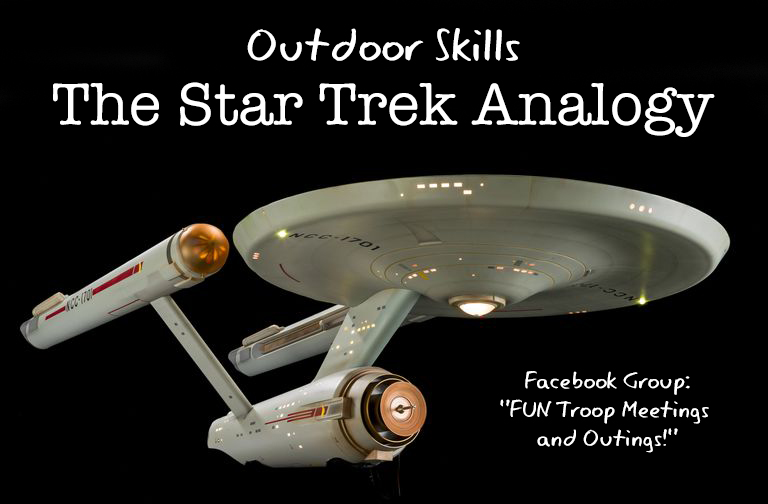
Scouting is Both: Star Trek Analogy


As the Story Goes: Members of the Enterprise’s fact-finding contingent consisting of Mr. Spock, Dr. McCoy, Lt. Sulu, and two members of security beamed down into what appeared to be a remote, forested area of a faraway planet in a newly charted solar system. The first thing they noticed was how frigid it was on the planet’s surface. Already starting to shiver, a security guard proceeded to zap a large rock with his phaser. This, of course would heat the rock to the point it would emit a stream of warming rays that would effectively counteract the cold. Unfortunately, the phaser seemed to be inoperable, as was that of the other security guard’s. To their dismay, for some inexplicable reason, none of their high tech equipment seemed to work on this planet—not their phasers, their tricorders, not even their communicators. What were they to do. How could they avoid freezing to death?

“Mr. Spock!” McCoy exclaimed with alarm in his voice, “What can we do?”

Spock looked around, and then thoughtfully replied, “You might remember, Doctor, at Star Fleet Academy, we were taught how to make something called fire by friction. Well it certainly appears that we’re in a forest that possesses a wealth of likely tools and materials to make, as I recall, what is referred to as a bow and drill.”

The members of the fact-finding contingent proceeded to very quickly gather up all they’d need, fashion a bow and drill, and use it to produce an ember and start a fire. And, because in addition to learning how to operate the latest, high tech devices, they were also taught how to use primitive, outdoor skills, these shivering space travelers were able to get warm, even on a freezing planet without their futuristic gadgets.

Scouting features a wide array of challenges, activities, and avenues of discovery. In such a multifaceted program there are opportunities to learn about subjects as diverse as on one hand: rocketry and robotics and on the other hand: wilderness survival and pioneering. Scouting is both the new and the old, the modern and the traditional, the innovative and the timeless!

Bow and Drill Campcraft How-To Video

Scouting is Both

Scouting’s Traditional Outdoor Skills

Raft Race at Summer Camp

The camp staff placed a supply of materials in an open area by the lake assigned as the designated raft building place. Groups of Scouts could use any of the materials there to create whatever kind of raft they chose. On hand were lengths of precut bamboo, plastic 55 gallon drums, and lengths of old manila rope. There was no set raft building schedule, so Scouts could devote as much of their free time as they wanted. The only definition regarding time factor was that of the race itself, scheduled for Friday at 3:00 p.m.

This raft building venture revealed a consideration that was not so obvious for many who participated, either in an advisory capacity or as a builder — a little something called “center off gravity”. As soon as many of the rafts were launched, this not so obvious consideration quickly reared its head, to the shock and surprise of the riders and to the delight of many observers. As soon as the race began, some of the rafts that looked like they’d do just fine performed a 180º flip over. By lashing on their drums directly under the bamboo, without taking into consideration the need to provide some form of counter balance, many of the Scouts had created a center of gravity that was too high, and this resulted in an unexpected and immediate dunking. All in all, it was a great race! And, after the race, I happened to overhear a wet group of Scouts remark, “That was fun. We gotta do that again!” Experience is the best teacher.