
CLICK HERE FOR SINGLE TRESTLE BRIDGE PROCEDURE, MATERIALS, AND INFORMATION.


CLICK HERE FOR SINGLE TRESTLE BRIDGE PROCEDURE, MATERIALS, AND INFORMATION.
CLICK HERE FOR SINGLE TRESTLE BRIDGE PROCEDURE, MATERIALS, AND INFORMATION.
CLICK HERE FOR SINGLE TRESTLE BRIDGE PROCEDURE, MATERIALS, AND INFORMATION.

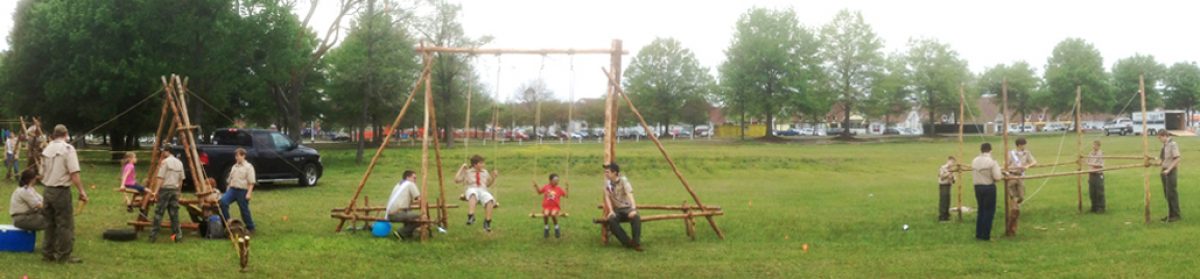
This fundamental trestle bridge design yields a solid structure. With Adolph Peschke’s text as the main point of reference, under the following photos there are some guidelines that will help in its successful construction:


Pioneering Bridges and the Saga of the Bridge of Fifteen Nations
 The following text is by Adolph E. Peschke as presented in the 1998 printing of the 1993 edition of the Pioneering Merit Badge Pamphlet:
Bridges are very popular pioneering projects. Essentially, a bridge consists of one or more trestles that support some sort of walkway. In the case of a monkey bridge, the walkway is just a rope that you walk on. But for many other bridges, you can build a walkway from spars that’s easier to walk on than is a monkey bridge.
In the Single Trestle Bridge, the Single Lock Bridge, and the A-Frame Bridge, the same type of walkway can be used. Each walkway can be 10 feet long and consists of two lateral spars and several cross spars. A 10-foot length of 2-inch x 10-inch construction lumber can be added as the plank to walk on.

MAKING A WALKWAY
To make a 10 foot section of walkway, select two spars with a butt diameter of 3-1/2 inches. These spars should be matched in the amount of sag they have when you stand on them with the ends supported above the ground. If one spar sags more than the other, it will make the walkway slant from side to side, making it hard to walk on.
Cross spars. The cross spars for the walkway should be approximately 2 to 2-1/2 inches in diameter and 3 feet long. You will need two additional cross spars that are 3-1/2 feet long for each walkway section. (The longer spars go at each end of the walkway.)
All of the cross spars are lashed to the lateral spars with 1/4-inch manila. Since the lashing is made only to hold the cross spars in position and not support weight, you can use a double strand of binder twine.
If you use binder twine, double it over and twist it a few times before you start the lashing. Make sure you have enough to complete the full lashing with the doubled-over binder twine. Don’t finish the lashing with only one strand if you run short. Instead, tie on more binder twine to complete the lashing.

Each of the cross spars is lashed to the lateral spars with a square lashing, making three wraps and two fraps. The Japanese Mark II is the easiest and quickest to tie.
There are two ways to approach lashing on the cross spars. If you are going to add a plank over the top of the cross spars, you will need a total of eight cross spars for each walkway. That is, six 3-foot cross spars, and two 3-1/2-foot cross spars (see Drawing 1).

Start by lashing one of the 3-1/2-foot cross spars about 6 inches from the butt end of the lateral spars. Place this spar on top of the lateral spars so that the ends of the cross spar extend 3 to 4 inches out over both sides of the lateral spars. This additional length hanging out is used to lash the cross spar to the stakes, which anchors the ends of the walkway in place.
After the first cross spar is lashed in place, add six more 3-foot cross spars every 16 to 18 inches down the length of the lateral spars. The last cross spar should be lashed about 12 inches from the ends of the lateral spars to allow room for the “underspar.”
Underspar. An important feature of this type of walkway is to lash one 3-1/2-foot cross spar to the underside of the lateral spars 6 inches from the end. When the two walkway sections are placed on the trestle(s) to form the bridge, these underspars should contact the transom of the trestle(s). Then the three spars [two underspars on the two walkways and the transom spar of the trestle(s)] are lashed together at three points using a strop lashing (see Drawing 3).

Walkway plank. Before lashing the walkway to the trestle, the walkway plank should be lashed in at least three places using a strop lashing.
To make a strop lashing, use a length of doubled-over binder twine. Reach down and wrap the middle of this length of binder twine under one of the cross spars (see Drawing 2). Then wrap the binder twine over the walkway plank and down under the cross spar at the other side of the plank. Do this two or three times and finish with a square Knot.
If you are going to walk directly on the cross spars (with no plank on top), you will need enough cross spars to make a safe walkway, one that your foot cannot slip through. Start making the walkway as described before by lashing a 3-1/2-foot cross spar at the butt end of the lateral spars. Then lash the 3-foot cross spars about 3-inch apart, using as many cross spars as necessary to go the entire length of the walkway, ending about 1′ from the other end. Finally, add the 3-1/2-foot long underspar.

Anchoring the walkway. After the walkway is assembled, the butt ends are placed on the bank of the creek or ravine. This end is anchored in place by driving stakes in the outside corners formed by the lateral spars and the first (3-1/2′) cross spar. Lash this cross spar of the walkway to the stakes with a strop lashing.
The small ends of the walkway are attached to the trestle to form the bridge. On most bridges, walkways come from both directions to meet at the trestle(s). The ends of the walkways rest on a transom spar of the trestle(s). Then the two underspars of the walkways are lashed to the transom spar at three points with a strop lashing (see Drawing 2).

When the walkways are lashed to the stakes and to the trestle(s), all the walkway sections become joined to form a single unit that is very strong.
If you put together a pioneering kit, take some time to save the matched lateral spars to be used for walkways only.
While the above text describes how to make 10-foot walkways, you can make 8 or 12-foot sections the same way. If you use the longer walkways, be sure to test the strength of the spars before lashing them into a walkway that could be unsafe.

One never knows when this specialized hitch might be needed. The barrel hitch can come in handy for hoisting up or suspending a bucket or other container that has no attached bail or handle. Forming the hitch is a very easy operation stemming from the tying of a simple overhand knot.
 The following text is by Adolph E. Peschke as presented in the 1998 printing of the 1993 edition of the Pioneering Merit Badge Pamphlet:
A barrel presents an awkward shape when you’re trying to tie a rope to it to lift it. If the barrel is turned on its side (horizontally), a rope grommet can be made into a sling and slipped over a hook to hoist the barrel.
If the barrel has to be lifted while remaining upright, the barrel hitch is a special knot that does the job with ease. Most books show only one loop around the center of the barrel, but a second loop will help stabilize the barrel in the upright position.

First of all, the square knot (Reef Knot) is primarily a binding knot. That is, it’s used to secure a rope or line around an object. In Pioneering, its most basic function is to commonly finish off a strop lashing, Mark II Square Lashing, Filipino Diagonal Lashing, West Country Round Lashing, and both the West Country and Sailmaker’s Whipping.
A square knot is formed by tying a left-handed half knot and then a right-handed half knot, or vice versa, and is regularly taught and learned by passing on the familiar, “right-over-left, left-over-right,” or “over-under, under-over.” However, frequently in the midst of tying the knot, it can be easy to forget what was done or how it began, e.g. right over left, or left over right, and which end was used. Therefore, here’s the sure-fire way to ALWAYS tie it right, every time! Simply tie a half knot, then tie another, BUT, keep the ends on the side they’re already on! In other words, don’t cross them over. Stay on the same side! One running end is nearer to you (in front) and the other is farther away (behind). Keep them there as you begin to tie the second half knot. Simple! In the illustration, red and blue ropes have been used and are referred to for clarity sake.

The beauty of this simplistic, little approach is you can see how to tie that second half knot without knowing (or remembering) how the first one was tied.
 SCOUT PIONEERING