
For information, contact: Albert Crowsky, 847-809-4593


For information, contact: Albert Crowsky, 847-809-4593

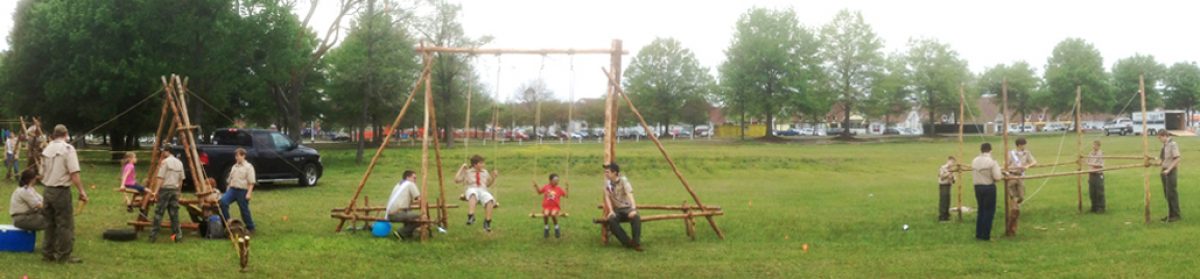
For those familiar with the traditional Double A-Frame Monkey Bridge design, a couple of noticeable modifications will be apparent from the outset. (Click on the photos for larger views.) Scout Engineering is a fluid undertaking, and frequently variations are necessary. Just as frequently an alteration or change can be deemed a desirable improvement. In the case of this double A-frame design, the consensus of opinion is these modifications are really neat, and I’m sure Adolph Peschke would concur.

JAMBOREE PIONEERING AREA: BRIDGES
JAMBOREE PIONEERING AREA: MAIN PAGE

The bridges featured in the pioneering area of the 2013 National Jamboree were a modified Double A-Frame Monkey Bridge, a specially designed pre-stressed triple walkway bridge, and two Single A-Frame Bridges that Scouts could put together from a couple of kits we supplied.
 Single A-Frame Bridge Building. The kits we supplied for the construction of a Single A-Frame Bridge afforded crews an opportunity to build their own simple crossing bridge. Each group’s success was gauged by how they all could use it to cross the ditch and then all stand on it and pose for a group photo. So the activity wouldn’t be too time consuming, the walkway subassemblies were pre-made. Click here for photos of the crews.

Modified Double A-Frame Monkey Bridge. By far, the bridge that received the most play was the monkey bridge. There’s just something about making your way on a foot rope that appeals to young folks, and frequently there was a line of Scouts waiting to make the crossing. This bridge illustrates a nice approach to the double A-frame construction. Click here for photos and information about the modified design.
 Prestressed Triple Walkway Bridge. The most sophisticated and by far most substantial bridge erected up on Garden Ground Mountain on the occasion of the 2013 National Jamboree was this well-designed prestressed bridge. Without getting technical about compressive forces and tension and stress mechanics, suffice it to say the bridge was impressively well-built and strong. Click here for information and photos.
JAMBOREE PIONEERING AREA: MAIN PAGE

After the spars were skinned and the initial supply of ropes were cut and whipped, there were about three days to build the pioneering area and batten down the hatches in readiness for the first troops to take the hike up to Garden Ground. There were thirty projects and structures to build and fifty pioneering area staffers to do the work, so the staff was split into construction crews and assigned various tasks.
Here are some photos revealing a bit of the work entailed in the overall building process. All thirty projects and structures can be seen and reviewed by following the links on the jamboree pioneering area: main page. The entire jamboree project area layout can be seen here.


What hasn’t been described or captured in photographs is the initial and ongoing process to gather and prepare mallet heads and handles for the Mallet Making Station. The demand for more and more materials was so great, each morning, mallet handle foraging expeditions were in full swing!

Ropes. For thirty different pioneering projects and structures, plenty of rope had to be measured, cut, and whipped for lashings, anchors, and guylines. We had plenty of manila and appropriate synthetic fiber rope in a variety of diameters on hand, and thanks to a well-organized storage arrangement and experienced quartermaster, ongoing supplies were readily available.
“We’ve got spars!” Of course the spars for our pioneering projects were a major consideration. Where would they come from, and how would we get them? By emailing this photo (on right) with the simple statement, “We’ve got spars!”, our director, Jim Keller let us know that spars for our projects and structures had been delivered to Garden Ground Mountain! Naturally, before we could build anything, they’d have to be skinned!

Skinning Spars. Starting full swing on the 11th of July morning, and continuing through the end of the 12th, amidst pouring rain with steadfast purpose and draw knives, a full crew persistently and methodically set upon the pile of heavy, hardwood spars. In spite of the tedious and often bent-over, backbreaking work, sloshing through mud in water-logged boots, spirits were high! There was something about working hard up on that mountain along with a like-minded, jovial crew that kept us going in fine form up to and after the very last spar had been relieved of its bark.


After spars were skinned, they were transported to central locations throughout the pioneering area and selected by crews in accordance with their length and diameter to meet the material requirements for specific pioneering structures and projects. Most often, they’d be sawed to the desired lengths before being carried off to various construction sites. The total pioneering area was later dubbed: Peschke Field (named after pioneering legend, Adolph Peschke).
Why skin the spars? Basically, there are three reasons:

Transporting heavy spars. An extra long spar for the flagpole and larger-diameter spars for the climbing area had to be moved by entire crews. The 30′ poplar flagpole was dragged by tying butterfly knots for handholds in the dragging line. The uprights for the climbing area were lifted and carried by joining the ends of a rope and threading it under the log so that a series of two carriers grabbing a hold of the rope could walk the spar along on either side.


The Pioneering Area was named Peschke Field after Adolph Peschke, who through the years had motivated and inspired so many with his high standards, creativity, and pioneering know-how.
The following layout is a depiction of the pioneering projects and activities featured at the 2013 national jamboree up on Garden Ground Mountain at the Summit Bechtel Reserve. For a larger view, click on the layout once. Then, for a closer view, click on any section you choose:


The Single A-Frame Bridge is made up of three subassemblies. Please refer to Bridge Walkways as a point of reference for two of the three of these subassemblies. The following photos will enliven the text and instructions featured in Adolph Peschke’s informative, older pioneering merit badge pamphlet. Click on the photos for larger views:


In the Pioneering Area of the 2013 national jamboree, we put together a couple of Single A-Frame Bridge kits, so Scouts and Venturers could build this simple crossing bridge during their visit to Garden Ground Mountain. Each kit included:
Whenever a crew wanted to build a bridge, we provided an overview of the design and gave them a quick introduction to tying a rope tackle and the Japanese Mark II Square Lashing. What follows are some photo montages of the Single A-Frame bridges built from the kits during the jamboree. For larger and largest views, click on the photos once, and then once again:


On occasion, a pair of Scouts wanted to build a bridge, and with persistence, and the help of staff or friendly Scouter, they were able to get it done.

JAMBOREE PIONEERING AREA: BRIDGES
JAMBOREE PIONEERING AREA: MAIN PAGE
Related article
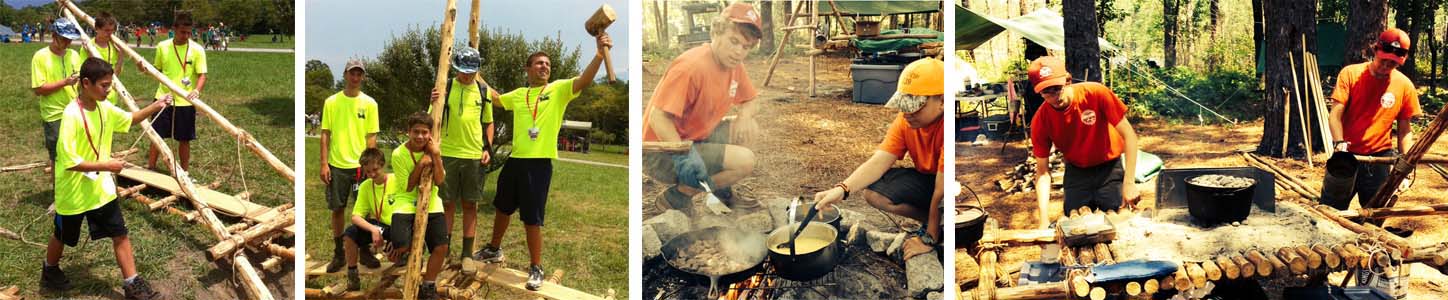
Premise: When Scouting is WELL-PROMOTED in its true and irresistible light, as a value-based movement providing experiences found nowhere else, there will be a manifold increase in membership comprised of those families who not only want to get involved, but who will knock on the doors of individual Scout units and their local councils to learn how.
MEMBERSHIP
RETENTION
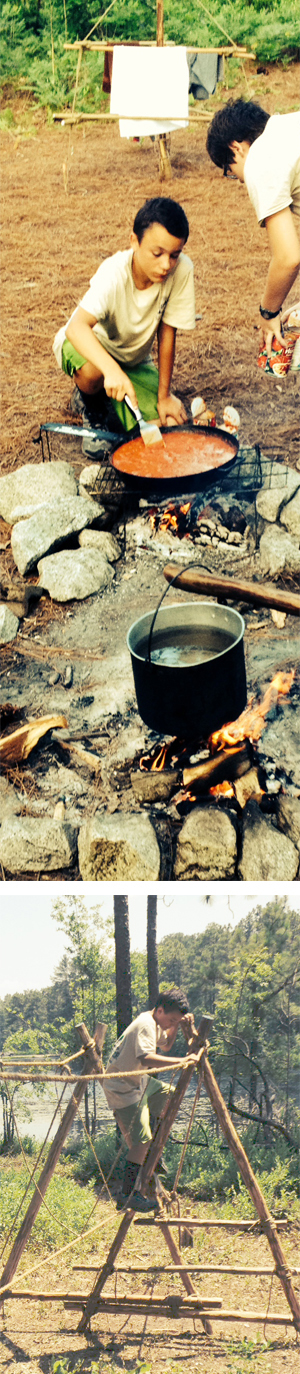
Premise: In conjunction with Rocketry, Robotics, STEM, and the advances in lightweight, no-impact, backpacking techniques, re-emphasize the traditional campcraft skills. They are timeless and carry with them the mystique and fascination that forever remains attractive to youth! Revitalize these skills as a central feature of the Scouting program, and in so doing, not only increase incentive to join and stay involved, but counteract the consensus that over the years the BSA’s outdoor skills requirements have undergone what has been construed as an unfortunate “dumbing down” yielding an influx of higher ranking Scouts that can’t put up a dining fly of light a fire in the rain.
 The following text is by Adolph E. Peschke as presented in the 1998 printing of the 1993 edition of the Pioneering Merit Badge Pamphlet:
Bridges are very popular pioneering projects. Essentially, a bridge consists of one or more trestles that support some sort of walkway. In the case of a monkey bridge, the walkway is just a rope that you walk on. But for many other bridges, you can build a walkway from spars that’s easier to walk on than is a monkey bridge.
In the Single Trestle Bridge, the Single Lock Bridge, and the A-Frame Bridge, the same type of walkway can be used. Each walkway can be 10 feet long and consists of two lateral spars and several cross spars. A 10-foot length of 2-inch x 10-inch construction lumber can be added as the plank to walk on.

MAKING A WALKWAY
To make a 10 foot section of walkway, select two spars with a butt diameter of 3-1/2 inches. These spars should be matched in the amount of sag they have when you stand on them with the ends supported above the ground. If one spar sags more than the other, it will make the walkway slant from side to side, making it hard to walk on.
Cross spars. The cross spars for the walkway should be approximately 2 to 2-1/2 inches in diameter and 3 feet long. You will need two additional cross spars that are 3-1/2 feet long for each walkway section. (The longer spars go at each end of the walkway.)
All of the cross spars are lashed to the lateral spars with 1/4-inch manila. Since the lashing is made only to hold the cross spars in position and not support weight, you can use a double strand of binder twine.
If you use binder twine, double it over and twist it a few times before you start the lashing. Make sure you have enough to complete the full lashing with the doubled-over binder twine. Don’t finish the lashing with only one strand if you run short. Instead, tie on more binder twine to complete the lashing.

Each of the cross spars is lashed to the lateral spars with a square lashing, making three wraps and two fraps. The Japanese Mark II is the easiest and quickest to tie.
There are two ways to approach lashing on the cross spars. If you are going to add a plank over the top of the cross spars, you will need a total of eight cross spars for each walkway. That is, six 3-foot cross spars, and two 3-1/2-foot cross spars (see Drawing 1).

Start by lashing one of the 3-1/2-foot cross spars about 6 inches from the butt end of the lateral spars. Place this spar on top of the lateral spars so that the ends of the cross spar extend 3 to 4 inches out over both sides of the lateral spars. This additional length hanging out is used to lash the cross spar to the stakes, which anchors the ends of the walkway in place.
After the first cross spar is lashed in place, add six more 3-foot cross spars every 16 to 18 inches down the length of the lateral spars. The last cross spar should be lashed about 12 inches from the ends of the lateral spars to allow room for the “underspar.”
Underspar. An important feature of this type of walkway is to lash one 3-1/2-foot cross spar to the underside of the lateral spars 6 inches from the end. When the two walkway sections are placed on the trestle(s) to form the bridge, these underspars should contact the transom of the trestle(s). Then the three spars [two underspars on the two walkways and the transom spar of the trestle(s)] are lashed together at three points using a strop lashing (see Drawing 3).

Walkway plank. Before lashing the walkway to the trestle, the walkway plank should be lashed in at least three places using a strop lashing.
To make a strop lashing, use a length of doubled-over binder twine. Reach down and wrap the middle of this length of binder twine under one of the cross spars (see Drawing 2). Then wrap the binder twine over the walkway plank and down under the cross spar at the other side of the plank. Do this two or three times and finish with a square Knot.
If you are going to walk directly on the cross spars (with no plank on top), you will need enough cross spars to make a safe walkway, one that your foot cannot slip through. Start making the walkway as described before by lashing a 3-1/2-foot cross spar at the butt end of the lateral spars. Then lash the 3-foot cross spars about 3-inch apart, using as many cross spars as necessary to go the entire length of the walkway, ending about 1′ from the other end. Finally, add the 3-1/2-foot long underspar.

Anchoring the walkway. After the walkway is assembled, the butt ends are placed on the bank of the creek or ravine. This end is anchored in place by driving stakes in the outside corners formed by the lateral spars and the first (3-1/2′) cross spar. Lash this cross spar of the walkway to the stakes with a strop lashing.
The small ends of the walkway are attached to the trestle to form the bridge. On most bridges, walkways come from both directions to meet at the trestle(s). The ends of the walkways rest on a transom spar of the trestle(s). Then the two underspars of the walkways are lashed to the transom spar at three points with a strop lashing (see Drawing 2).

When the walkways are lashed to the stakes and to the trestle(s), all the walkway sections become joined to form a single unit that is very strong.
If you put together a pioneering kit, take some time to save the matched lateral spars to be used for walkways only.
While the above text describes how to make 10-foot walkways, you can make 8 or 12-foot sections the same way. If you use the longer walkways, be sure to test the strength of the spars before lashing them into a walkway that could be unsafe.

One never knows when this specialized hitch might be needed. The barrel hitch can come in handy for hoisting up or suspending a bucket or other container that has no attached bail or handle. Forming the hitch is a very easy operation stemming from the tying of a simple overhand knot.
 The following text is by Adolph E. Peschke as presented in the 1998 printing of the 1993 edition of the Pioneering Merit Badge Pamphlet:
A barrel presents an awkward shape when you’re trying to tie a rope to it to lift it. If the barrel is turned on its side (horizontally), a rope grommet can be made into a sling and slipped over a hook to hoist the barrel.
If the barrel has to be lifted while remaining upright, the barrel hitch is a special knot that does the job with ease. Most books show only one loop around the center of the barrel, but a second loop will help stabilize the barrel in the upright position.

First of all, the square knot (Reef Knot) is primarily a binding knot. That is, it’s used to secure a rope or line around an object. In Pioneering, its most basic function is to commonly finish off a strop lashing, Mark II Square Lashing, Filipino Diagonal Lashing, West Country Round Lashing, and both the West Country and Sailmaker’s Whipping.
A square knot is formed by tying a left-handed half knot and then a right-handed half knot, or vice versa, and is regularly taught and learned by passing on the familiar, “right-over-left, left-over-right,” or “over-under, under-over.” However, frequently in the midst of tying the knot, it can be easy to forget what was done or how it began, e.g. right over left, or left over right, and which end was used. Therefore, here’s the sure-fire way to ALWAYS tie it right, every time! Simply tie a half knot, then tie another, BUT, keep the ends on the side they’re already on! In other words, don’t cross them over. Stay on the same side! One running end is nearer to you (in front) and the other is farther away (behind). Keep them there as you begin to tie the second half knot. Simple! In the illustration, red and blue ropes have been used and are referred to for clarity sake.

The beauty of this simplistic, little approach is you can see how to tie that second half knot without knowing (or remembering) how the first one was tied.
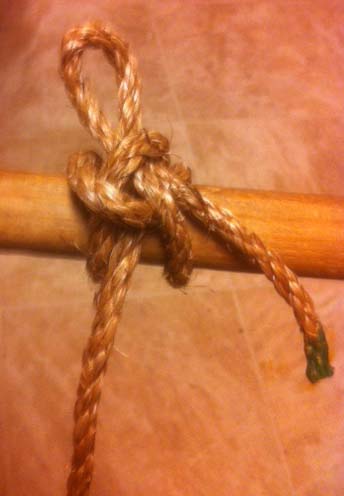
This is a neat quick-release knot that can hold a considerable strain. It’s also known as the Fireman’s Hitch and the Highwayman’s Hitch. Though there is no verifiable evidence that it was ever used by robbers on horseback to unhitch their horses for a quick getaway, it is ideal for reliably securing a boat to a mooring (or horse to a hitching post) with the assurance that you can easily release the knot with a simple tug and quickly be on your way. And all you need is one hand to do it. In Scout Pioneering, John Sweet describes the draw hitch as “definitely a fun knot—fun to make and use.”
In addition to securing the end of a line to a fixed point, the draw hitch can be tied in the middle of the line resulting in two ends of the rope hanging down equally. This way, a climber can lower himself down using one end (standing part), and have the ability to retrieve the rope by tugging on the other end (free end).
Pioneering Use: When hoisting a large structure that is not intended for climbing, e.g. a tall gateway, and the lines you’re using for lifting and preventing over-pulling are not guylines, tie the middle of the hoisting ropes to the structure with draw hitches. Then, when the structure is standing, these lines can be easily removed with a simple tug on the free end.
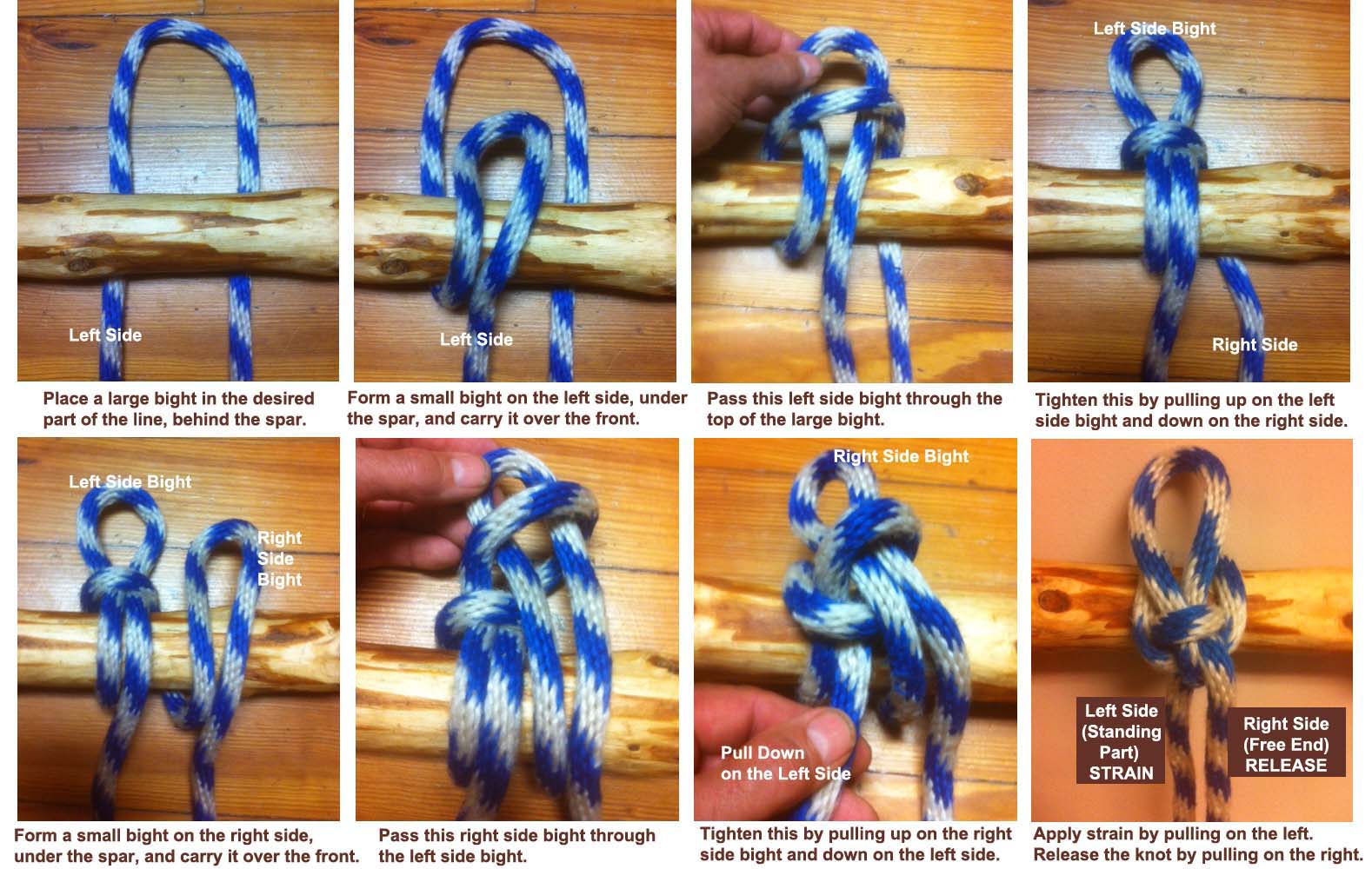
The following photos illustrate the draw hitch being tied starting from the left and ending on the right, i.e. the part of the line that will be holding the strain is on the left, and the part of the line that will be pulled to release the rope is on the right. The draw hitch can be tied just as easily proceeding from right to left. Click on the photos for a larger view:
The following text and diagrams are by Adolph E. Peschke as presented in the 1998 printing of the 1993 edition of the Pioneering Merit Badge Pamphlet:
History of Rope Making – Making rope out of plant fibers is still done today in remote parts of the world. In many cases people make their own rope because money is in short supply and the native plants that have the needed fibers are in great abundance. As early as 1200 A.D. the Papago Indians of the American Southwest made rope from cactus fibers using a twirling stick. The technique can still be used today.
The old saying, “Necessity is the mother of invention,” seems to apply to the fact that ropemaking became a popular practice on many farms in this country around the turn of the century (1900). This happened, in part, because of the invention of the McCormick Reaper and Hay Baler. Both of these farm machines required the use of binder twine. Farmers soon realized that with the supply of binder twine they had for tying up bales of hay, they could easily make all the rope they needed at home by using a simple geared machine.
All they had to do was hook strands of binder twine to each of the three or four hooks on the machine to make almost any size and length of rope they wanted. These machines worked by turning a handle to twist the strands of binder twine into rope. The ropemaker also used a notched paddle to keep the strands from fouling and to regulate a uniform twist as the rope was forming.
At the turn of the century cast iron ropemaking machines could be bought for a few dollars and were found on almost every farm. Today you have to search the antiques shops for one, and if you find one, it might cost over a hundred dollars.
Before the industrial revolution in the 1900s, rope used for big sailing ships was made by hand in 1200’-long ropewalks that required a great deal of manpower. Then, fast-moving machines were invented to simplify the task. Even today, fiber ropes are still made into coils of 1200’. Rope made from man-made fibers (plastics) comes in varying lengths on spools for ease in dispensing.
It might be a bit impractical for your troop to make all the rope needed for camping or for your pioneering projects, but learning how to make rope will help you understand how yarns and strands are twisted to form rope.
The basic process of making rope consists of twisting fibers to form yarns. Then several yarns are twisted together to form strands. Finally, several strands are twisted to form the rope. For example, to make 1/4”-diameter, we start with binder twine as the yarns. Three of these binder twine yarns are twisted to form a single strand. Then three strands are twisted to form rope approximately 1/4” in diameter.
INDIAN ROPE SPINNER
The simple rope spinner shown in figure 71 is a replica of one used sometime around 1200 A.D. by American Indians who lived in what is now Arizona. With this spinner and fibers from cactus plants in that area, the Indians were able to make the rope they needed to construct shelters and for many other purposes. Museum samples show a two-strand rope slightly less than 1/4”.
Using this spinner, it is as easy to make rope today as it was a thousand years ago, except that today we can use binder twine instead of cactus fibers.

Making the spinner. To make the rope spinner, start with a piece of pine (or any softwood) about 1-1/2” thick by 2” wide by 12” long. This can be cut from a two-by-four (2” by 4”), which is a type of construction lumber.
Draw the basic shape of the spinner on the wood, following the pattern shown in figure 71. Cut the basic shape with a coping saw.
The sides are tapered to produce a shape with more weight at the bottom. This aids in spinning. The top knob is shaped to prevent the yarns from slipping off.
After the shape is cut out, drill a 7/16”-diameter hole 2” from the top for the handle.
The handle for the rope spinner is made from a piece of 3/8”-diameter dowel about 10” long. To make the stop block needed at the end of the handle, cut a 3/4” square block. Then drill a 3/8”-diameter hole through the center of this block. Glue the handle dowel into the hole. After the handle is made, slip it into the 7/16” hole in the spinner’s main body.
Using the spinner. To use the Indian rope spinner to make a 6’ length of rope, you will need to start with a 60’ length of binder twine.
Start by tying one end of the 60’ length of binder twine to the neck of the spinner (see figure 72). Then run the binder twine out to another person holding a small stick or a hook about 20’ away. Loop the binder twine over the stick and then run it back to the head of the spinner. Run it out to the other person one more time and tie it to the stick or hook so that you have three strands of binder twine running between the rope spinner and the hook.
Now hold the spinner in front of you and face the other person. Spin the head of the spinner in a clockwise rotation. This will cause the three strands of binder twine to twist into a single piece that will become one “strand.” Twist the three yarns until the strand is tight. A little bit of practice will tell you how tight to spin the strand.

Spinning rope. After making one strand, it’s easy to make a three-strand rope. Leave the strand on the spinner and hook. Grab the strand and loop it over the spinner and also loop it over the hook. At the same time, have the other person move closer to you so there are three strands running between the spinner and the hook, all the same length (about 7’ long).
Now spin the spinner in a counterclockwise rotation, as was done with the three yarns of binder twine. (This is opposite of the way for making the strand.) As you spin, the three stands will twist to form a rope. Only practice will tell you how tight to twist the rope.
After making the rope, use a short piece of binder twine to temporarily tie both ends of the rope so it doesn’t ravel. Then whip both ends of the rope and trim them.
ROPEMAKER
Another device that can be used to make rope is fashioned after the ropemaker used on farms during the early 1900s. With it you can twist the three yarns on each hook into a strand, and the three strands into a rope all at the same time.
Make the device. The pieces of the ropemaker are cut from two pieces of 3/4”-thick plywood about 4” wide. One piece should be about 20” long and the other about 15” long (see figure 73).

Cut out the pieces. First, cut the handle (A) to shape as shown in figure 74. (Do not drill the holes yet.)
Next, cut out pieces (B) and (C). Glue and screw them together to form the base unit (see figure 75).
Then, cut the separator paddle (D) to the same shape as the handle (see figure 74). Later, notches will be cut in the paddle (see figure 76).

Mark holes in the handle. After these pieces are cut, you have to drill holes through the handle (A) and the upright part of the base unit (C) for the three tuning hooks. To do this, first draw a 3-1/2”-diameter (1-3/4” radius) circle on the paddle (see figure 74). The edge of the circle should be 1/4” from each of the three edges of the handle (see figure 74).
Now mark the positions of the three holes for the turning hooks. You can use a protractor to mark the holes at 60º intervals, at the three, the seven, and the eleven o’clock positions.
Drill the holes. After marking the positions of the holes, hold the handle up to the upright piece on the base unit (C). (See figure 75.) Clamp the pieces together, then use a hand drill to drill 1/8”-diameter holes through both pieces.

Make the hooks. These hooks are made from coat hangers. Cut three pieces of coat hanger wire about 8” long. Then make two bends in the end of each wire to form an L-shaped end to fit in the handle. Each bend should be about 1-1/2” long (see figure 76).

Now, insert the three turning hooks in the holes in the upright piece (C) of the base unit. After they’re in place, use pliers to bend a hook shape in the end of each wire (see figure 76).
Make the separator paddle. The separator paddle is used to keep the strands separated while they are twisted into rope. To make the separator paddle, place the handle (A) on top of the paddle (D) and mark the position of the three holes on the paddle. Then cut notches in the edges of the paddle at these locations. You can use a coping saw to cut out the notches (see figures 74 and 77).
Make the end hook. This is the final step (see figure 76). Use a piece of scrap left over from making the handle. Screw in a 3”-long screw hook in the center of the scrap piece.
USING THE ROPEMAKER
To use the ropemaker, first clamp the base unit to a table or a bench. To make a 6’ length of rope, cut a 60’ length of binder twine. Tie one end of the binder twine to one of the three turning hooks on the base unit. Then ask another Scout to hold the end hook about 6’ away.
Now thread the binder twine to the end hook and back to each of the three turning hooks. Continue to do this until you have three yarns of binder twine going from each turning hook to the end hook that’s held by the other Scout.
As you begin, the Scout with the end hook should pull on his end to keep the slack out of the yarns. Then ask a third Scout to insert the three strands in the notches of the separator paddle. Start near the Scout holding the end hook. As the rope is turned, the Scout holding the separator paddle should move the separator paddle towards the base unit, making sure that the strands do not become fouled.
Start tuning the handle so that the hooks turn in a clockwise rotation. As you turn the handle, the yarns (binder twine) will begin to form into twisted strands, and these strands will also twist to form into rope. The Scout operating the separator paddle should move it to prevent the strands from fouling. If the separator paddle is moved too fast towards the base unit, it will result ina loosely twisted rope.
You’ll have to practice to determine the speed of turning the handle and the movement of the paddle to make a good piece of rope. Too few turns will produce rope that is loose. Too many turns will produce rope that is twisted too tight and might be hard to use.

Though there have been some changes and modifications through the years, in most respects, pioneering in the Boy Scouts remains constant. Why Pioneering!
The following text has been extracted from the Introduction to the 1981 Printing of the 1974 Revision of the BSA Pioneering Merit Badge Pamphlet. Most of the action photos have been scanned from the Pioneering Projects section. (Many are also featured in the GREAT 1976 printing of the 1967 revision of the Boy Scout Field Book.)

Remember Robinson Crusoe? He was the guy who was shipwrecked on a desert isle and managed to survive. Of course he was lucky—he salvaged a lot of useful equipment. But his story makes you wonder what you’d do if the same thing happened to you.
Have you ever thought what you’d like to have if you found yourself all alone in a wilderness with no chance of escape? So let’s make the problem easier—you can choose just one item, one “tool,” to take with you.

Only one tool? Impossible, you may think. The guys who have this merit badge would be very likely to choose rope. For with it anyone skilled in the outdoor arts of pioneering can build many useful things.
It’s one of the oldest tools we know. Thousands of years ago, primitive men twisted vines or plant fibers to make rope that they used to attach handles to their simple tools. Ropes were used in building the pyramids.

In Central and South America, Indian tribes were crossing deep valleys on rope suspension bridges long before the first explorers arrived from Europe. And with the help of rope our own pioneers could, when they had to, build a temporary bridge that would enable woman and children to cross a stream safely. They could build a raft to carry a winter’s catch of fur to market.
Take a look at this pamphlet, and you’ll discover why rope would be a good “tool” to have in the wilderness. Everyone of the requirements depends on rope. Pioneering, in the Scout sense, means being able to construct a great variety of things with poles and rope. In order to build a bridge without nails or a tower without bolts, the builder needs ropes—plus the knowledge of how to use them. Most pioneering is concerned with lashing poles together to make something—usually temporary—that makes living in the outdoors a little easier.
In pioneering, the use of knots and lashings is of supreme importance. A wrong knot, an insecure lashing, or a weak rope could lead to disaster. Did you know, for example, that tying a Bowline in a rope cuts its efficiency by 40%? And that a Square Knot reduces the rope’s efficiency by 50%? Which means that it’s only half as strong as an unknotted rope. Knots, turns, and hitches weaken a rope by forming a bend that distributes the load on the fibers unequally.

All this knowledge comes in handy in pioneering—but our wilderness has shrunk so much that the average troop no longer can go into the woods and cut the trees needed for building a rope-lashed tower. However, there are isolated areas where Scouts might get permission to clear out some trees, and the thinning might make the ones left standing grow better. A troop that can acquire poles this way should keep them perhaps on a campsite—and use them over and over.
–
–

Most often the best bet for anyone who wants to learn pioneering is summer camp. Here there will be the poles, the ropes, and—just as important—someone with the skills to teach you how to make Square Lashings, Diagonal Lashings, and Shear Lashings. Ever hear of a parbuckle? Can you tie the required 10 knots and explain their use? The best way to learn is by observing someone who already knows.
Our pioneers were good at improvising. They had to be. Without being able to improvise they never could have settled the wilderness., built bridges and houses, and turned it into the comfortable communities we live in today. Scouts who want to try their hands at pioneering will learn to improvise—and will be using some basic engineering principles that still have plenty of applications.

For example, engineers working in mountainous areas often use rope conveyers in preference to rigid railways. The aerial cableway used in the construction of the Hoover Dam in Colorado consisted of six steel-wire ropes crossing a 1,256-foot span. The “bucket” or carriage they supported could carry 150 tones of excavated material away from the site at one time or bring in the same amount of concrete from the mixing plant.

You need not wait until you get to summer camp to begin your own pioneering. Even in a big city, you can learn to tie the knots and find out the best applications for each. Learn how to make Eye, End, and Short splices. And learn how to make lashings by building scale models. A scale of 1 inch to 1 foot is convenient and easy to use: This means that a tower 24 feet tall will scale down to 24 inches in your model.
Pioneering merit badge is not one of those required for Eagle. But in a time when most people have no understanding of what our ancestors had to know to live in the wilderness, pioneering is a cultural tie with the past, an emergency skill worth learning, and a real test of your cooperative spirit. The patrol or troop has to work together as a team, and learning the give-and-take in carrying out a construction project is as important as learning the technical skills of pioneering.
 SCOUT PIONEERING