Safe Pioneering

Link to: Older Pamphlet Info

These 22 Safety Points are included in the manuscript for the next edition of the Pioneering Merit Badge.

The following text is by Adolph E. Peschke as presented in the 1998 printing of the 1993 edition of the Pioneering Merit Badge Pamphlet:

As you begin your pioneering activities, safety must be your first consideration. The following safety points are some that you and your group should keep in mind:

  1. Check all equipment, rope, tools, and hardware to ensure they are in good working condition.
  2. Appoint a safety officer as soon as you arrive at the work site.
  3. The safety officer, along with the rest of the group, should constantly check the work site to keep it clean of debris. Equipment should be kept in an organized fashion.
  4. During the construction of a project, only one person should give instructions and signals.
  5. Do not work during rainy or wet conditions. Rope and spars become slippery, as does your footing. Knots can slip when wet and become unsafe.
  6. Wear clothing to fit the season and wear gloves when necessary to protect your hands.
  7. Take regular breaks to discuss the work in progress and ensure that everyone understands what is required of them.
  8. Double-check all anchors and holdfasts on the pioneering project as strain is applied during use.
  9. Test the structure or bridge before allowing general use.
  10. Ensure that you have good footing, use both hands to make the work easier, and do not lift more than you can handle.
  11. When the day’s work is complete, untie all knots, coil all ropes, check all hardware, and store everything in its proper place.
  12. When tying knots that will be out of reach, secure the running end with a piece of light cord.
  13. When the bottom end of a spar, such as the leg of a tower, rests on hard ground, it should be “heeled in”— that is, set in a 4″ to 6” deep hole to keep it from shifting.
  14. When raising towers, have at least two hoisting lines on the opposite side to prevent overpulling the proper position.
  15. If the design calls for a certain size and type of rope or spar, do not substitute something of lesser strength.

Here are some obvious but necessary additional safety measures that should be remembered:

General

  • Spars resting on the ground are not for standing upon. They can unexpectedly roll causing injuries.
  • Only one person at a time belongs on a ladder. Persons coming down from a project use the ladder first.
  • Racing up or down a ladder can result in slipping and an accident.
  • The number of people using a platform should be strictly limited to the maximum number established beforehand and announced by the safety officer.
  • Jumping or playing around while on a platform is totally unnecessary and can have dire results.
  • When lifting the a spar to facilitate the frapping of a tripod lashing, care should always be taken to ensure that the person working the rope doesn’t injure his fingers.
  • There should always be plenty of room between the person carrying spars and other people.
  • When working with newer manila lashing ropes, rope splinters can be avoided by wearing gloves.
  • When using heavy mallets to pound in pioneering stakes, pain can be avoided by being especially careful.
  • All equipment should be treated with respect and used appropriately for its intended purpose.

Monkey Bridges

  • There should only be one person on a monkey bridge at a time.
  • While crossing the bridge, people shouldn’t bounce or purposely swing or sway on the ropes, nor should anyone race to see how quickly they can get across, which can easily lead to losing their footing.
  • Those waiting their turn to cross the bridge should stay off the ropes between the anchors and the bridge framework.
  • Whenever the foot rope and/or hand ropes are being tightened, or the spanner ropes are being adjusted, everyone should stay completely off the bridge.

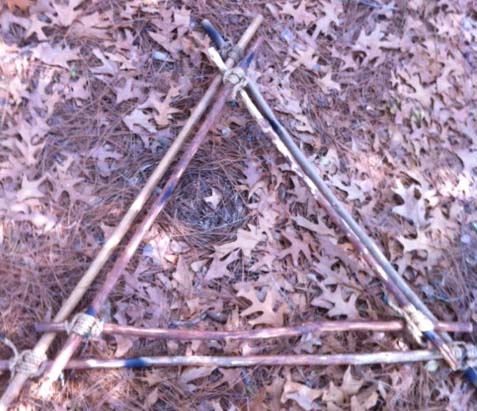


A Better Clothes Drying Rack

You’ve got to love this design. It’s compact, it’s sturdy, and it’s ingenious!

This drying rack is based on suspending two concentric, equilateral triangles to make six cross sections for hanging wet clothing or towels during a long term encampment, and there’s no reason you can’t put it up on an overnighter if there’s a practical need. All that’s been said before regarding the advantages of this kind of campsite improvement apply to this simple camp gadget:

  • It takes up less space while drying more wet things.
  • It eliminates the clutter of clothing and towels haphazardly strewn around on tables, tree branches, tent platforms, or overcrowded on a disorganized array of drooping clothes lines.
  • It can be set up in a location where there is the most sunshine.
  • It’s especially useful when camping in an open area with few trees.

Materials (adapt these as you like)

  • three 4-foot  x 1-inch sticks
  • three 5-foot x 1-inch sticks (Scout staves are ideal)
  • one 6-foot x 1-1/2 to 2-1/2-inch straight pole for the upright (or an additional 5-foot Scout stave)
  • one 30-inch pioneering stake
  • eight camp gadget lashing ropes (6 to 10-foot)
  • three 15-foot lashing ropes
  • three small stakes
Two Equilateral Triangles

Procedure

Lash the triangles. Start by lashing together two equilateral triangles, one smaller for the top (three 4-foot sticks), and the larger one for the bottom (three 5-foot staves). Use square lashings. One easy way is to lash two at 90° and then bend them in and tie the third square lashing to make the triangle. This yields a nice, tightly-lashed triangle, (but be careful you’re not putting too much stress on the ropes and poles when preparing to apply the third lashing).

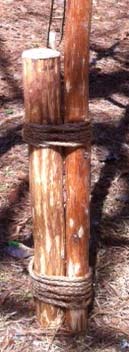
Pioneering Stake
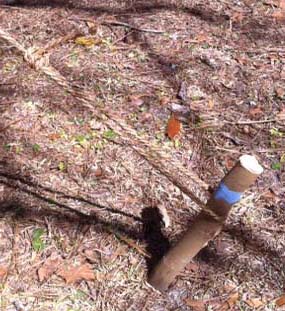
Pioneering Stake

Erect the upright. Pound in a pioneering stake and lash the 6-foot pole to it securely with two tight strop lashings or round lashings. Making this upright stand up vertically without moving or wobbling at all is a key to a good and sturdy clothing dryer. So, solidly pound in the stake and make sure it’s as straight as possible. Also, make sure the lashings are well-tied and tight.

—> ALTERNATIVE APPROACH: A clothes drying rack can be erected without having to either pound in a stake or sink the center pole, by using the same principle as when erecting a flagpole. The key is using the support ropes as guylines. SEE PHOTO.

Rolling Hitches
Rolling Hitches

Attach the triangles. Lay the triangles on the ground over the upright, first the larger triangle, and then the smaller one on top.

Using rolling hitches, tie the three 15-foot support ropes to the top of the upright. (Roundturns with two half hitches also work just fine.)

Tie each corner of the smaller triangle to a support rope so it will be suspended about 5 feet above the ground. Use clove hitches which can be adjusted as necessary to assure the triangle hangs evenly and the 4-foot sticks are horizontal. Continuing with each of the three support ropes, repeat this process for the larger triangle so that it will hang about 4 feet above the ground.

Clove Hitch
Clove Hitch
Tautline at Stake
Taut Line Hitch at Stake

Anchor the support ropes. Hammer in a small stake a foot or so out, in line with each corner of the bottom triangle. Using the remaining length of the support ropes, attach them to the stakes with a simple taut-line hitch. This will further stabilize the clothing dryer and enable you to make fine-tune adjustments to the way the triangles lay. (You can also just make them fast to the stakes with a roundturn with two half hitches, or another clove hitch.)

Better Clothes Drying Rack
An assembled clothes drying rack at the 2013 Jamboree gets the once over.

Making a Rope Ladder

Rope Ladder Attached to a Tree

The kind of rope ladder referred to here is constructed using two lengths of rope and short spars (3′ x 2″ are ideal) to serve as ladder rungs. To easily and effectively attach the rungs to the ropes, a Marlin Spike Hitch, also known as a lever hitch can be used. As John Thurman explains in Pioneering Principals, “The vital thing to remember is that the knotted part of the hitch must be under each ladder rung so that when a weight is put on the rung the knot will work in support. The ladder used the other way round can result in the rungs slipping as the weight goes on to them.”

Simple Slip Knot
Simple Slip Knot

The method applied here is very similar to tying the old fashioned Slip Knot where you make an overhand loop, reach through underneath, grab the standing part of the rope and pull it through.

In the process of making a rope ladder, after pulling the standing part through, stick the ladder rung inside the new loop you just formed. Tying the Marlin Spike Hitch in this manner assures you will have the part of the hitch with the knot under the ladder rung.

Depending on the diameter of the short spars, to space the ladder rungs about a foot apart, make the next overhand loop about 15 inches away from the previous rung.

Make an overhand loop. Reach through UNDERNEATH and grab the standing part. Pull the standing part through the overhand loop.
Preparing the Marlin Spike Hitch
Insert the rung in the loop made out of the standing part. Adjust the rung and tighten the hitch.
Inserting the Ladder Rung

It’s easy to adjust the position of the rungs by loosening the Marlin Spike Hitches and moving them with the short spars up and down on each side until the desired distance between the rungs is achieved and they are nicely horizontal and perpendicular to the ropes. Then, give the rope on either side of the rungs a good pull to tighten the hitch back up.

When tying on the rungs, start at the top of the ladder. For a shorter ladder, you can attach the ropes to their anchor point and tie on the rungs vertically. For a long ladder that needs to be prepared before attaching it to the top anchor points, construct the ladder on the ground.

When the ladder is completed and attached at the top, don’t forget to tie it off at the bottom, which will measurably increase stability and the ease of climbing. This can be done by driving in a pioneering stake in line with each rope at a 45° angle. Pull the ropes taut and tie them to their respective stakes with a roundturn with two half hitches or a rolling hitch.

Splicing Rope

Link to: Older Pamphlet InfoThe following text is by Adolph E. Peschke as presented in the 1998 printing of the 1993 edition of the Pioneering Merit Badge Pamphlet:

Making the proper splices in the proper places on your ropes is the benchmark of a skilled craftsman. Very often, the ability to do a neat job of splicing is placed on the top of the skills list of ropework. Making splices is not really all that hard to do. There are three basic types of splices that are typically made on three-strand twisted rope: an eye splice, a back splice, and a short splice. The basic process in all three splices is to unlay the strands at the end of the rope, then weave them over and under back into the rope to form the splice. In some cases the right knot could do the same job as each of these three splices: a bowline might be used instead of an eye splice; a Sheet Bend, Water Knot or Carrick Bend instead of  a short splice, and whipping could replace the back splice. Knots are bulkier than splices. Splices are neater and smaller and not likely to come untied in use. Splices in ropes make the rope secure and ready to go when needed.

There are a number of rather complicated splices. The eye splice, back splice and short splice are basic and well suited to the type of pioneering outlined (in this pamphlet.) The splices shown here can be made in any three strand rope (manila, sisal, poly, or nylon). Learning how to make the first tuck on each of the three strands is the key to splicing. The first tuck sets up the pattern for the following tucks and gives the splice a symmetrical appearance. Those first few tucks that you make might look a bit rough, but try to remember that neatness is one of the keys to a well-made splice. Try to prevent each strand from raveling while you’re working with it. Also, you should try to pull each set of tucks tight and with even tension. The rope should maintain approximately 80% of its strength if the splice is made with a series of three tucks on each of the three strands. If after making the first three tucks on all three strands, you reduce each strand to one-half of its fibers and make a fourth tuck, the splice will have a nice tapered look.

To learn the technique of splicing, it’s best to practice with a short piece of 1/4″ three strand manila rope. Avoid sisal and plastic rope until you have mastered splicing with manila rope. Even the best drawings of the steps for making a splice can look confusing. The best way to learn how to splice is to sit down one-on-one with someone who is familiar with the techniques and go over each step a few times until you get used to how the strands are woven together. Splicing is not one of those skills that you can do once and then never forget how to do it. It takes a lot of practice.

Back Splice
Back Splice

BACK SPLICE The back splice is made to prevent the end of the rope from raveling. It can be used instead of making a whipping. Of the three splices shown here, the back splice is the least used because its bulk at the working end of the rope makes tying some knots more difficult.

  1. Unlay more than sufficient to make the splice and spread the strands evenly.
  2. Make a crown knot by bending each end over its neighbor in turn, going the same way round as the lay of the rope.
  3. Pull the crown knot into shape.
  4. Tighten it on top of the rope.
  5. Tuck each end in turn over the adjoining main strand and under the next. Draw tight close up to the crown knot.
  6. Continue in this fashion until you’ve made at least three tucks. Draw the ends tight after each round of tucks.
EyeSplice
Simple Eye Splice

EYE SPLICE

  • The eye splice creates a fixed loop at the end of the rope. These are some of the uses for an eye splice:
  • Splice a fixed loop onto the end of a guyline.
  • Splice a fixed loop with a thimble in a 10′ rope to form a strop (refer to the “Anchors” section).
  • Splice a rope into an eyebolt at the bow of a canoe.
  • Splice a rope into a tent or fly grommet.
  • Splice the throwing line into a ring buoy at the waterfront.
  • Splice the line into the block of a block and tackle.
  • Put eye splices into each end of a rope to be used as a sling.

Link to: Larger Image

  1. Unlay more than enough strands for tucking. Lay the strands out so there’s one on the left, one in the middle and one on the right.
  2. Take the middle strand and tuck it under a strand at the proper distance to form the size eye you want.
  3. With the strand on the left go over the strand you just went under, and under the strand behind it.
  4.  Turn the splice over and tuck in the last strand so that it exits where the middle strand entered. All strands should be coming out evenly at the same position around the rope.
  5. Continue to tuck in each strand, over and under.
  6. Make a total of three tucks for natural fiber rope, and four tucks for synthetic rope.


Short Splice Used to Make a Rope Grommet

SHORT SPLICE A short splice can be used in place of a knot to join two ropes or the ends of the same rope together. If two ropes are being joined with a short splice, they should be the same type of rope and have the same diameter. Some of the applications of a short splice follow:

  • Splice the ends of a long line that has been cut, or when a frayed or unsafe portion needs to be cut out.
  • Splice the ends of a short length of rope to form a grommet (fixed loop).
  • Use it on a 10′ length of rope to form a strop (fixed loop). (Refer to the “Anchors” section.)

Link to: Larger View

  1. Unlay the ropes, intertwine the strands, and tie a temporary whipping to hold the ropes together. Tie each strand with a constrictor knot to prevent raveling.
  2. Starting with one strand (blue) of the left rope, take it over one of the strands on the right rope, and tuck it under the next strand on the right.
  3. Roll the rope towards you and take the next strand (white) in turn. Take it over the strand on the right rope, and tuck it under the next strand.
  4. Roll the rope towards you again and take the third strand (green) over the next strand and under the one after on the right rope.
  5. At this point, three strands of the left rope should be tucked under two strands on the right rope. Continue by making another tuck with each strand.
  6. Continue the process until three tucks have been made with each strand. Remove the temporary whipping and splice the other left ends in the same way.

Scout Meeting Challenge: Catch the Snapper

What we’re doing here is challenging each patrol to build a device that will set off and “catch” a cocked rat trap (the snapper) placed 15 feet away.

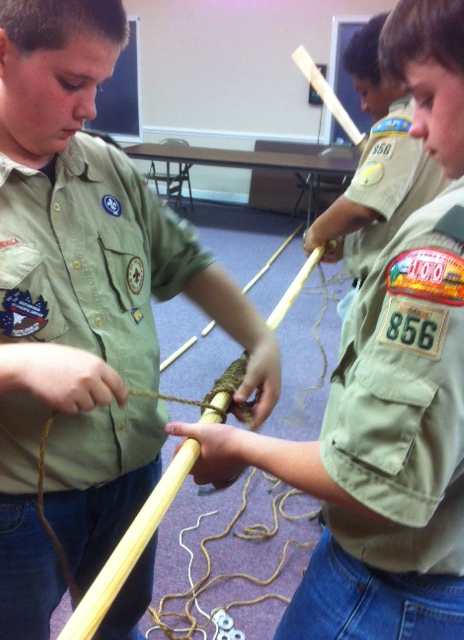
Spacing their round lashings.
The lashings have to be tight and well-spaced.

This simple interpatrol challenge is fine for team building and simultaneously a whole lotta fun! The only lashings required are round lashings, but applying a sensible approach to spacing them effectively is also necessary. As with all pioneering projects, in order to pull them off the whole crew’s got to pull together. So it is with the simple process of racing to join the Scout staves together, and then setting about angling the long “fishing pole” so the sinkers will hover just right over the cocked rat trap.

CatchTheSnapper
Activities That are FUN!

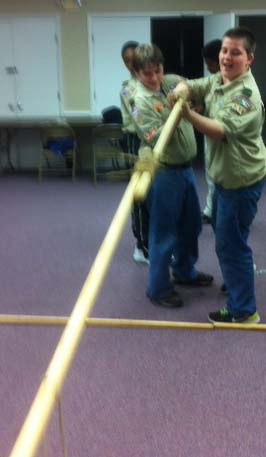
Procedure. Using two tight Round Lashings to join each of the staves together, each patrol forms a long “fishing pole,” and attaches a cord with a weight tied on to the end. Using this device to pick up their snapper, there are two objectives here: one is to catch the snapper as quickly as possible, the other is to work together and successfully complete the task as smoothly as possible. Basically, three rules apply: no patrol member is permitted to cross a line between their work area and the cocked rat traps 15 feet away, the only thing allowed to touch the snapper is the weight at the end of their “fishing pole,” and all materials must be used.

Angling to Catch the Snapper
  • four 5-foot  Scout staves
  • six 6-foot lashing ropes
  • one 3-foot light cord
  • a weight (fishing sinker or some heavy metal washers)
  • rat trap(s)


Careful handling of the rat traps is required!
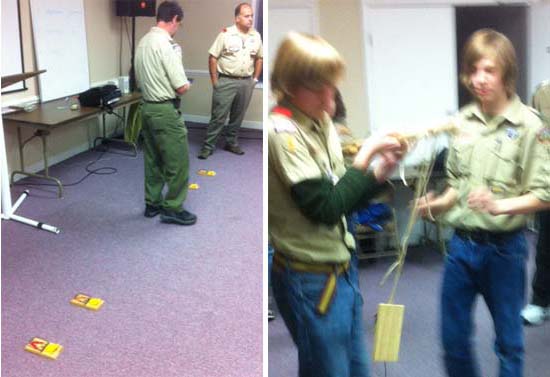
Left: Setting out the Rat Traps  / Right: Catching the Snapper

SCOUT MEETING CHALLENGES MAIN PAGE

Single A-Frame Bridge

Two A-Frame Bridges in the  Early Morning Fog on Garden Ground Mountain at the Summit Bechtel Reserve
Two Single A-Frame Bridges in the Early Morning Fog on Garden Ground Mountain at the Summit Bechtel Reserve

The simplest of all crossing bridges is the Single A-Frame Bridge. The design was featured at the 2013 National Jamboree which afforded Scouts an opportunity to construct the bridge right on the spot.

Single A-Frame Bridges at the Jamboree

Single A-Frame Bridge Pictorial

Link to: Older Pamphlet InfoThe following text is by Adolph E. Peschke as presented in the 1998 printing of the 1993 edition of the Pioneering Merit Badge Pamphlet:

Building this bridge is quite simple because there are very few lashings needed for the center A-frame. The A-frame is a triangular shape that resists racking and provides strength for the structure.

A-frame. Start this project by determining the depth of the creek or ravine to be spanned. You have to add 8 feet to that measurement to get the total height of the legs for the A-frame. For example, to span a creek 4 feet deep, the legs of the A-frame should be about 12 feet or longer.

This total length allows for the distance from the butt ends of the A-frame legs up to the transom that supports the walkways. The transom should be about 1 foot higher than the banks of the creek. It also allows for the height from the walkways up to the tops of the legs to permit free passage for a person along the walkways.

Lay the A-frame subassembly out on the ground to check if the spars are long enough when lashed together for the two requirements mentioned above.

A-frame Legs. When you’ve determined the length of the spars for the legs of the A-frame, lash them together at the top with a shear lashing, not a diagonal lashing. This lashing should be made somewhat loose so that you can spread the spar legs apart to form the A-frame. As you spread the spar legs, the Shear Lashing will tighten. A little practice will show you how loose to make the shear lashing initially in order for it to be tight when the A-frame is formed.

View of A-frame and Attachment of Walkways

Ledger and transom. To complete the A-frame, use square lashings to lash the bottom ledger across the legs about 1 foot from the bottom of the legs. Then lash a transom spar to support the walkways at the proper height in relation to the banks of the creek.

Walkways. The two 10-foot walkway sections are made as separate subassemblies. (Refer to “Bridge Walkways.”)

Assembly. After the walkways are made, take them to the assembly site along with the A-frame. Place the A-frame in the center of the creek and heel in the legs about 4 to 6 inches deep. As the legs are being heeled in, level the transom to accept the walkways in a level position.

Single A-Frame Bridge

When the A-frame is upright and the transom is level, lash both underspars on the walkways to the transom with strop lashings at three points. Finally, lash the cross spars at the ends of the walkways to stakes on the banks of the creek with Strop Lashings.

For safety, it’s best to add a light 1/4-inch guyline from the top of the A-frame to both sides of the creek to prevent it from tipping over.

List of Materials for a A-Frame Bridge

  • two 3-inch x 12-foot A-frame legs
  • one 2-inch x 6-foot bottom ledger
  • one 3-inch x 6-foot transom
  • four 3-inch x 10-foot walkway lateral spars
  • twelve 2-inch x 3-foot walkway cross spars
  • four 2-1/2-foot  walkway cross spars
  • two 2-inch x 10-foot walkway planks
  • four stakes

Single Trestle Bridge

Single Lock Bridge

Pioneering Bridges and the Saga of the Bridge of Fifteen Nations


Bridge Project built in Brazilian Boy Scout Camp

Before we relate this interesting, real-life account, here’s a little about building bridges and Pioneering: To open up the frontier, pioneers built BRIDGES. To this day, the most familiar and most  functional of all “larger” pioneering projects are bridges. In the older edition of the Pioneering Merit Badge Pamphlet, pioneering legend Adolph Peschke provides details for five “boy-sized” projects. Four of them are bridges: (Double A-Frame Monkey Bridge, Single Lock Bridge, Single Trestle Bridge, Single A-frame Bridge).

Here are some scanned photos and text from the 1976 printing of the Boy Scout Fieldbook where, again, there is a major emphasis on building bridges:

The 1967 edition of the Boy Scout Fieldbook is replete with photos of real Scouts doing real Scouting, old-school-style!
Three Walkway Bridges

“With your knots and lashings down pat, you’re ready for one of the most exciting outdoor crafts going: pioneering—building structures of timbers for practical purposes. It tests many skills, including teamwork. Probably your first try ought to be a simple project—but you may get your gang really steamed up by the notion of a bridge to avoid a long walk around a gully, stream, or pond on your campsite. So bridge it!

“LOCK BRIDGES are used for spanning streams with steeply sloping sides. If the stream is narrow, use a single-lock bridge (top right), consisting of two trestles and two roadways. For a wider stream, build a double lock bridge (center) in which the two trestles that are placed in the water are locked into a horizontal trestle that carries the center section of the roadway.

“TRESTLE BRIDGES are used to span fairly wide streams with shallow beds and gently sloping sides. The trestles are of different heights, depending on the depth of the water at various points. The bridge is constructed by placing the first trestle in the water, then lashing two “road bearers” (lateral spars) to the top of it, and anchoring the other end of the bearers to the bank. Other trestles are then placed in the water and connected with more road bearers.”

THE BRIDGE OF FIFTEEN NATIONS

In the preface of his book, Progressive Pioneering, John Thurman tells a story illustrating a modern-day scenario of pioneering in action and how it “saved the day.” Additionally, the account provides a shining example of people from fifteen different countries working very well together to satisfy a common objective:

“SOMETIMES cynical people say, “Why pioneering, anyway?”, “What is the practical application in the  modern world?” Well if ever pioneering was justified, the true story that follows surely proves the point.  From the very start of Scouting, one overall idea was ‘being prepared’ and I still find that this makes sense, in any country, in any situation, in any age.”

John Thurman goes on to describe exceedingly rainy conditions that prevailed for nine days throughout the training session. With the training at an end, the last day, a September Sunday, was set aside for a special celebration:

“We, that is myself and the members of the Training Teams of fifteen countries of the Americas—North, South, Central, and the Caribbean—had the previous night, at midnight exactly, come to the end of a strenuous, exacting, but very satisfying “Training the Team” Course. The course had been held in the National Training Centre of Mexico, a place called Meztitla. The site was literally hacked out of the jungle, on the lower slope of a considerable mountain range. I had done what I went to Mexico to do and on this Sunday I was relieved of all responsibility and content to be a part of whatever final celebrations the Mexican Scout people planned. The morning was glorious with brilliant sunshine and a fresh and pleasant breeze. The camp looked lovely, although it  was a little wet under foot. The flags of fifteen nations flew proudly and unitedly in the centre of the camp. Visitors, many of considerable importance, began to gather; the Mexican Minister of Education, the First Secretary of the British Embassy, the Governor of the State, the Mayor and his supporters, and wives and families, relatives and grandparents of many of those who had taken part in the course.”

In his book, what follows are descriptions of the festivities. It was quite a party with lots of speeches, special presentations, Mexican music, and lots of Mexican food. Then, like it had during the previous nine days, the rain began to fall…and fall, and then really fall. It was one serious downpour, a veritable deluge. John describes that rivers appeared where the paths had been. The only way into camp was a ford across a mountain stream, and this, it was discovered, was already impassable. He writes:

“It steadily worsened; the mountain stream was now a raging torrent, bringing down boulders, tree trunks, and great lumps of what had been the bank. The ford had vanished completely and in front of us was a chasm or ravine about twelve feet deep with a raging torrent tumbling along its new course.

“There was no other way out of camp. We could have stayed and we could have managed, but it would have been hard on the woman and children who were our guests. We could have thrown a foot bridge across the ravine but then they would have been faced with abandoning vehicles and a very long and tiring walk to the nearest habitation.

“Unanimously it was decided that we should build a bridge; not a foot bridge, not a monkey bridge, not an aerial runway, but a road bridge which would carry the vehicles, the equipment, and the people.

“And so began the Saga of the Bridge of Fifteen Nations, for the men of fifteen nations contributed to its building. Mercifully equipment was available and there was a large supply of timber. The hands were willing, experienced, and capable. The men knew their knots and lashings and their basic pioneering.

“Three hours later, as darkness began to cover the area, the first car—a little Renault—gingerly felt its way across the bridge. As it accelerated up the bank on the far side of the ravine, the cheers from the men of fifteen nations were united, vociferous, and heartwarming. We were wet and tired; some of us were bruised and battered, and some had minor cuts, but spirits were never higher. Within the next half hour, every vehicle and every person made their way across the bridge and so onward to Mexico City; perhaps a little later than expected, but Mexico is one of the countries of ‘manana’, so why be concerned about slight errors in punctuality?

“It was truly a memorable day. It was Scouting in action and Scouting in practice. It was good to know that we could build a bridge when a bridge was the only answer. It was even better to know that the men of fifteen nations could work unitedly and effectively to build the bridge.”


Whipping

The following text is by Adolph E. Peschke as presented in the 1998 printing of the 1993 edition of the Pioneering Merit Badge Pamphlet:

Whipping the ends of all the ropes in your pioneering kit is an indication of a well-managed kit, and a practice that will give your ropes good service in the field. Trying to tie knots in ropes with frayed ends is not only a bother but a waste of time. This can all be avoided by having a small spool of whipping cord as part of your pioneering equipment.

The type of whipping cord that you use is most important. Flax cord that is waxed and made of six strands is the best for pioneering work. Cotton string is not strong enough and will not wear well. Nylon cord is very strong, but tends to be slippery, especially when it’s waxed. A second drawback to nylon cord is that it stretches easily which makes it easy to slip off.

Waxed flax cord can be purchased at most leathercraft stores or shoe repair supply dealers.

The merit badge requirement for whipping can be fulfilled by using any whipping method shown in other Scouting publications. Because of the hard usage that ropes get during pioneering activities, it might be worth the time to learn how to do one or both of the following methods.

HALF HITCH (WEST COUNTRY) WHIPPING

How to Tie a Half Hitch (West Country) Whipping: Video

A group of countries west of Bristol, England, which has long been a seafaring area, is referred to as West Country. This area is also famous as a starting point for Pilgrims sailing to America. Why and how the West Country Whipping was developed seems to be lost in history. Whoever invented it has left us with a simple and very effective method for whipping the end of a rope.

The Half Hitch (West Country) whipping works equally well on any type of rope, twisted or braided, or rope made from natural fibers or plastic filament. (All plastic ropes should have the end melted back first.) The success of the whipping depends on the tightness of the knots formed by the cord and the interlocking action of the Overhand Knots.

To make a West Country Whipping on a 1/4″-diameter rope, start with a 14″ length of waxed flax cord. Wrap the cord around the end of the rope about 1/2″ to 3/4″ from the end, and tie an Overhand Knot (see photo 1). If the rope is badly frayed, it can be pulled together with a clove hitch or Constrictor Knot to begin the whipping.

Photo 1: Use waxed flax cord and tie an overhand knot about 3/4

Continue by taking the two ends of the whipping cord around the the back of the rope (away from you), and tie another Overhand Knot* (see photo 2). Keep repeating Overhand Knots, front and back until the whipping has been formed. A good rule of thumb to follow when making this kind of whipping is to make the whipping as long as the diameter of the rope.

Always tie each Overhand Knot right over left of left over right so that the knots lay neatly together and snug against the previous knot to form a smooth finished whipping. The West Country Whipping is finished with a Square Knot and the excess cord is trimmed.

* An Overhand Knot tied as the first half of a Square Knot, is more   accurately termed a Half Knot. An Overhand Knot is formed when applying the configuration at the end of a line.

SAILMAKER’S WHIPPING

How to Tie a Sailmaker’s Whipping: Video

Just the thought of sails and ropes flapping in a strong wind when a sailing ship is under way makes you realize that the ends of the ropes aboard a ship have to be whipped to keep them from raveling under the strain. Sailmakers knew that a little extra effort spent whipping the ends of the ropes would make their work much easier in the long haul.

To make the Sailmaker’s Whipping, first unlay the three strands at the end of the rope about 1″ (see figure 81). With a length of whipping cord approximately 16″ long, form an open bight about 3″ long at the end of the cord. Slip the bight over one strand and then lay the two running ends of the cord between the remaining two strands of the rope. (See A and B in figure 81).

Relay the strands of the rope to form the original twist (see figure 82). Then wrap the long end of the whipping cord tightly around the rope. Wrap the cord clockwise, moving toward the end of the rope approximately six turns. Keep each wrap tight against the previous one and neatly together (see figure 82).

Figures 81, 82, and 83

To complete the whipping, bring the original bight up over the same strand it was originally looped over (see figures 81 and 83). Then pull the short end of the whipping cord until the bight is pulled tight on top of the wrappings. Finally, bring both ends of the whipping cord, (A) and (B), up to the end of the rope and tie a Square Knot, pulling it down tight between the strands of the rope and snug on top of the wraps (see figure 83). Cut off any excess from the ends of the whipping cord. This Sailmaker’s Whipping will stay put under hard use.

Get ready to begin. Unlay the three strands about an inch or so. Feel free to mark strand 1. Spread out the strands for easy access. Make a bight in the whipping cord and slip the loop over strand 1, between strands 2 & 3. Relay the three strands. Holding the bight and the rope in one hand, take the long end of the cord in the other hand. Begin to wrap the long end of whipping cord around the rope. Continue wrapping tightly. Done wrapping. Unlay the three strands Take hold of the loop and slip it over strand 1. With the short end of the whipping cord, pull the loop tight over strand 1. With the short end of the whipping cord, pull the loop tight over strand 1. Place the long end of the whipping cord between strands 1 & 3. Join the short and long ends of the whipping cord with a square (reef) knot. Pull it tight. Twist the top strands of the rope back together. Trim the excess off the top.
How to Tie a Sailmaker’s Whipping (Click on the image once and then again to bring up the largest view.)

Alternate Procedure for Beginning the Whipping

Favorite Pioneering Knots: Carrick Bend

VIEW VIDEO: How to Tie a Carrick Bend

The following text is by Adolph E. Peschke as presented in the 1998 printing of the 1993 edition of the Pioneering Merit Badge Pamphlet: “When you have to tie the ends of two large ropes (1/2”-diameter or larger) together, there is no better knot to use than the carrick bend. While many other knots reduce the strength of the rope considerably, a carrick bend reduces its strength only slightly. You’ll find that once a carrick bend is put under a big strain, it’s not all that hard to untie. The knot will tighten under the strain of the ropes, but won’t slip and works well with wet or slippery ropes.

Link to: Larger Image
The Carrick Bend Pulled Tight (collapsed)

The carrick bend looks very symmetrical when it’s first tied and is still loose, like two interlocking loops . But, as soon as it’s pulled tight, it looks quite different and is often hard to identify.”

Pioneering Uses

  • To tie large diameter (1/2-inch diameter or larger) ropes together, especially if there will be heavy strain on the rope.
  • To tie two ropes of any size together when the rope is wet or slippery and when you need a knot that will untie easily.
Tying a True Carrick Bend

To tie a true carrick bend, where the ends of the rope emerge diagonally from opposite sides, start by making an underhand loop at the end of one rope (red and white rope) and bring the end of the other rope (blue and white rope) under the loop as in the left photo. Then, weave the end of the other rope (blue and white rope) over and under at every crossing, as in the middle and right photos.

The carrick bend’s main function is to join the ends of large diameter lines that are stiff and not at all easy to form into other common bends. In these instances, the knot can be left in its elongated form and the ends are seized to their standing part. This way, after maximum strain is applied, the carrick bend can be easily untied.

A Carrick Bend With the Ends Seized

Get Pure Manila Rope and Don’t Be Fooled!

Sure APPEARS to be manila!

There was a volunteer who procured ten 50 feet x 1/4-inch packages of what was presented as 100% manila rope. He wanted to prepare the rope to be used for Scout pioneering projects and set about diligently pre-stretching each 50′ length, cutting each into various lengths for lashing, painstakingly applying a sailmaker’s whipping to each end, burning off excess hairs because the ropes were very hairy, and then color-coding the ends with a little paint.

Hairy and Stiff
Hairy and Stiff

Because the rope was so hairy, uneven, and rather stiff, the volunteer was concerned that the quality of this manila was pretty poor. But, he persevered in his labors because this is what he had to work with. During the process of coiling and storing the lashing ropes, he became more and more concerned that this manila must be very old or something, because it was so dry and a whole lot less flexible than the lashing ropes he had provided Scouts for their projects in the past. Wondering if there was something he could treat the rope with to perhaps make it a little more flexible and soft, he set out to get some information from a rope expert. In the process, he contacted a real rope man from Louisiana who’s company distributed rope to bona fide suppliers. After this man learned that the rope was from China, it became very clear, the rope was not manila at all. Instead, it was sisal that had been color-treated to resemble manila. Pure manila rope comes from the Philippines. The man said the rope in question should NEVER have been sold as manila, but instead as “natural fiber” rope!

So, please watch out! Buyer beware! Sisal is not anywhere near as good for projects as manila. There’s a big difference between the two:

Manila rope is from the stems of the abaca plant which grows in the Philippines. (The capital of the Philippines is Manila, and hence the rope’s name.) The stems of the abaca plant have long fibers that make them very well-suited for making rope. As Adolph Peschke mentions in the older Pioneering Merit Badge Pamphlet:

“Pure manila rope is by far the best all-around rope. It is easy to handle, has good strength-to-size ratio, and does not have an objectionable stretch factor. It handles well in three important pioneering areas: knot tying, lashing, and in using a block and tackle.

“Manila rope can be spliced easily and withstands repeated wetting and drying cycles, making it suitable for boat and marine use, as well as many camping and pioneering applications. Manila rope should provide the bulk of the rope needed for your troop’s pioneering kit. (Its cost is mid-range.) Properly cared for it will give good service for quite a few years.”

Sisal rope, on the other hand, is from a cactus plant that grows in very dry areas and whose fibers are shorter and more splintery. Big difference! Here’s what Adolph Peschke says about sisal:

“Sisal rope has much the same appearance as manila rope, but it is quite inferior in strength and does not handle well when used for lashing or knot tying. When sisal rope that is tied into a knot or lashing gets wet and then dries, it becomes useless because of the kinks that remain.

Made in China!
Made in China!

“Even though it costs less. it is not cost effective because it breaks down quickly during use and when it gets wet. It might offer limited use in cases where expendable, but overall the cost is high when compared to other types of rope that can be used again and again.”

Please don’t be fooled. As for the poor volunteer who went through all the time and effort to prepare new lashing ropes and ended up with forty of lower quality, you gotta love him. And, after 80 applications, at least he’s now an expert at tying the sailmaker’s whipping.

Rope for Pioneering and Camp Use

Making a Trestle

Lashing together a Trestle from Bamboo Spars
Lashing together a Trestle from Bamboo Spars (note the friction tape)

Link to: Older Pamphlet InfoThe following text is by Adolph E. Peschke as presented in the 1998 printing of the 1993 edition of the Pioneering Merit Badge Pamphlet:

A trestle is the basic component for building a bridge in a pioneering project. It is used to support the walkways.

The most basic form of a trestle is an H-frame. It consists of two legs, two ledgers, and two cross braces (see figure 125). When building a bridge, the top ledger is also called a transom. This is the part that supports the walkways.

To make an H-frame trestle, the two ledgers are lashed near the top and bottom of the legs and the cross braces are added, lashing them to the legs.

Figure 125
Figure 125

All of the lashing on the H-frame trestle is done with two types of lashings: a square lashing and a diagonal lashing. The ledgers are lashed to the legs with square lashings. Although it might not look like it, the cross braces are also lashed to the legs with square lashings, not a diagonal lashing. A diagonal lashing is used to lash the two cross braces together where they cross in the center.

When setting out to build an H-frame trestle, choose the two spars for legs first. These spars can be most any length, depending on the type and height of the structure you’re building.

To build a basic H-frame, lay the two legs on the ground with the two butt ends of the spars at the same end and even with each other. Then add the ledgers.

Ledgers. The ledgers are spars that are typically 2 to 2-1/2 inches in diameter. They are lashed to the legs with square lashings. Any of the three square lashings (shown in this pamphlet) can be used. The position of the ledgers on the legs will depend on the structure you’re building. There are a couple of general rules to keep in mind.

Assembling the X-Brace Side
This Trestle is One of Several Subassemblies in a Larger Project

First, always keep the legs parallel and the butt ends of the legs even with each other as you’re lashing on the ledgers.* If you don’t, the trestle will stand crooked when you stand it up. As you add the ledgers, they should not stick out too far beyond the legs. You must leave enough room at the ends to tie the lashing, Any more will get in the way.

When using a Traditional Square Lashing or a Modified Square Lashing to tie the ledgers to the legs, be sure the starting clove hitch is placed on the leg so it’s beneath the ledger. When the clove hitch is below the ledger it will support it when the trestle is stood upright. As you tie the lashings, make sure they ar all very tight.

If you use a Japanese Mark II Square Lashing, you can start this lashing with a clove hitch in the middle of the rope to help support the ledger.

Cross braces. Next, the cross braces are added. The cross braces are spars that are usually 2 inches in diameter. They are lashed to the legs in a particular sequence.

First, flip the trestle over and work on the opposite side from the ledgers (see figure 125). Lash one cross brace to the back side of both legs. As mentioned before, use a square lashing (not a diagonal lashing) to attach the ends of the cross braces to the legs.

The second cross brace is added so that the bottom end is on the same side as both ends of the first cross brace. The other end is placed on the front side, the side with the ledgers (see figure 125). This is done so that the cross braces are standing slightly apart. There will be a gap where they cross at the center.

Trestle built with 5' Scout Staves
Trestle built with 5′ Scout Staves

Diagonal Lashing. After the ends of the ledgers and the cross braces are lashed to the legs, stand the trestle up on end. Adjust the trestle so that the legs are parallel. Also check to see that the top ledger is parallel to the ground. If it is not, lower the trestle, untie the lashing, and adjust it.

When the legs are parallel and the top ledger is parallel to the ground, you’re ready to tie the diagonal lashing to the cross braces while the trestle is standing upright. This lashing is very important to the strength of the trestle.

The diagonal lashing creates triangles that are important to stiffen the arrangement of the spars and to keep the trestle from racking. Look around at steel towers, bridges, or buildings being erected and you will see the triangle used in many places for the same reasons as we use it to build a trestle.

When the cross braces are lashed to the legs, there is a slight gap between them where they crossed at the center. A diagonal lashing is used here because it starts out with a timber hitch. The timber hitch pulls the cross braces tightly together. This adds strength to the whole trestle. You have to keep a strain on the lashing rope as you complete the diagonal lashing with three wraps in each direction around the X. Then make two frapping turns between the cross braces to pull the wraps tight. Finally finish by tying another clove hitch on one cross brace.

Once the possibility of racking has been taken care of with the diagonal lashing, the trestle’s vertical legs provide support for a large downward load. Since this is a downward force, also known as a shearing force, the legs don’t have to be very big. In fact, the overall shape of the trestle is an engineered structure that is able to support quite a bit of weight with rather small-diameter spars for legs.

* An exception is building a Single Lock Bridge when the top of one trestle has to fit between the legs of the other.