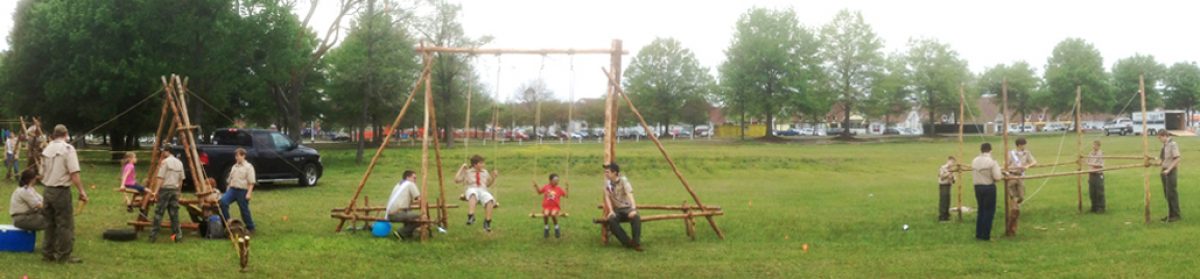
Pioneering Stumbling Blocks (For Those Who Haven’t Gotten Started Yet)

As John Thurman so succinctly states:

“Why Pioneering? To me the overriding reason for presenting Pioneering is that Scouts like it.”

We know with certainty that the majority of Scouts do like pioneering, and the better they get at it, the more they like it. So, if the Scouts have the desire, why aren’t more Scout units providing the remarkable fun that goes hand in hand with building and enjoying a wide range of pioneering structures?

Stumbling Blocks:  -1-    -2-    -3-

The reason or reasons are obvious. Somewhere there’s an obstacle or obstacles, and a problem or problems. If there wasn’t, more and more Scouts would be happily involved in unit pioneering programs, building ever-more wonderful things at camp, on outings, and during camporees. The fun, adventure, involvement and challenges are built right in—and also the success. And, nothing succeeds like success! So lets start right there:

STUMBLING BLOCK 1: Nothing Succeeds Like Success!

Generally speaking, experiencing failure is not great for sparking enthusiasm and rarely results in an exclamation like, “Hey! That was fun!” In his book Pioneering Projects, Gilwell Camp Chief, John Thurman wrote, “if any Patrol, Troop, or Scouter tries to start pioneering before establishing a sound background of basic Scout training in regard to knotting and lashing, then pioneering will become unpopular and will go down in the history of the Patrol or Troop as a failure.” Why? Because without the prerequisite skills, the structure won’t work or stay standing. That’s no way to equate pioneering with something the Scouts can successfully accomplish, and that’s no fun.
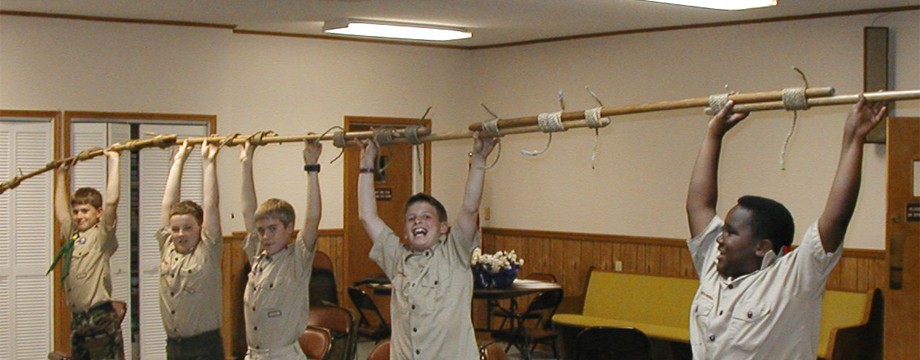
An Introduction to Round Lashing for New Scouts During a Troop Meeting

But, just teaching Scouts the ropes is not enough! Unless the training sessions on knotting and lashing are “tied” to some fun or practical application, then repeated knot-tying and lashing sessions will be a source of exasperation and boredom—an inevitable turn off. Not good! After introducing some basics, give the Scouts a real opportunity to put them into action! Not with an elaborate project, but with a challenge or game where they actually get to use what they learned.
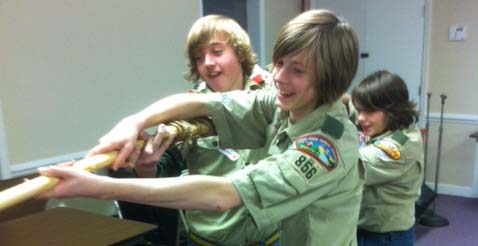
Scouts use they're round lashings to play
Scouts use they’re round lashings to play “Catch the Snapper.”

(Refer to Favorite Scout Meeting Challenges.) Make sure the activity matches their skill level. That way, success is assured, and each new success is a building block to a bigger one. When these initial forays into pioneering are successfully carried out, then it’s a sure bet that actually building the useful camp gadget and larger campsite improvement will result in its own success story with a tangible outcome in the form of a concrete accomplishment. “We built that!”

Now, if the youth and adults are really interested, what else will hold a troop back from implementing an effective Pioneering program?

STUMBLING BLOCK 2: Lack of Scouter Training.
Pioneering Team Building Challenge at a Camporee

(a) It’s possible the Scouters themselves don’t possess the necessary knowledge and skills required to introduce their Scouts to the knotting and lashing techniques required to construct even a simple camp gadget, not to mention a bridge.

No excuse. The basic knowledge and skills required are super easy to gain. Knot and lashing diagrams, online animations and demonstrations, and learning sessions from fellow Scouters are available to one and all. What it takes is devoting some time to mastering each technique so it can be passed along directly to the Scouts or to those who will be doing the instructing. VIEW: HOW-TO PIONEERING SKILL VIDEOS

(b) Perhaps the Scouters never actually built the pioneering projects themselves, resulting in a natural hesitation to embark on ventures into unfamiliar territory. When there’s a desire to get into pioneering, but there is very little or no pioneering experience, the best training by far is from qualified individuals who have presented a well-rounded pioneering program to their units and have themselves helped provide the opportunities to successfully build the projects. In lieu of that, a great place to start is to get information that is both understandable and dependable. Successful pioneering programs have been developed from scratch by utilizing the 1993, 1998 edition of the Pioneering Merit Badge Pamphlet by Adolph Peschke. The pamphlet is like an A to Z primer on the modus operandi of basic pioneering.  Additionally, as a source of comprehensive information, the book Scout Pioneering spoon feeds the reader with practical approaches and ideas.

STUMBLING BLOCK 3: Lack of equipment.

Lack of equipment is easily the most understandable of all deterrents. Naturally, when there are limited or even zero materials, implementing a unit pioneering program can be daunting proposition. For smaller camp gadgets you can use sticks, Scout staves and binder twine. But, for larger projects, you need the right kind of lashing ropes and the right kinds of spars.
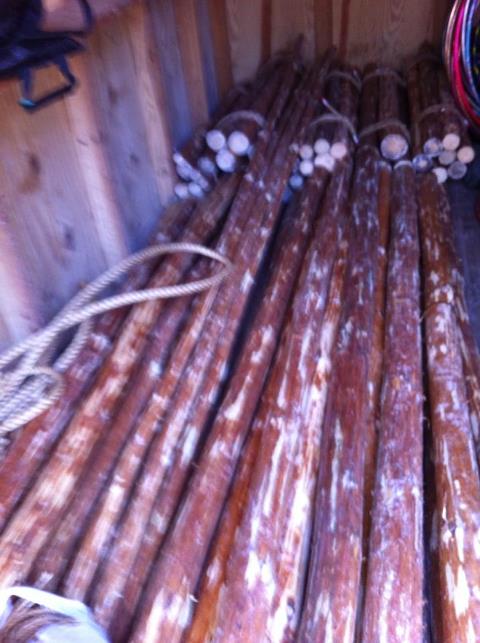
A collection of pine spars ready for transport to the unit's storage facility.
A collection of pine spars ready for transport to the unit’s storage facility.

A favorite John Thurman quote is, “Determination remains the enduring answer to most problems.” So, coupled with the determination that Scouts will be rewarded with rich pioneering experiences, here are some avenues to pursue:
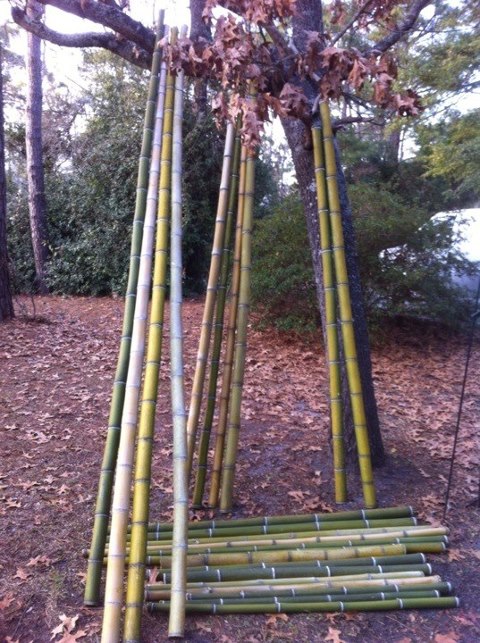
A collection of bamboo, the quantity and size to build the chosen project.
A collection of bamboo, in the quantity and size to build the chosen project.
  • Make an ongoing and concerted effort to get everyone on deck to help locate and gather the materials needed to build the targeted project(s). This is a whole lot easier and more practical than when one individual takes on the responsibility all by themself.
  • Check with the owners of land where there are stands of trees that are good for making spars, sharing with them what you want to do with the spars, and offering to do a little unnoticeable thinning out of some trees, which will be beneficial to the overall tree population. Forest Stewardship
  • Start with what you need. Expand as you go. Necessity is the mother of invention.
  • Team up with other Scouters in neighboring units, in the District, or in the Council, and put together a pioneering kit for communal use. (For a unit interested in putting together their own pioneering kit, a good place to start is to gather the materials necessary to undertake the specific project or projects the unit wishes to build. More supplies can be added to the unit’s kit to meet additional demands for materials, as required by the desire and wherewithal to tackle new and different projects.)
  • Gather the materials you need based on where you are in the cumulative pioneering process. Start with what’s necessary for training and interpatrol activities, and then add the components required for a chosen project, starting from the more simple, e.g. a Double A-frame Monkey Bridge. That way, you can start building your pioneering program around the specific project you’ve got in your sights.
  • If you’re in an area that just ain’t got no trees, check into building a pioneering kit made up of laminated spars.

Nothing really worth doing is ever really easy. The keys are a willingness to learn, a desire strong enough to motivate you to persevere, and the sound conviction that: this is going to be great!

As John Sweet says in Scout Pioneering, in regards to giving Scouts the opportunity to experience the joys of Pioneering, “…greater efforts are obviously needed to open up this adventurous, creative, challenging Scouting activity to the Scouts who would undoubtedly revel in it if given the chance to do so. Everything, finally, will depend on the attitude of the Troop Scout Leader, and they are the one who must be won over. Scouters who are themselves well-versed in the simple techniques of pioneering will need no encouragement and might even have to be restrained! To the others, a vast company, we would merely say that in all fairness they should at least allow their Scouts to have a go. One thing is pretty certain. If they do they will add another dimension to their training programme.”

(Questions? Call or email.)

Scouting’s Traditional Outdoor Skills

Timeless Attraction. The mission of the Boy Scouts of America is to prepare young people to make ethical and moral choices over their lifetimes by instilling in them the values of the Scout Oath and Scout Law. The purpose of the Boy Scouts of America, incorporated on February 8, 1910, and chartered by Congress in 1916, is to provide an educational program for youth to build character, to train in the responsibilities of participating citizenship, and to develop personal fitness. The Mission and Purpose of the Boy Scouts of America are and shall forever remain unchanged.

One Legged Fire Crane
A Dovetail Notch is used to fashion a “One-Legged Fire Crane” to boil water in a fire pit at Scout camp.

At the same time, the contribution that our heritage of outdoor skills makes to the richness of the Scouting experience is also unchangeable. Over the years, as evidenced in the contents of various Scouting publications, as well as the offerings and general layouts of a cross section of Scout camps, some “old school” Scouters might have observed there’s been something of a gradual shift away from the emphasis on many traditional campcraft skills that for a hundred years have attracted young people to our movement. Naturally, the BSA is rightfully compelled to keep up with the times, assuring the Scouting program is relevant to today’s youth. However, even though Scouts of today are understandably attracted to the new developments and technological advances obtaining in the modern world, when they are also exposed to the many timeless skills that were practiced by resourceful frontiersmen and passed down through the ages, they are still eagerly receptive and captivated by the undeniable mystique. Many experienced Scouters find it regrettable that as a matter of course today’s Scouts are not granted the same opportunities to experience what is too often mistakenly construed as out-of-date or old-fashioned. The outdoor skills that in the past inspired many ideas, activities, and Scouting fun, are still relevant and useful, even in the midst of this fast-paced digital age.

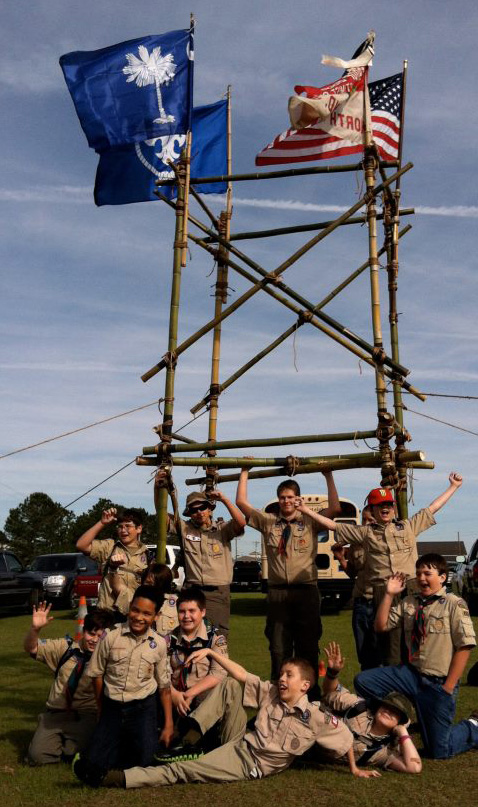
Scouts strike a pose after hoisting their Four Flag Gateway Tower at a Scout Expo.
Scouts strike a jubilant pose after hoisting their Four Flag Gateway Tower at a Scout Expo.

Are we Denying Our Youth? Because there are so many additional, modern program ideas prevalent in Scouting today, it’s easier than ever to deny our youth much of the magic and wonder that in the past attracted many Scouts of yesterday. When demonstrating the art of fire making, elaborate camp cooking, pioneering, and pre-modern technology campcraft, the Scouts in attendance are openly enthusiastic. The fact is, many of today’s Scouts love this stuff—just like many did over half a century ago! Stating this as fact does not stem from simple nostalgia for the good old days. Neither is it motivated by an attempt to alleviate the disappointment experienced when seeing that many of today’s Eagle Scouts can’t light a fire in the rain or put up a traditional dining fly with guylines and tent stakes. The statement is repeatedly born out by Scouts’ reactions. Trumpeting this simple fact is motivated by what is maintained to be a path the BSA should take in conjunction with new, high-tech developments and STEM—a path to increase membership and retention—a launching of a renewed emphasis throughout our movement on the timeless, traditional outdoor skills.

Youth Relevant. We all believe Scouting has to keep up with the times. The BSA must keep its program “youth-relevant.” But, at the risk of being redundant, amidst the wide spectrum of fun available in Scouting, there’s always an attraction to and fascination with what’s termed, “old school.” It’s apparent, along with the new push for the STEM/Nova program, and all the “high adventure for the mind” merit badges like space exploration, digital technology, and robotics, a large population of today’s Scouts are still greatly enamored with acquiring the skill sets revolving around wilderness survival, the building of an impressive pioneering structure, and the creation of an amazing, front country campsite.

StavesDiningFly4
Round Lashings join tougher two Scout staves for the upright poles of a patrol dining fly.

What is the Concern? Outdoors and camping are still at the heart of Scouting, but the concern revolves around the de-emphasis and absence of many skill sets that don’t depend upon the use of high-tech substitutions. As an example, take the advent of the widely-used, prefabricated, metal-framed dining flies. In conjunction with using this kind of camping shelter, shouldn’t today’s Scouts also be adept at putting up a dining fly using a tarp, Scout staves, guylines and stakes? In addition to advantages like ease of transport and durability, think of the useful skills they’d utilize:

  • Two Half Hitches (or Bowline) at the grommets
  • Taut-line Hitch at the stake
  • Round Lashing two staves together to form taller uprights
  • open-end Half Hitches (Clove Hitch on a Bight) where the ridge line and/or guy lines meet the uprights
  • mensuration involving the positioning of both the guylines and the stakes
  • a whole lot of teamwork

Imagine further, knowing how to improvise their own stakes (without impacting the environment) and using their resourcefulness to attach the guylines when the tarp had a ripped out grommet or no grommets at all.

BP’s Ideal CampBaden-Powell said, “My ideal camp is where everyone is cheery and busy, where the patrols are kept intact under all circumstances, and where every patrol leader and Scout takes a genuine pride in his camp and his gadgets.” For a front country outing, and especially for a long-term camp, why not bring all the materials needed to build an array of useful, impressive, and fun camp gadgets? Scouts can put together everything using their walking sticks with zero environmental impact. 

Page 384
Two Half Hitches

Relevancy and Usefulness. An experienced Scouter recently commented on a LinkedIn poll, that Scoutcraft skills are relevant today, “IF they’re taught in conjunction with the WHY and not just the HOW.” He stated that Scouts need to be able to make a connection that is relevant to them. As an example, he sited teaching two half hitches is “the proper knot for connecting a guyline to a dining fly” but “is irrelevant if your troop doesn’t use dining flies or if you have the ones with the nifty little plastic widgets where a proper taut-line hitch is supposed to go.” He concluded his comment by stating, “make it relevant and they will learn AND retain.” Learning to tie two half hitches (clove hitch around the line’s standing part) to attach a guyline to the grommet of a tarp is, as mentioned, part of an array of skills that can come into play when erecting a dining fly in one of the “old-fashioned” ways. These kinds of skills can be very relevant when:

  • new-fangled stuff malfunctions
  • there’s a shortage of manufactured paraphernalia
  • it’s necessary to utilize one’s resources
  • you just want to have fun being impressive using so-called “primitive” camping techniques.

Using “nifty, little, plastic widgets” is fine, as is erecting a shelter with a metal framework when “car-camping.” But, it’s also practical to know how to put up a tarp “Philmont-style.” The knowledge and abilities that lie therein can be VERY useful! Scouting is both the time-tested old and the attractive new!

Focus
Patrol Challenge: Hot Isotope Transport

Presenting Scout Skills. Outdoor Scout skills, are presented best and most effectively, when done so in conjunction with activities. That’s activity-based instruction! After the Scouts are enabled to actually demonstrate the skill, they should do something with it that: engages them, that illustrates its use, and that’s FUN! Just look at the expressions on the faces of Scouts while they are involved in putting their skills into action in a way that’s challenging and fun, and you’ll be able to gauge not only their high level of involvement, but also their pleasure. John Thurman, Camp Chief at Gilwell for over 25 years, alluded to this in one of his many books, Pioneering Projects. I quote, “It is all very well to learn to make knots, bends, and hitches, and to lash things together. Up to a point this is an interesting activity, but inevitably it begins to pall unless the Scout is given a chance to do something effective, interesting and to some degree adventurous with their knowledge.” For example. staging a rope tackle tug-of-war  in conjunction with  introducing the rope tackle demonstrates in a memorable way that’s lots of fun how this configuration provides a useful mechanical advantage, when one needs to apply proper strain on a line.

An “Old School” Advantage. “Old School Scouting” skills can live happily side by side with high-tech advances. But, when new materials are not available, or malfunction, a Scout should be equipped with the skills to make use of whatever is at his disposal. Hand in hand with learning and applying Scout skills is resourcefulness, ingenuity, and using our available resources to make things happen.

Recently, I was on the beach and needed to erect a sun shelter for a July 4th festival. The festival hosts had furnished one of those store-bought, 10’x10′ canopies with a cloth top and metal framework. Well, it was windy and the canopy would definitely need to be anchored. But, in the sand, there was no way the skinny, little stakes it came with would ever supply enough resistance to keep the structure from blowing away. So…what to do? I found four, large pieces of driftwood, attached a 15′ braided, nylon guyline to each (I just happened to have a supply of these in my vehicle), and buried the driftwood in the sand 45º out from each corner. After securing the lines to the four corners of the metal framework with a “Boy Scout knot,” the whole thing was stable and wind resistant. The festival folks thought I had performed magic! Not magic to a Scout—just applying a little Scout perseverance and creativity, which in this case was the wherewithal and knowledge of how to make “dead man anchors.”

Rope Tackle
Rope Tackle (Truckers Hitch)

It’s Useful Stuff. In 1994, pioneering legend, Adolph Peschke introduced me to the butterfly knot and tying a rope tackle. Suffice it to say, I’ve used this outdoor skill on numerous occasions. It’s very effective, very handy, and very useful, especially in the great outdoors and pioneering. Then there’s the diamond hitch. The prospectors of yesteryear used it to pack their burros. It was one of the many interesting outdoor skills featured so invitingly in the older, older Fieldbook. Of course there aren’t so many burros out there anymore, but we do still see some roof racks and flatbed trailers. Best solution I can think of when you have no bungee cables but have some cordage. Actually, you can keep the bungee cables. The diamond hitch works better!

The Old and the New. It’s all about striking a balance between the timeless and the modern. When I started as a Boy Scout, most all the personal flashlights were double D-sized. Now we have super bright, tiny LED lights. If I had my old light from the late 50’s, though it would still shine a beam, it would be a whole lot less bright and a whole lot more cumbersome than my cute, little LED light. I’m an old guy enjoying my modern technology. On the other hand, take the pre-modern technology, outdoor wood tools skills necessary to prepare the tinder, kindling, and fuel for a fire, when all you have is a log, a hand axe, and a knife. Now, light the fire and keep it burning when all you have are two matches, or maybe, no matches at all. Here you can see that whether it be yesterday and today, these kinds of skills remain constant. And of course, Scouts from both yesterday and today love this kind of stuff!

Cooking Comparison
The old and the new. Scouting is both!

Scouting is both. At the Jamboree, I had the opportunity to sit down with Jack Furst who helps oversee the BSA’s high adventure bases. Being involved with Pioneering, we were discussing various approaches to include a pioneering training program at the Summit. Jack’s “wheels” are always turning, and he put forth an idea that would simultaneously present Scouting in both a marvelous high-tech, and, a fascinating old-school light. For example, on one hand you have a camp kitchen that features the new “GrubHub,” organizer—a chuck box-sized, all-in-one kitchen fixture that has everything including the kitchen sink. On the other hand you have a back-to-basics camp kitchen, cooking area, featuring two forked sticks with a crossbar suspending an 8 quart pot over a zero-impact cooking fire, and a collection of useful camp gadgets made primarily of Scout staves: double A-frame table, tool rack, fire bucket holder, and wash station. Scouting is BOTH!

10857917_354369231410344_2973837487075411257_n-1
“Pioneering is practical and character building…” – Baden Powell

Building Character. According to Baden-Powell (and many others) in addition to being fun, the benefits of learning, and using “old school” outdoor skills is the contribution made to the building of an individual’s character. For example, those of us who are proponents of giving our Scouts repeated opportunities to engineer and orchestrate the construction of pioneering structures understand the set of Scout skills these traditional endeavors incorporate is more than just “knowing the ropes.” Pioneering is all about using one’s creativity, ingenuity and resourcefulness! The Scout Pioneering website states, “Taking part in these projects contribute to the development of self-esteem and nurture a broad sense of accomplishment. They necessitate working hard and working together towards a common goal. Besides being really cool and impressing people in and out of Scouting, they require the mastery of a set of useful Scout skills that can be applied over a lifetime of outdoor activities—activities for both work and recreation.” Quoting B-P, “Pioneering is practical and character building: the two essential ingredients of any program material for Scouts.”

Series2
Scout Stave Launcher

Pioneering. Quoting John Thurman, Gilwell Camp Chief for over twenty-five years, “There are few activities which, properly presented, have a greater appeal to the Scout and Senior Scout than Pioneering and ever since the introduction of Wood Badge training, Pioneering has been given a full share in the program of Scouters’ training.” Very recently I visited a troop located out in the SC boonies. The Scouts in this troop are a gung-ho, gang—eager and receptive. That’s why you gotta love ’em. The purpose of this first of three consecutive visits, was to give them the tools they’d need to put up a Double A-Frame Monkey Bridge at their council’s Scout Expo. The sixteen Scouts in attendance responded very favorably to each aspect of a well-presented EDGE approach to tying the Mark II Square Lashing. There was learning and there was laughter! The subject matter was old school, traditional Scout skill stuff, and they gobbled it up! After they were enabled, and as a culminating activity, their SPL divided them into four crews to make Scout Stave Launchers. That’s when the real fun began!

SingleTrestleVertical
Pioneering Merit Badge Class on their Single Trestle Bridge

Scout Engineering. Personally, I’m a fan of the STEM/Nova program. Along these lines, a machine that tests the tensile strength of knots sounds like fun! Great way to show how the symmetry of a knot’s shape along with other factors will effect its efficiency. It also might provide a platform to study how various knots hold up under stress without slipping, and how some work better than others on wet or slippery rope. But, there’s a dichotomy here that exists as follows: on one hand a component of a traditional Scout skill is being examined scientifically, and on the other hand, the skill isn’t actually being applied to contribute to an outdoor experience that is enriching and fun. Approaching knots and lashings from a scientific standpoint is one thing. Putting them to use when raising a bear bag or building a pioneering structure like a Single Trestle Bridge is quite another. Pioneering has been termed “Scout Engineering.” B.-P. wrote, “I am inclined to suggest to Scouters that in addition to the technical details of knotting, lashing, and anchorages, there is an educative value in Pioneering since it gives elementary training in stresses, mensuration, etc.”

Along these lines, John Thurman relates the following: “Pioneering is not old-fashioned in its purely technical sense. I was showing a Managing Director of a large civil engineering firm round Gilwell when a Wood Badge Course was pioneering near the Bomb Hole. He displayed very great interest in the Pioneering and looked closely at all that was happening. From our point of view there was nothing unusual going on; this was a usual routine exercise with two or three bridges being built, a couple of towers, and a raft. As we walked away my civil engineering friend said, ‘I am delighted that the Scout Movement is still doing this: it is tremendously important. Despite the fact that modern machinery and equipment is magnificent there often comes a time when a man has to use ingenuity and improvise in order to move the job forward and the engineer who has the spirit that your kind of training produces is the man we want in our business’.”

In conclusion. The sentiment shared by many is that it would be most beneficial if Scouting was presented as a value-based program that offers extraordinary opportunities to build character, while learning a broad range of new and timeless outdoor skills that are fun to use, yielding the ability to take care of oneself and others. It’s been repeatedly spelled out: Scout outings provide the magical laboratory for putting these skills into play. As B.-P. wrote, “Scouting is a School of the Woods.” Of course, Scouting also provides numerous other avenues of interest and relevancy. But, in accordance with Scouting’s founders, these areas of learning and discovery will always surround Scouting’s everlasting hallmark—getting out and thriving in the majesty, beauty, serenity, and immediacy given to us by God and forever found in the great outdoors.

Simple Rope Halyard

In the campsite it’s easy to fly the colors by simply tying them directly to the top of the simple flagpole with a couple of short cords. But, on a taller pole that’s going to stay standing, and when you want to raise and lower the flag(s), of course you need a halyard. Here’s one ultra simple recipe that will work with ease and that you can use with confidence:

Materials

  • A length of 1/4-inch nylon cord that is almost twice as long as the flagpole is high. If your flagpole will be thirty-two feet high, sixty feet of cord will work well.
  • 1/4-inch pulley
  • 2 small carabiners for each flag
When joining the ends of  smooth, slippery rope, the water knot won't fail.
When joining the ends of smooth, slippery rope, the Water Knot won’t fail.

Procedure

• Fuse the ends of the nylon cord.

• String on the pulley and join the ends of the nylon cord with a water knot.

The Top of the Halyard

• With an indelible marking pen, mark the middle of the cord. This middle mark will be be just about at the top of the flag pole.

• Stretch out the cord and lay out the flag(s) the desired distance from the middle mark, and using small butterfly knots, tie a fixed loop at each grommet.

• Attach a carabiner to each loop.

Top of the Rope Halyard with the carabiners attached in position.
Top Section of the Rope Halyard with the Carabiners Attached to Match the Positions of the Grommets

When you’re ready to use the halyard, attach the pulley to the flagpole at the top with a prusik or a rolling hitch on a doubled rope. For shorter, lighter flagpoles, in lieu of a bully, the halyard can be reeved through a simple metal ring.

The MOST Simple Halyard

Favorite Pioneering Knots: Water Knot

VIEW VIDEO: How to Tie a Water Knot

Water Knot
Water Knot

Link to: Older Pamphlet InfoThe following text is by Adolph E. Peschke as presented in the 1998 printing of the 1993 edition of the Pioneering Merit Badge Pamphlet:

Water Knot

What could be simpler than tying two Overhand knots to form a water knot? Its use goes back to commercial fisherman who needed to tie the ends of two wet fishing lines together.

In recent years, mountain climbers have found this knot very useful. They use a man-made fiber rope that is somewhat slick and is difficult to be spliced in the field. To tie two ropes together, climbers use the water knot because it’s a simple knot with little bulk and above all, it’s a knot that will not fail.

Mountain climbers also use the water knot to tie a rope seat and to tie the ends of short lengths of rope together to form a grommet (loop) that’s used in many climbing applications. This knot also works well with nylon webbing used in mountain climbing. Basically, the water knot is handy for tying together any types of ropes of the same diameter. In pioneering, whenever you’re using ropes made of man-made fibers that are braided and slick and don’t hold knots well, think of the water knot.

Pioneering Uses

  • To tie together the ends of two wet or slippery ropes.
  • To make a grommet (loop) using all types of rope (braided or twisted). Keep in mind that once strain is put on the knot, it will be hard to untie.
  • To tie together the ends of halyards.
  • To tie the ends of flat nylon webbing to make a grommet (loop) or sling.
Begin the water knot by tying a loose overhand knot in the end of one rope. Then bring the end of the other rope over and under the first overhand knot, following the same path but in reverse.
Water Knot

(Another name for the Water Knot is the Ring Knot.)

Easy Tall Flagpole

At most Scouting events, there isn’t a permanently-installed, tall, metal pole for raising and lowering the colors. During opening ceremonies at these Scout gatherings, a tall flagpole made by joining long spars together can impress and inspire.

Opening Ceremony at a District Camporee

What is meant by tall? Naturally, the height of the flagpole depends on the size of the flag and the size of the area where it will be raised. For the most part, the flags used in Scouting are 3 x 5 feet, and the average size outdoor flagpole for a 3 x 5-foot flag is 20 feet. Of course, the main criteria for flagpole height is how far away you want the flag to be seen. But also, flying a flag high is synonymous with pride, and the taller the pole the greater the impact. However, this post is about a simple flagpole and not a pioneering display of goliath proportions. The specific flagpole featured on this page topped out at 32 feet, which was impressive, but not uncanny.

Building and putting up a taller flagpole requires more attention than one for an easy campsite setup, but all in all it’s still a relatively simple operation. Basically, four things are needed:

  1. Long spars
  2. An effective way to join the spars together so the flagpole will be rigid
  3. A series of planned steps to take before standing the flagpole up *
  4. A crew to lift the flagpole to its vertical position

Long spars. Depending on your point of reference, the definition of long spars is relative, and will hinge on what’s available in your geographic area and how practical it is to procure and transport them. Naturally, the longer the spars the fewer you’ll need to make the pole tall, which of course has obvious advantages. Again, depending on your point of reference, a long spar can be seen as having a length anywhere from 10 to 20 feet.

Tall View
Simple, Tall, Pioneering Flagpole

In the flagpole featured on this page, there are three long spars: 16-foot bottom, 14-foot middle, and 10-foot top. The lower the spar, the larger the diameter. The butt end of the next spar up should be as near to the same diameter as possible to the top of the one it’s joining.

West Country Round Lashing Joining Two Bamboo Spars

An effective way to join the spars together so the flagpole will be rigid. Obviously, the rigidity of the flagpole is a primary concern. You don’t want it to bend and  you don’t want it to come apart. It has to ever-withstand the stress of its own weight in a vertical position, as well as the weakening forces of wind, rain, and varying temperatures. When it comes to joining spars together to extend their length, there are basically four lashings that can be employed. For the tightest and most secure lashing, the West Country Round Lashing works really very well.

When the utmost rigidity is required, a quarter of the spars’ lengths should overlap each other. Using long lengths of 1/4-inch manila rope, start each of the two lashings approximately 1-1/2 to 2 inches from the ends of the overlapping spars and tie at least ten tight half knots (overhand knots) towards the middle of the overlap. Depending on the length of the lashing rope and the size of the spars, for added security, additional lashings can be tied e.g. in the photo to the left, where the bottom spar and the middle spar overlap, four West Country Round Lashings were applied.

* A series of planned steps to take before standing the flagpole up. Before transforming the finished flagpole from horizontal to vertical, these steps need to be taken:

  1. Determine the spot on the ground where the flagpole will stand and dig a hole about 4 inches deep with a diameter just a little larger than that of the flagpole’s butt end.
  2. Position the flagpole so the bottom is right over the hole.
  3. To attach the rope halyard, tie a small rope grommet and pulley to the top of the flagpole with a prusik.
  4. Reave the prepared rope halyard through the tackle.
  5. Attach four guylines of the  proper length (see: Guylines.) Tie the guylines to the flagpole about 3/4 up the pole with four rolling hitches. Tie them on so they will each line out to their respective anchors.
  6. Measure out the proper distance from the bottom of the flagpole in four perpendicular directions and mark the spots where the front pioneering stake will be driven into the ground for each 1-1 anchor. The rule of thumb is drive in the stakes at a distance equal to twice the height from where the knots were tied, measured out from the base of the flagpole.

  7. Build four 1-1 anchors in readiness for attaching the four guylines.

A crew to lift the flagpole to its vertical position. When ready, four crew members each take hold of a guyline and position themselves in line with their respective anchors. Additional crew members line up along the length of the flagpole ready to walk the pole up to its vertical position. One member is stationed at the bottom to guide the pole into the hole as the others lift. When everyone is in position, a signal caller gives the go ahead to lift. Those with the guylines pass the ends of their lines behind the front stake of their anchor. Once the flagpole is standing upright, each guyline is secured to its anchor with a rope tackle. Final adjustments can then be made to each guyline until the pole is standing straight.

SaveSave

14′ Gateway Tower (4 Flag Tower)

Coker Four Flags
Gateway to the Boy Scout Camp Pioneering Area

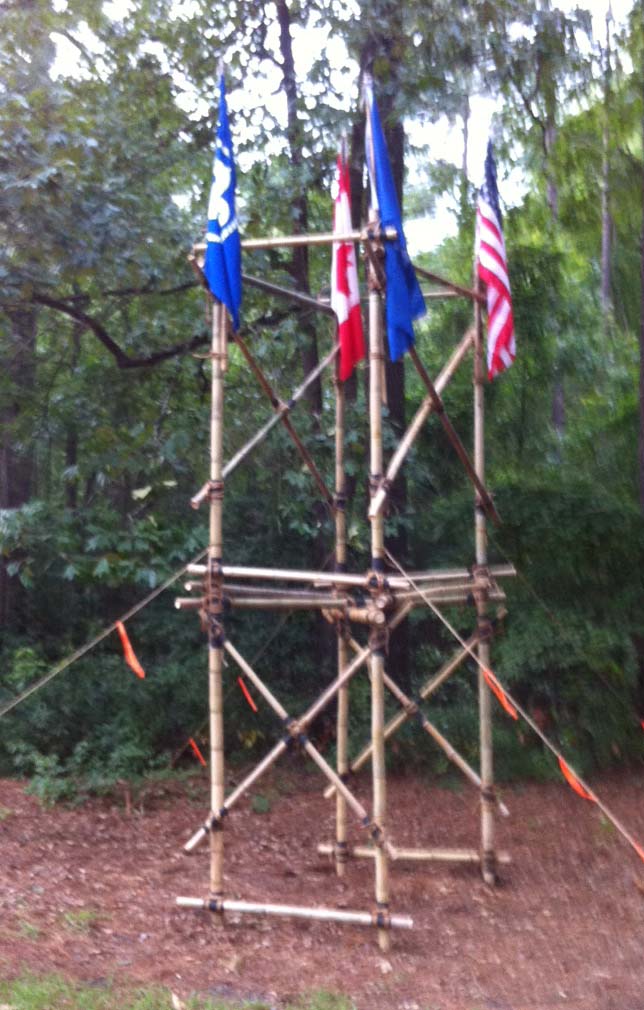
Using the 14′ Double Ladder Signal Tower as a point of reference, here are the plans for a very tall campsite gateway that stands out (and up) and serves as an impressive feat of Scout engineering. One of the perks included in this project is it provides an opportunity for new Scouts to experience hoisting a “boy-sized” structure replete with their own special colors e.g. their patrol flags.

Since this 14-foot structure isn’t climbed on, the spars can be considerably thinner in diameter. Bamboo is ideal. Lashing on those flags attached to each corner creates a spectacular effect and hence the name “4 Flag Tower!”

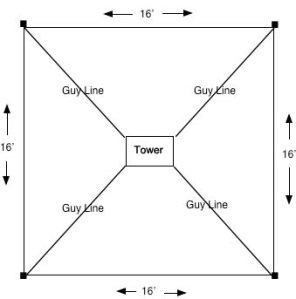
14′ Tower Gateway Schematic / Gateway to a Scout Expo Photo

Note: This design is not self-standing. Therefore, using it as a gateway at a camporee or Scout Expo with the necessary guylines requires an area wide and deep enough to accommodate a 16 x 16-foot space.

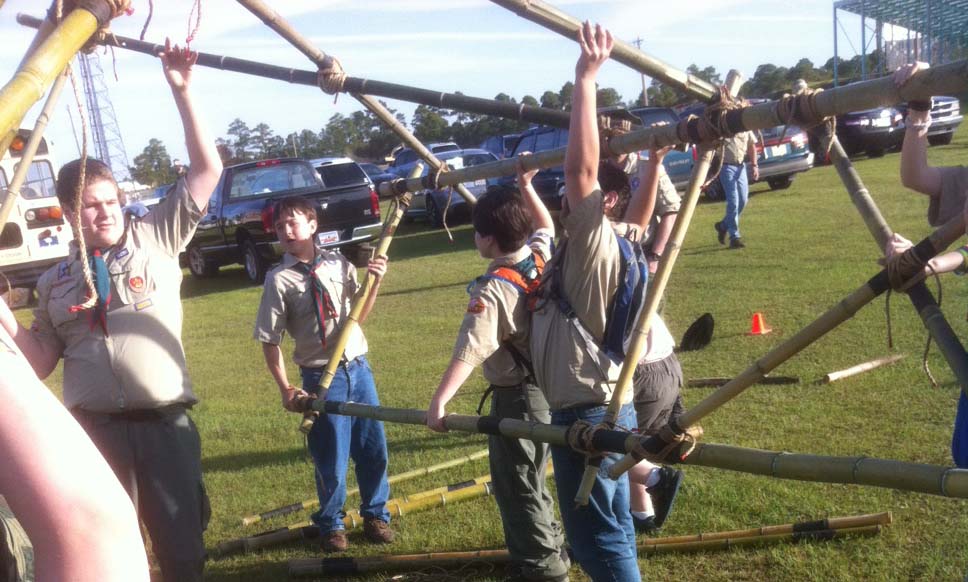
Scouts lash together a 4' Side.
Scouts lash together a 4′ Side.

Materials Needed:

  • four 2-1/2 to 3-inch x 14-foot leg spars
  • six 2-inch x 8-foot X-brace spars
  • four 2-inch x 6-foot X-brace spars
  • four 2-inch x 6-foot support spars
  • six 2-inch x 4-foot leg spreader
  • forty-five 15-foot x 1/4-inch lashing ropes
  • four 25-foot guylines
  • eight 24-inch pioneering stakes

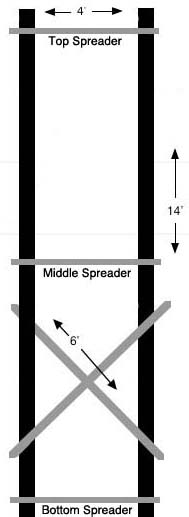
Assemble the 4-foot sides. Begin by laying out two pairs of 14-foot spars for the tower legs, side by side, 3 and 1/2 feet apart. Be sure the butt ends are even at the bottom so the tower will stand up straight.

NOTE: All lashings need to be very tight.

Diagram 1
Diagram 1

Lash the legs together starting with a 4-foot bottom leg spreader about 6 inches up from the butt ends. Lash on a 4-foot middle leg spreader in the middle of the 14-foot legs (7 feet up), and a 4-foot top spreader about 3 inches from the top of the 14-foot legs.

When the legs are joined with the three 4-foot spreaders, lash on two 6-foot X-brace spars using square lashings to lash the ends to the legs, and a diagonal lashing where they cross, forming a trestle in the bottom half of the legs (see diagram 1). Three of the ends are lashed to the outside of the legs, and one on the inside, so that a slight gap is created where they cross. As the diagonal lashing begins, this gap will be cinched together with the timber hitch. Repeat the whole process with the other two 14-foot legs.

Diagram 2
Diagram 2

Join the 4-foot sides. Turn both sides up horizontally, parallel to one another about 5 and 1/2 feet apart. Make sure the bottoms are even.

Lash on one of the 6-foot support spars directly above the 4-foot middle spreader (see diagram 2).

Lash another one of the 6-foot support spars directly under the 4-foot side spreader at the very top.

Lashing the X Braces with a Diagonal Lashing.

Now, lash on two of the 8-foot X brace spars diagonally between the two 6-foot supports using square lashings to lash the ends to the legs, and a diagonal lashing where they cross forming a trestle in the top part of the wide (6-foot) side (see diagram 2). Three of the ends are lashed to the outside of the legs, and one on the inside, so that a slight gap is created where they cross. As the diagonal lashing begins, this gap will be sprung together with the timber hitch.

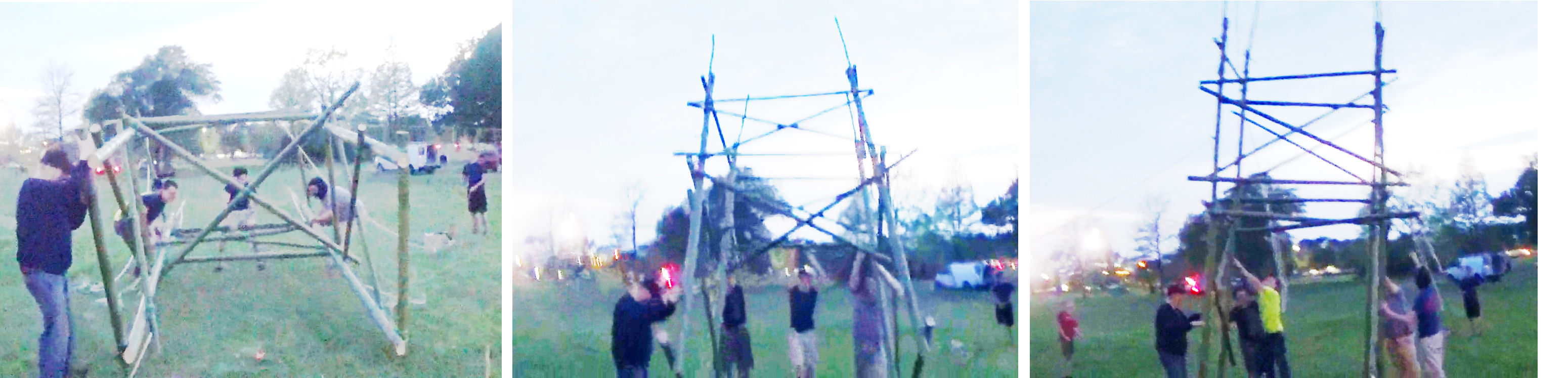
Lash the other side. To make the lashings on the other side, you have to get the whole crew together to carefully lift and roll the tower over 180° so that it’s laying on the X-brace, and the other sides of the 4-foot sides are easier to get to.

Repeat the same procedure as before.

Scouts carefully lift the structure and rotatie it 180° to lash the other side.

Lash on the middle X-brace.  This X-brace is what will keep the four sides from racking. Lash the two remaining 8-foot X brace spars diagonally across the legs just under the 4-foot middle leg spreader (see Tower Gateway Schematic on the top of this page). Use square lashings to lash them to the legs and a diagonal lashing where they cross. To accomplish this, some crew members will have to hold up the top of the tower so that  there is better access to all four ends of the 8′ X brace spars.

Lash on the flags. If you want a flag or flags to fly from the top of the tower, lash the flagpole(s) to the top of each tower legs using a couple of tight round lashings.

Tower Gateway Layout

Anchors and guylines. When all the lashings are done, move the tower to where it will be hoisted. Before actually hoisting the tower, lay out the position of the four legs on the ground.  Then determine where the four anchors for the guylines will be placed to steady the legs of the tower.

Using the pioneering stakes, build four 1-1 anchors. Each should extend 16 feet, 45° out from the leg.

Attach the four guylines to the legs about 12″ above the middle 4′ spreaders with a roundturn with two half hitches.

NOTE: Make sure the flags are unfurled before hoisting the tower.

Hoisting the tower. You’ll need a whole crew to do the hoisting. Get ready to hoist the tower by delegating the following:

  1. One signal caller who tells the crew members when and how fast to pull on the ropes.
  2. One safety officer who observes for all safety considerations and signs of trouble during the hoisting.
  3. Four Scouts to serve as “Lifters” to lift the top 6′ support spar that’s on the ground. Their job is to first left and then push the tower up.
  4. Two Scouts, one on each of the 2 guylines attached to the legs, to make sure the tower isn’t over pulled and topples over
  5. Four “Pullers” who will use the two guylines as hoisting ropes to pull the tower until it is standing
We did it!
We did it!

When everyone is in position, the signal caller should direct the Scouts on the hoisting ropes (the pullers) to hoist the tower into position, while the lifters start lifting. Care should be exercised not to over pull the tower.

As soon as the tower is standing, four Scouts should temporarily tie the guylines to the anchors using a roundturn with two half hitches.

Heeling the tower. If the tower is uneven, you can heel the the butt ends of the legs 4 to 6 inches deep as needed to make it more level.

Tighten the guylines. As soon as the tower is in position, go to each of the anchors and untie the Roundturn with Two Half Hitches and replace it with a rope tackle. Use the rope tackles to hold the tower steady, by gradually applying strain to each of the four guylines at the same time. Do this by tying a butterfly knot in each guyline about 6 to 8 feet from the anchor. Then wrap the running end of the guyline around the forward stake of the anchor and back through the loop in the butterfly knot. When rope tackles are tied to all four anchors, gradually tighten the lines. Apply enough strain to each of the guylines to hold the tower firm and in a vertical position. Then tie off the rope tackles and secure the running ends with half hitches.

Hoisting a Larger Version: 17' high x 8' wide x 6' deep
Hoisting a Larger Version: 17′ high x 8′ wide x 6′ deep

Double Platform Monkey Bridge

Project completed in time for a Scout Expo by a Pioneering Crew for Chicora Chapter, Santee Lodge No. 116, Order of the Arrow
Double Platform Monkey Bridge

It’s a pretty safe to say most Scouts love to climb things. So, it makes sense that if a monkey bridge is combined with something to climb on, it will be even more fun. The challenge in constructing a project like this is to assure the structure can safely support not only the weight of those climbing on the platforms, but also the continual stress created by repeatedly crossing the rope bridge. Building this version of a double platform monkey bridge entails quite a few subassemblies and a procedure with many steps. Basically, with the materials listed, the ropes span a distance of 25 feet between two identical square platforms 4 feet wide and 8 feet high. At the front of each platform is an X-brace just under 5 feet high, providing a V for the foot rope. The hand ropes run through the junction where the X-braces intersect the top of the front legs, and then extend down joining the foot rope at a log-stake anchor 10 feet behind the back of each platform.

Bridge in operation during a Scout Expo

Here are the materials needed to construct the project:

  • eight 8-foot x 4-inch spars for platform legs
  • four 8-foot x 3-1/2-inch spars for X-braces
  • four 6-foot x 2-1/2-inch diagonal side braces
  • eight 4-foot x 3-inch spars for side base spreaders (4) and platform supports (4)
  • sixteen 4-foot x 2-inch spars for ladder rungs (10), handrails (4) and X-brace leg spreaders (2)
  • twenty-four 4-foot x 2-inch floor spars
  • two 4-foot x 4-inch log and stake anchor logs
  • sixteen 30-inch pioneering stakes for 2 log-stake  anchors
  • sixteen large wooden stakes for the 8 guyline 1-1 anchors
  • sixteen small tourniquet stakes
  • two rope grommets with large O-rings
  • one 70-foot x 1/2 or 3/4-inch manila foot rope
  • two 70-foot x 1/2-inch manila hand ropes
  • eight 8-foot x 1/4-inch manila spanner ropes
  • thirty-six 15-foot x 1/4-inch manila lashing ropes
  • twenty-six 20-foot x 1/4-inch manila lashing ropes (for X-braces, base spreaders and platform supports)
  • eight 25-foot x 3/8-inch manila guylines
  • four 35-foot x 1/4-inch manila lashing ropes for floor spars
  • six burlap or canvas saddles (for the foot rope and hand ropes)
  • two large mallots
  • Binder twine
  • Tape Measure
Anchors are being built as sides are being connected.

Tips:

• Participants should be well-acquainted and experienced in the skills required for building this project.

• Select a project leader who will divide the participants into work groups, assign tasks, and oversee operations.

• Before proceeding, position the materials in proximity to the location where the project will be placed. It’s good to organize the materials by the tasks for which they’re needed.

• Depending upon how many Scouts are participating (will there be a small group of 6 Scouts, or a large group of 24), many of the subassembly steps needed to finish the project can be completed simultaneously. This division of labor can enormously streamline the project’s completion.

• If the opportunity presents itself, it can very  helpful to initially lay out the hand and foot ropes, in conjunction with completing Task E, before proceeding with Tasks A & B.

• The following tasks can be completed at the same time:

  1. Tasks A 1 & 2  /  B 1 & 2  /  Tasks D  1 & 2 and E
  2. Task C  1  /  Task C  2
  3. Task F 1 & 2 /  Task H 1 & 2
  4. Tasks I & J  /  Tasks K, L & M

• If one task is taking longer to complete, workers from other groups can lend a hand and help finish it up so the next step can commence.

• Placing a 4-foot spar underneath the spars lying on the ground, in a strategic position, will raise the project sides up and make lashing much easier.

• There are 64 square lashings in this project and, for stability and safety, they must be tight! For speed and efficiency, the Japanese Mark II Square Lashing is highly recommended.

Ladder Side
Schematic of Ladder Sides

TASK A – 1 & 2: Building the ladder sides of the platforms. 1) Lay out two 8-foot legs side by side. Space the spars apart so that the distance from the middle of each spar, at both the top and bottom ends, is 40 inches. Use a tape measure. Also, make sure the butt ends are at the bottom and absolutely even. Starting 6 inches up from the butt end, connect the legs by lashing on a 4-foot ladder rung directly above the 6 inch mark, with tight square lashings.

Using a tape measure, measure 5 feet up from the butt end of each leg, lash on another ladder rung, directly below, just touching, the 5-foot mark, ON THE OTHER SIDE (what will become the inside) of the legs. See the diagram on the right.

Right in the middle of these two ladder rungs, lash on another ladder rung, and then, between the middle ladder rung and the top and bottom ladder rungs, lash on two more. Use tight square lashings.

2) Repeat the whole process on two other 8-foot legs for the other platform.

Assembling the X-Brace Side
Assembling an X-Brace Side

TASK B – 1 & 2: Building the X-brace sides of the platforms.

The premise for these sides is the X-braces have to cross each other  just under 5 feet for the foot rope, and they have to intersect the tops of the legs equally on each side for the hand ropes. Because of the size of the spars involved, and the necessity for very secure connections that do not shift, use 20-foot lashing ropes and two Scouts for each X-brace square lashing.

1) Lay out two 8-foot legs side by side. Space the spars apart so that the distance from the middle of each spar, at both the top and bottom ends, is 40 inches. Use a tape measure. Also, make sure the butt ends are at the bottom and absolutely even. Starting 6 inches up from the butt end, connect the legs by lashing on a 4-foot ladder rung as a leg spreader, directly above the 6-inch mark, with tight square lashings.

Schematic of X-Brace Sides

With a tape measure, mark 56 inches up from the butt end of each leg.

Temporarily stretch a piece of binder twine over each 56-inch mark and tie it to each leg to help define where this intersecting line lies. It’s at the middle of this line where the X-braces need to cross so that the foot rope will extend just underneath the floor spars of the platform.

Lay out an 8-foot X-brace spar diagonally in such a way that the top end lays over one leg about 4 inches from the top of the leg, and extends out approximately 6 inches from the side. Angle the spar so that it will cross the middle of the intersecting line (56 inches up from the butt ends of the platform legs). Line up the bottom end of this X-brace so that it is positioned under the bottom of the opposite leg. Lash the spar in place with tight Square Lashings.

Lay out a second 8-foot X-brace spar on top of both legs so that it creates an X.  Angle this spar so that it will cross the middle of the intersecting line (56 inches up from the butt ends of the platform legs). Make sure this spar also extends out approximately 6 inches from the side and that it intersects the leg at the same distance from the top as the X-brace on the other side. Lash this spar in place over both legs with a square lashing. It’s between the top of the front legs and the extension of the X-braces that the hand ropes will be supported.

Now, with a diagonal lashing, lash the middle of  both 8-foot X-braces springing them together where they cross, using a 20-foot lashing rope.

2) Repeat the whole process with the two remaining 8-foot legs.

Schematic of Connecting Side
Schematic of Connecting Sides

TASK C – 1 & 2: Connecting the Ladder and X-brace sides. (If Task E has already been completed, before joining the ladder and X-brace sides, carry the two completed sides for each platform to the approximate location where they will eventually be positioned.)

1) Turn both a ladder side and an X-brace side up horizontally, parallel to one another. On the X-brace side, make sure the leg spreader and the X-brace spars are facing out. Space the legs apart so that the distance from the middle of each leg, at both the top and bottom ends, is 40 inches. Use a tape measure. Also, make sure the butt ends are absolutely even. With tight Square Lashings, join both sides by lashing a 4-foot side base spreader to the legs just below the bottom leg spreaders with a 20-foot lashing rope.

On the inside of the platform, using a 20-foot lashing rope, lash a 4-foot platform support to both legs so that the top edge comes up to 58 inches on both sides (directly under and as close as possible to the top ladder rung on the ladder side.). We will be laying the floor spars on top of this support.

Lash a 4-foot hand rail (same as ladder rung) to the top of both legs.

Lay a 6-foot diagonal side brace diagonally over both legs, between the base spreader and platform spreader, and lash in place using square lashings.

To join the other side, carefully lift and roll the platform over 180°, supporting the spars as much as possible, and repeat the above steps.

2) Repeat the whole process to join the ladder side and X-brace side of the other platform.

TASK D: Stand the platforms upright. With three Scouts lifting at the ground-level handrail, and two to three pulling on the other handrail, raise the platform to an upright position. If TASK E has been completed, we can proceed to Task G.

TASK E: Site preparation. Begin by stretching a length of binder twine along the center line of where the ropes will span. Drive a tent stake into the ground marking the center.

Working from the center, measure 12-1/2 feet toward each end and drive another tent stake to mark where the X-braces of each platform are to be placed. They should be 25 feet apart. Then with two other tent stakes, mark out another 14′ to where the anchors are to be built.

25' span, 4' platforms, 10' to anchors
25-foot span, 4-foot platforms, 10 feet to anchors
Log Stake Anchor Diagram. Click image for larger view.
Log Stake Anchor Diagram

TASK F – 1 & 2: Build the anchors. The foot and hand ropes will be attached to anchors at both ends.

1 & 2) Build a log-and-stake anchor (also known as a log and picket holdfast), 14 feet from where the X-braces of each platform are to be placed. To make the log-and-stake anchors, place one of the 4-foot x 4-inch logs perpendicular to the pull of the line, 14 feet from where the X-brace side will be. Drive in a row of four pioneering stakes spaced evenly in front of the log, leaning them back at a 45° angle. Slip a rope grommet through an O-ring and then slip the ends of the grommet around the log (see diagram). Drive a second row of pioneering stakes 24 inches behind the front stakes. Then anchor the front pioneering stakes to the rear pioneering stakes with a tourniquet made of binder twine or rope using four tent stakes. After twisting the tourniquet tight, hammer the tent stake into the ground to keep it from loosening.

TASK G – 1 & 2: Position the platforms. All hands on deck! Move both upright platforms into position no more than 25 feet apart. Place them on the binder twine that marks the center line of the bridge, making sure the X-braces of each are facing each other 10 feet from the center mark.

Bridge in Operation at a Council-wide Scout Expo

TASK H – 1 & 2: Lash on the floor. Lay 4-inch floor spars on top of the platform supports so that the ends extend out evenly on each side. Using the Double Floor Lashing and the 35-foot lashing ropes, lash the floor securely in place.

TASK I – 1-8: Add anchors for platform guylines. For added stability, we’ll be adding four guylines to each platform. To start, measure 10 feet, 45° out from each leg and drive in a 1-1 anchor.

TASK J – 1-8: Secure the platforms. Attach one of the 25-foot x 3/8-inch guylines to each leg, directly above the floor spars, with a roundturn with two half hitches.

Extend the guyline down to the corresponding 1-1 anchor and attach it to the anchor with a rope tackle. Repeat this process at each leg.

TASK K: Foot rope. First place a piece of heavy canvas (called a “saddle”) in the top V formed by the X-braces. This will protect the foot rope and allow it to slide a little as needed.

If the foot and hand ropes are not already laid out during Task E, two Scouts will be needed to stretch the foot rope out, aligning the center of the rope with the center stake along the binder twine.

Next, lay the ends of the rope over the saddle in the V formed by the X-braces on each platform. Then, maintaining the rope’s center alignment between the platforms, extend the rope under the platforms, through the ladder sides and pulling it somewhat taut, thread the ends through the O-rings attached to the log-and-stake anchors. Tie these off temporarily with a roundturn with two half hitches.

TASK L: Hand ropes. Two Scouts will be needed to stretch the hand ropes out on either side of the foot rope, aligning the center of each with the center stake along the binder twine.

Climb the platforms and place saddles in the crotch between the X-brace extensions and the front legs.  Maintaining the center alignment between the platforms, place one hand rope over its corresponding saddles. Then extend the rope down, crossing it over the outside of the top ladder rung, pull it taut, and thread the ends through the O-rings attached to the log-stake-anchors. Tie these off with a roundturn with two half hitches. Repeat the process for the other hand rope.

Good Show!

TASK M: Stringer ropes. Now add the stringer ropes that will go from the foot rope to the hand ropes. Start by tying the center of an 8-foot long stringer rope at the center of the foot rope, using a clove hitch. The stringer rope is tied around the foot rope so that both ends are 4 feet long. Add two more stringer ropes on both sides of the center stringer rope (so there are five stringer ropes in all), tying them about 4 feet apart.

Tie one end of each stringer rope to one of the hand ropes, again using a clove hitch. Then do the same with the other ends of the stringer ropes, attaching them to the other hand rope.

TASK N: Tighten the foot rope and hand ropes. Now you can put a strain on the foot rope. Undo the Roundturn with Two Half Hitches, and make a rope tackle on each end of the foot rope. Two Scouts will need to adjust the tension at each rope tackle so that the middle of the rope stays midway between the platforms.

As needed, adjust the tension of the hand ropes by tightening them at the anchors and retying the roundturn with two half hitches.

Final testing. With caution, one crew member can get on the bridge as all lashings, anchors, and knots are observed by the safety officer and all other crew members. Make adjustments as required.

Safe operation calls for only one Scout to be on the foot rope of the monkey bridge and up to two on either platform at a time.

Favorite Pioneering Knots: Pipe Hitch

The pipe hitch has a variety of uses, but it really comes in handy to help pull out those pioneering stakes that were driven in deeply to maximize the holding power of the anchors. Using the pipe hitch for this purpose can eliminate a good deal of straining, banging, and possible damage when it comes time to take down the structures and disassemble the anchors.

Ready to wrap the  running end of the loop around the stake. Start wrapping from top  to bottom. Make at least four turns around the stake. Pass the runnning end up through the end of the loop. Pull the stake out from the opposite direction, at the angle that it was driven in.
Using the Pipe Hitch to Pull Out Pioneering Stakes (Click on the image for a larger view.)

You can make a couple of rope grommets out of 12-foot lengths of heavy line that can be set aside and reserved for use with a Pipe Hitch, for easier pioneer-stake-extraction.

Note: When stakes are driven in deeply, and especially when the ground is hard, the above technique will be very helpful, but also in conjunction with a process of first loosening the stakes by knocking them on the sides with a mallet.

Link to: Older Pamphlet InfoThe following text is by Adolph E. Peschke as presented in the 1998 printing of the 1993 edition of the Pioneering Merit Badge Pamphlet:

Using a rope to pull a pipe or spar can be difficult because you need all the gripping friction you can get to keep the knot from slipping off as you make the pull. One of the best knots for this type of task is a pipe hitch.

Most of the time, the pipe hitch can be tied with four or six turns. If this doesn’t hold, you can always lay on more turns to get the friction you need. Be sure to pull the turns snug as you make them so that you can get the full effect of their friction.

Keep in mind that when you use this knot for a hard pull or for a heavy weight, it should be tied with larger-diameter rope.

Pioneering Uses.

  • When considerable grip is needed for a lateral pull on a pipe or spar, or to pull a stake or post out of the ground
  • To hook a light tackle to use in lifting (see figure 27)
Form a bight in the rope and wrap it around the spar. Use at least four wraps, more for more gripping power. Finish the knot by pulling the standing end of the rope through the bight. If a spliced grommet (fixed loop) is used, wrap it around the spar and finish as shown. Then you can hook tackle in the bite of the grommet.
Pipe Hitch Diagram (One can actually perceive what’s referred to as the “standing end” to be the “running end.”)

Rope Tackle for Pioneering Use

VIEW VIDEO: How to Tie a Rope Tackle

Using a Rope Tackle, two Scouts tighten a hand rope on their monkey bridge.
Click on the image for a larger view.

We apply a rope tackle, (also known as the Trucker’s Hitch, Lineman’s Hitch, Load Binder, and Harvester Hitch) where the guylines meet the anchors for pretty much all our pioneering projects. For safety reasons, Taut-Line Hitches should never be used in any pioneering work, because if the tension is eased the knot can slip. 

The rope tackle is one of the many skills learned for pioneering that can be used in a variety of situations for many years to come.

Securing a load of spars to a flatbed for transport.

Frequently, we use a rope tackle when creating a ridge line between two trees for dining flies and tarps, and love using them whenever there’s an appropriate need to hold the strain on a line being tightened.

Simple Rope Tackle for a Low Stress Application using Braided Nylon Cord.

Author: Adolph Peschke

Start with a Butterfly Knot in the desired position along the standing part of the rope. When there is lots of line, make a bight in the running end and feed it through the fixed loop of the Butterfly Knot. To tighten the line, grab a hold of the bight and pull it towards the anchor. When the desired tension is put on the line, with one hand, keep the line taut, and holding the bight in the other hand, use the bight to form a half hitch around both tight lines. As the half hitch is secured, maintain the tension on the line by pinching the standing part, making sure it doesn’t slip. Still maintaining the tension on the tightened lines in the standing part, cinch the half hitch up close to the fixed loop of the Butterfly Knot. As an added measure, tie another half hitch around the tightened lines. All excess rope should be  coiled under the knots.
Rope Tackle for Pioneering Use

The following drawings and text have been extracted directly from the 1993 publication of the Pioneering Merit Badge Pamphlet written by Adolph Peschke:

When you want to lift or pull more than your own strength will permit, or when you want to make a heavy lifting job a little easier, the rope tackle is a device that can be used.

The idea behind a rope tackle is similar to that of a tackle using blocks and pulleys. In a rope tackle, one lead (end) of the rope has to be fixed. That is, it has to be anchored around a spar or tied through a ring or other piece of hardware that doesn’t move.

Loop knot.  Then a loop knot is tied along the standing part of the rope. The Butterfly Knot and the Bowline on a bight are suitable for making a loop knot because they can be tied in the standing part of the rope and they are both easy to tie and fairly easy to untie even after being put under a strain. If you have no other reason to become proficient in tying these two knots, the rope tackle should convince you.

Vertical display, as for lifting or pulling an object.

Connect with the load. After you’ve tied the loop knot, it forms a fixed loop that acts as the wheel in a block. If you’re using the rope tackle to lift or pull an object, pass the running end through a ring or other hardware that’s attached to the object (load). The ring (or other hardware) is used so that the rope is free to slide as you pull on the hauling end of the rope as the tackle takes effect. If you want to use the rope tackle to tighten a line, pass the running end around a fixed object such as a spar, a stake, or a tree.

Finally, the running end of the rope is passed through the fixed loop in the loop knot. The running end becomes the hauling line which is pulled to make the tackle work.

Principles. The rope tackle works on the same principles as any other tackle using mechanical blocks or pulleys. The rigging method shown on the left develops twice the lifting or pulling power that’s applied to the hauling end. In other words, you can lift a fifty-pound weight using only twenty-five pounds of force on the hauling end.

To determine how much force is needed to lift a weight, the general rule is that you count the number of ropes passing through the ring where the object (load) is. In this case there are two ropes passing through the ring that’s attached to the load. Then divide the number into the weight being lifted. Let’s assume that the weight being lifted is fifty pounds. The answer is twenty-five pounds, which is the amount of pull required to lift the fifty pounds with the rope tackle.

When you take into consideration the friction of the ropes rubbing together, you will have to apply a bit more than the twenty-five pounds to make the lift. But even with the loss caused by friction, the rope tackle is quite effective.

Sometimes it is better to actually experience the effect of how the rope tackle works than it is to understand the technical explanation of the process. Setting up a rope tackle will convince you.

Tying off the Rope Tackle
Tying off the Rope Tackle & Maintaining the Tension on the Line

Tying off. When using a rope tackle, if you want to hold the position of a load being lifted or pulled, or if you want to hold the strain of a line being tightened, form a bight in the hauling end of the rope and tie it off with a tight Half Hitch below the fixed loop in the Butterfly Knot.

Types of rope. The type of rope you choose for a rope tackle should have a low stretch factor, such as pure manila rope. Ropes that stretch like polypropylene and nylon, even though they are strong, require that you pull the stretch out of the rope before your tackle takes effect.

Note: When in use, the rope tackle can put considerable strain on the fibers of the rope. Therefore, repeated use of the same section of the rope for this purpose should be avoided. The ropes used to make the tackle should be inspected for damaged fibers on a regular basis.

Uses of the rope tackle. The wide range of uses for a rope tackle by a number of different craftsmen speaks for its effectiveness. Each craft seems to use a slightly different knot or hitch to form the loop that makes a rope tackle. The Lorryman’s Hitch, the Lineman’s Hitch, the Stagehand’s Hitch, are all samples of different knots or hitches used to form the loop. The only difference between these hitches is that in some of them the type of knot used to make the loop is more easily untied than others after a hard pull. But they all do essentially the same thing. That is, they form a fixed loop for the rope to be used as a tackle.

The extent to which the rope tackle has been used by craftsmen and tradesmen in their daily work can be better understood from the following list of uses and by the various names by which it is called:

  • The Linesman’s Hitch is used to put strain on a line in the process of stringing electric or telephone lines. It was used as far back as the building of the telegraph lines that opened up the western states during the 1800s.
  • The Stagehand’s Hitch is used to adjust the height of the curtains on a theater stage.
  • The Wagoneer’s Hitch is an English reference to the hitch used to secure the load on a wagon or lorry.
  • The Load Binder is is what the farmer called the hitch he used to tie down a load of hay on his wagon.

Pulling a log. One of the uses of a rope tackle is to pull a heavy load such as a log. To do this, you need two ropes. Tie a short (6′ to 8′) length of rope to the end of the log with a Timber Hitch. Then tie a bowline at the other end of this rope.

Pulling a Log or Other Heavy Object

To pull the log, tie a long line to a tree or other anchor point with a Roundturn with Two Half Hitches. Then tie a Butterfly Knot in the long line to form the loop for a rope tackle. Run the end of the long line through the Bowline and back through the fixed loop in the Butterfly Knot. Then pull on the end of the long line to pull the log.

Pioneering Uses

  • To adjust the strain on the guylines of a pioneering project or a flagpole (see figures 98 and 99)
  • To put the strain on a picket line used for tying up horses or canoes
  • To tie down and secure your equipment on a trailer or truck (see figure 100)
  • To hoist or lower equipment in rock climbing
  • To tie a line to air your sleeping bag or to make a clothesline for wet clothes
  • To tighten hold-down ropes on large tents and flies

Single Pull Rope Tackle Monkey Bridge Configuration

Uses for a Rope Tackle

Favorite Pioneering Knots: Prusik

Link to: Older Pamphlet Info

A Prusik is tied by first making a rope grommet (fixed loop).After attaching the grommet around the spar forming a common lark’s head. Next, inside the middle of the lark’s head, wrap the loop around the spar at least two complete times. When finished, position the Prusikand pull the loop tight
Attaching a light pulley for a rope halyard on a flagpole.

The following text is by Adolph E. Peschke as presented in the 1998 printing of the 1993 edition of the Pioneering Merit Badge Pamphlet:

PRUSIK

This knot has the reputation of having a firm, sure grip once it is put under pressure. The multiple opposing turns provide friction and put a bend in the standing part of the rope, which becomes more difficult to pass through the turns as a lateral pull is applied. The prusik is widely used by mountain climbers as they attach a loop (grommet) made from a smaller rope to a larger rope to form a hand or foothold. It can also be used to form hand and shoulder loops for a lateral pull on another rope or to drag a log or spar. Pioneering Uses

  • To hook a light tackle on a vertical or horizontal spar.
  • To make hand and foot loops for climbing another rope or vertical spar.
  • To make hand and shoulder loops as an aid to hauling a large log. It can easily be moved along as the positions require.
  • To provide the grip and a loop to tie another line with a sheet bend.
  • To provide a safety brake against back-slipping on a load-lifting line. (Do not use when lifting a person.)
Prusik Tying Sequence

The Misunderstood Clove Hitch

VIEW VIDEO: How to Tie and Apply the Clove Hitch and Half Hitches

Ah, the clove hitch. It’s a simple way to attach a rope to a pole, it’s side-to-side adjustable and is frequently used to start and finish a variety of lashings. Some folks don’t like it because in various applications, it’s not the most secure or reliable choice. But, in those instances, there are numerous alternatives. See the following photos—all close clove hitch relatives.

Clove Hitch / Rolling Hitch / Constrictor / Spar Hitch

The clove hitch is one of the most-frequently-used knots Scouts learn, so common, yet it can also be very elusive, especially when it comes to completing certain lashings. In the knot-tying universe, the clove hitch is a whole lot more prevalent than most of us realize, and it can be tied in a variety of ways and from a variety of different perspectives.

Of course they're all clove hitches!
Of course they’re all Clove Hitches!

Two Half Hitches. Here’s what John Thurman says in Pioneering Projects: “The first and everlasting thing to remember about the clove hitch is that it is composed of two half hitches. What a very obvious thing to say, but there is hardly one Scout in a hundred who learns what it means. If only we can get Scouts to learn that if you make one half hitch and another half hitch and bring them together they make a clove hitch, what a lot of time the Movement would save in the amount of fiddling and fumbling that goes on when a clove hitch is the order of the day. We would be able to start in the sure knowledge that we can make clove hitches and pass quickly on to better and brighter things.”

Starting from the right and proceeding the the left. / Starting from the left and proceeding to the right.

Before addressing the various ways to approach tying a clove hitch, did you ever wonder why the basic knot, two half hitches is called “Two Half Hitches?” (The name “Double Half Hitch” has also been used.) What’s a half hitch anyway? Well, now we know it’s half a clove hitch, (the line wraps around the object and then passes under itself) but how many of us have realized that in actuality,  two half hitches is a clove hitch tied around the rope’s standing part? That’s what it is! On a side note, the very useful taut-line hitch is nothing but a clove hitch started off with a roundturn (called a rolling hitch), which is also tied around the rope’s standing part. As mentioned above, the clove hitch is whole lot more prevalent than most of us realize, and indeed it can be tied in a variety of ways. Here we go:

A Hitching Post with a Series of Half Hitches
Hitching Race during the Troop Meeting Gathering Period
Hitching Race during a Troop Meeting’s Gathering Period

Open-End Clove Hitch (Clove Hitch on a Bight). Back in the 60s at Camp Wauwepex, a Scout camp on Long Island, one of the attractions in the Scoutcraft area was a vertical pole about 4 feet tall with a rope attached near the bottom. This was a “Hitching Post.” It was put up so Scouts could see how many Half Hitches they could throw over the top of the pole as quickly as possible. Watching fellow Scouts who had mastered the simple technique provided enough motivation to learn how to do it too, and it was easy to get quite good at it. As we were throwing hitches over the pole with greater and greater alacrity, we weren’t aware that every two of these hitches was a clove hitch. Nor would we have cared. It was just fun to see how fast we could get. VIEW VIDEO: Hitching Race

When preceding from the left, all that needs to be done is:

  1. Form a right underhand loop and place it over the pole.
  2. Form another right underhand loop and place it over the pole (on top of the pervious one).
  3. Voila! Clove hitch!

When preceding from the right, instead of right underhand loops, form left underhand loops.

In no position to tie anything but an
In no position to tie anything but an “Open-Ended Clove Hitch!”

Without being informed, one can just look at two of these half hitches and see they look exactly like a clove hitch. Of course, that’s because these two half hitches are a clove hitch. Throwing two half hitches over the open end of a vertical pole is the hands down, quickest way of tying a clove hitch. After you’ve done it for awhile, it takes about a second. A common way to refer to this “Clove Hitch on a Bight” is to call it an “Open-Ended Clove Hitch.” It’s exactly what the doctor ordered when you need to tie a clove hitch over the end of a spar. It’s also the only way to tie a clove hitch in the middle of a long line, like when securing a hand rope on the top of an A-frame during the construction of a Double A-frame Monkey Bridge (unless you want to pull foot after foot of rope through the hitches because you’re using an alternate method, or… you just don’t know any better).

Open-Ended Clove Hitch
Open-End Clove Hitch

It’s really surprising how many folks, old and young, aren’t familiar with this simple method of tying a clove hitch. Here’s an amusing illustration: A young Scout was competing at a camporee for the best time in completing a Rope-Toss-Log-Lift Challenge. After throwing the rope over the crossbar and tying the end to a log with a timber hitch, the third step is to secure the other end of the rope to a stake in the ground with a clove hitch. Ah! An open ended pole! So, this young Scout completes the first two steps, runs over to the stake and, bam! He ties an Open-Ended Clove Hitch over that stake in nothing flat. The jaw of the Scouter conducting the event drops down. With mouth open and a look of bewilderment on his face, he leans down, scratches his head, and examines the knot. Yes, to his surprise, indeed it’s a clove hitch! This skinny, young Scout did something the adult had never seen before, and the old guy was astonished!

Finishing a Lashing with Two Half Hitches. 

Finishing a Diagonal Lashing with Two Half Hitches forming the Clove Hitch

Here’s the story:  When you learn how to do this, number one, it’s faster. Number two, it’s also easier to securely finish off the frapping turns, because it’s a cinch to snug both half hitches in close and pull them real tight, which is definitely something you want to do.

1/2 HITCH + 1/2 HITCH = CLOVE HITCH  —> WATCH AND SEE!